

Last Updated: September 13, 2026
Satellite internet has opened the world wide web for millions of people around the world by making high speed internet accessible to remote, rural and seldom served locations that generally don‘t have access to broadband. How Does Satellite Internet Work is a fact based resource to assist consumers and industries select the right sources of internet service for the home, business, shipping industry and remote locations.
Satellite The satellite internet service uses communication satellites placed into space for providing internet access. It is one of the best forms of access in 2026 because it allows access from anywhere that has an open sky. The efficiency of today s Low Earth Orbit (LEO) network, Starlink, has seen a massive reduction in latency and an increase in speed compared to older geostationary systems.
Table of Contents
What is Satellite Internet?
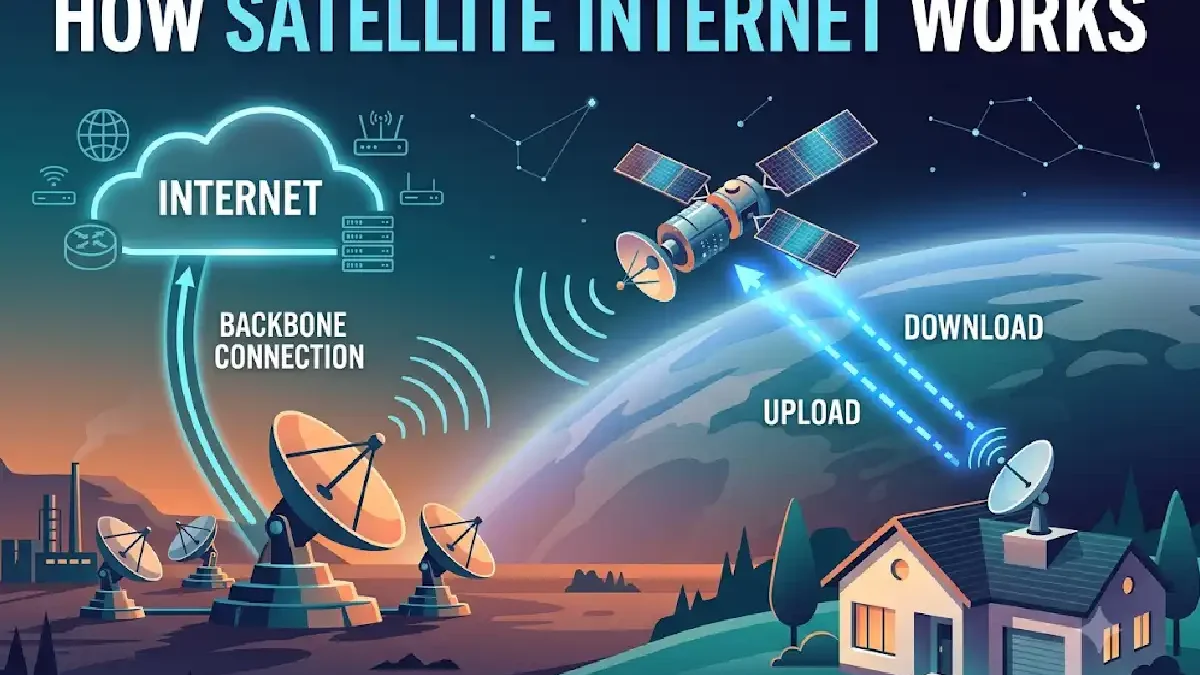
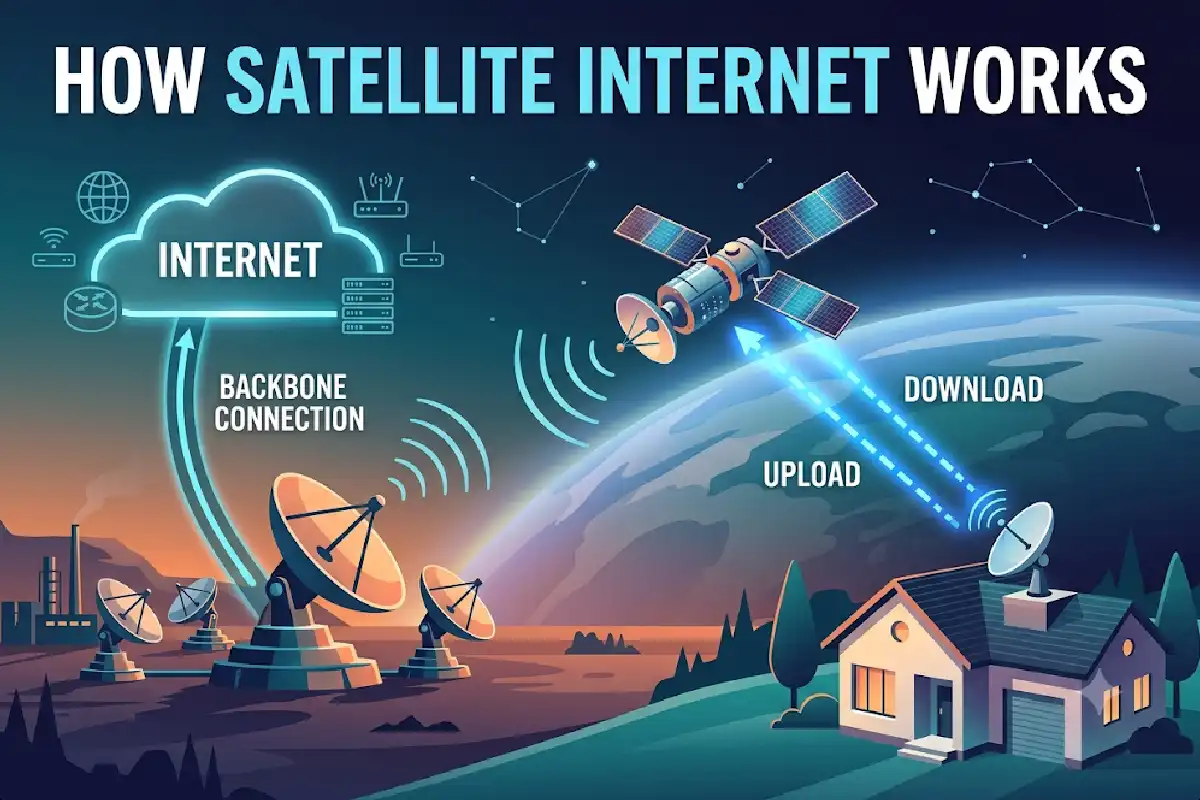
Satellite internet is the broadband service that utilizes the satellites in space to send and retrieve the internet data. The data instead of going through underground fiber cables and cellular towers, from satellite dish of user, to satellites in orbit, then to ground stations that are connected to internet backbone.
Key Components
| Component | Function |
| User Terminal (Dish) | It transmits and receives signals. |
| Modem/Router | Translates signals to internet connection |
| Communication Satellite | I can transmit data to and receive data from Earth space using the relays |
| Ground Station (Gateway) | Links the satellite to the internet |
| Network Operations Center | Handling routing and quality of work |
How Satellite Internet Connects to Users
The connection process follows a straightforward path:
- Define user request a webpage.
- The data from the modem is fed to the satellite dish.
- The dish is aimed toward the satellite and sends the radio signal through the dish.
- The satellite passes information to the ground station.
- The ground station retrieves the site.
- The data comes back through the same pathway to the user.
Satellite Internet Signal Flow
Device
↓
Modem/Router
↓
Satellite Dish
↓
Communication Satellite
↓
Ground Station
↓
Internet Backbone
This fast process is completed within milliseconds.
Role of Communication Satellites
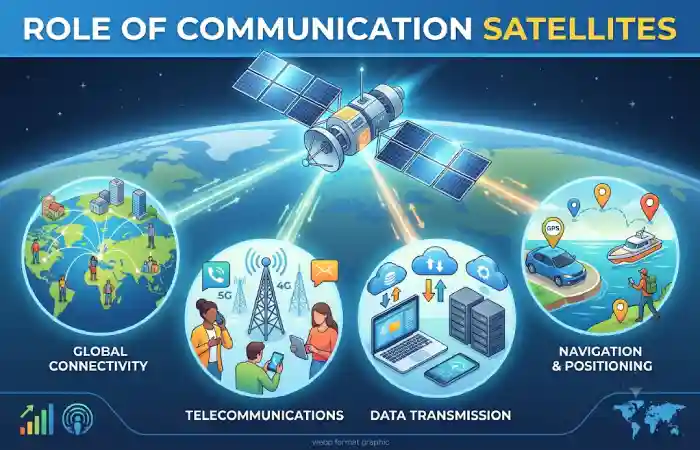
The main things that facilitate satellite internet are the communication satellites. These are at the heart of satellite internet systems and are essentially relay stations in space. They communicate with the ground stations by receiving the data signals and retransmitting back to user terminals and ground stations. Without the communication satellites, this system would not work to any significant extent!
Major Satellite Types
| Type | Orbit Height | Typical Latency |
| GEO (Geostationary) | 35,786 km | 500–700 ms |
| MEO (Medium Earth Orbit) | 2,000–20,000 km | 100–200 ms |
| LEO (Low Earth Orbit) | 300–1,200 km | 20–50 ms |
LEO Low earth orbit satellites. Many currently utilized satellite providers tend to be in LEObecause they provide higher speed and less latency.
Ground Stations and User Terminals
It act as a hub between a satellite and the Internet.
Ground Station Responsibilities
- Traffic routing
- Signal processing
- Network management
- Security monitoring
User terminals include:
- Satellite dish
- Modem
- Wi-Fi router
- Mounting equipment
More modern LEO systems employ electronically-aimed antennas that can seamlessly track moving satellites:
Data Transmission Through Satellites
A route is the course taken by data when a user visits a website.
Example Process
| Step | Action |
| 1 | User navigates to website |
| 2 | Request to dish 28.3.14 about user in a new account, she can’t publish stories. |
| 3 | Dish transmits to: |
| 4 | Satelite forwards to gateway |
| 5 | Gateway can reach the web site in. |
| 6 | Response must be: how the system reacts to the user‘s input. |
This architecture allow to have internet connection anywhere, even where it would be complex and too costly to deploy fiber.
Download and Upload Process
Download Process
- Froma website will deponent data if Data requested.
- Data transmission to ground station
- Tilteknologi. satellite relays information.
- The user terminal receives the content.
Upload Process
- User submit file or request
- Dish reflects signal downward, firing the signal toward a reflector (artificial or natural).
- Satellite relay signals to receiver.
- Ground station provides data online
Both processes are happening at the same time. These occur during video conferencing, streaming, as well as cloud collaboration.
Latency in Satellite Internet
Latency: Delay during transmission of data.
2026 Latency Comparison
| Internet Type | Average Latency |
| Fiber Internet | 5–20 ms |
| Cable Internet | 15–40 ms |
| 5G Internet | 10–50 ms |
| LEO Satellite | 20–50 ms |
| GEO Satellite | 500–700 ms |
LEO networks, we have demonstrated that the LEO networks outperform traditional GEO networks by far for gaming, video conferencing, and other real-time applications.
Factors Affecting Performance
There are many factors that describe the satellite internet quality.
Performance Factors
| Factor | Impact |
| Weather Conditions | Rain atténuation, and signal degradation |
| Network Congestion | Reduced speeds |
| Satellite Type | Determines latency |
| Dish Alignment | Signal quality |
| Obstructions | The trees and buildings cause blockages. |
| Provider Capacity | Performance of the entire network |
The best way to use it is by installing the dishes with a clear view of the sky.
Satellite Internet Limitations
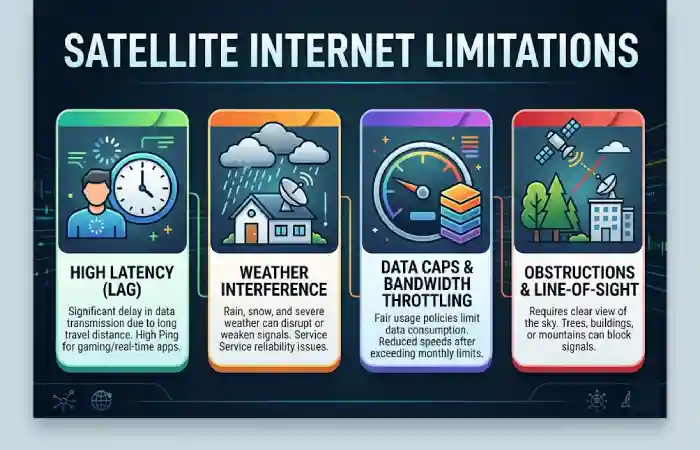
Despite the fact that satellite internet is nationwide, there are some disadvantages.
Common Limitations
- Equipment costs higher.
- Weather sensitivity
- Possible data limits
- Availability is constrained in certain areas.
- GEO networks experiences delay due.
Satellite vs Fiber Comparison
| Feature | Satellite Internet | Fiber Internet |
| Coverage | Nearly Anywhere | Due to infrastructural constraints |
| Speed | 25–400+ Mbps | Could be up to 10 Gbps |
| Installation | Easy | Infrastructure required |
| Latency | Medium to High | Very Low |
| Rural Availability | Excellent | Limited |
Future of Satellite Connectivity
Satellites internet is destined to have a bright future because numerous governments and private companies are pouring huge sums of money into next-generation satellite constellations.
Key 2026 Trends
| Trend | Impact |
| LEO Expansion | Faster speeds |
| Direct-to-Device Services | Mobile connectivity |
| AI Network Optimization | Better routing |
| Optical Inter-Satellite Links | Lower latency |
| Global Coverage Growth | Expanded access |
Various companies have launched their satellites to make internet accessible across the world such as the Starlink, OneWeb and Amazon (as well as the National) satellite programs are ever increasing their satellite launches around the world along with changes to regulations allowing more spectrum and wider availability of internet.
Frequently Asked Questions
Who does wireless internet work?
A satellite internet system sends information between the satellite dish installed by the user, the orbiting satellites, and the ground stations that are linked to the conventional internet.
First, compare satellite internet and broadband:
Today‘s LEO satellite services are capable of providing broadband speeds, however fiber Internet remains faster.
In soionline there is the question of ’ Why is there any latency for satellite internet??’.
Calculates the transmission delays that result from long-distance communication between the Earth and Outer Space.
Can satellite internet function under foul weather?
Yes, but heavy rain, snow or storms may temporarily degrade performance.
How well does satellite internet work for remote locations?
Yes. For remote or rural areas, satellite internet is frequently the preferable solution.
Conclusion
Knowing How the Satellite Internet Works is important to see how it is revolutionizing internet delivery. Satellite Internet is possible through a network of communications satellites, ground stations, and customer terminals that work seamlessly to deliver the Internet to anywhere on this planet.
Low Earth Orbit technology improvements will continue to improve the speed and accessibility of Satellite Internet and eclipse traditional Broadband offerings for hundreds of millions of users. The space-based internet architecture network will continue to grow through 2026 and beyond and provide coverage for never-before-connected markets such as remote villages, corporate and transportation networks, and new digital evolutions.