

Last Updated: June 22, 2026
Cloud computing is defined as the provision of computing services (e.g. Servers, storage, databases, networking, software etc., analytics, etc.), over the Internet (“the cloud”) as opposed to being provided from a local or on-premise data centre.
In fewer than 25 words cloud computing is allowing individual consumers and commercial organizations to tap into computing resources at will without the need to buy expensive hardware and software. For example. Gmail, Google Drive, Netflix, Microsoft 365 and AI are all cloud computing services you are using.
The common definition of cloud computing provided by The National Institute of Standards and Technology (NIST) states that cloud computing delivers computing resources such as networks, servers, storage, applications, and services on demand and the ability to quickly provision and release resources with minimal management effort.
In the midst of more digital transformation projects, cloud adoption will still be a key business strategy in 2026.
Table of Contents
What Is Cloud Computing and How Does It Work?
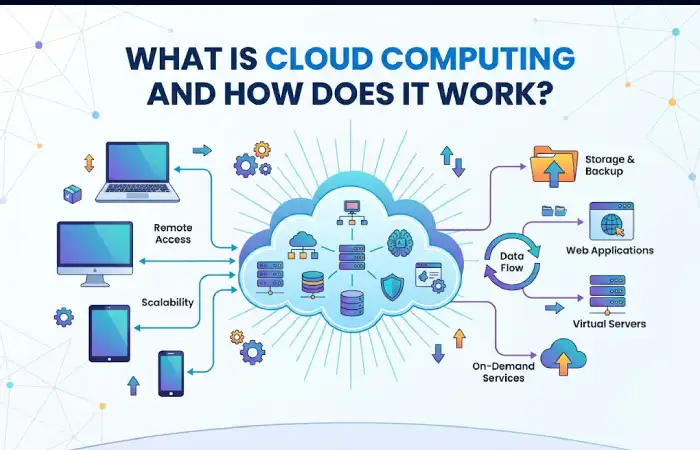
Cloud computing works by transporting applications, data and processing power to remote centers of data exclusively owned and maintained by a hosting provider or ‘cloud vendor’.
Instead of storing files or running applications directly on your computer:
- Data is stored in cloud servers.
- Applications run on virtualized infrastructure.
- Users connect through the internet.
- Resources scale automatically based on demand.
Simple Example
When you upload a file to Google Drive:
- The file is stored in Google’s cloud infrastructure.
- You can access it from any device.
- Storage expands when needed.
- Google manages the servers behind the scenes.
Therefore, businesses would not have to maintain expensive infrastructure.
Cloud Service Models Explained
| Model | What You Get | Example Use Cases |
| SaaS (Software as a Service) | Ready-to-use applications | Gmail, Microsoft 365 |
| PaaS (Platform as a Service) | Development environment | App development |
| IaaS (Infrastructure as a Service) | Virtual servers and networking | Hosting websites |
| Serverless Computing | Code execution without server management | Event-driven applications |
The three major service models the SaaS, PaaS and Iaa S still serve as the basis for contemporary cloud computing.
Key Components of Cloud Computing Infrastructure
A cloud computing infrastructure refers to the combination of hardware, software, networking and security as mentioned above for a system to be enabled as a cloud. This will help user to understand the critical terms associated with cloud computing infrastructure.
| Component | Function |
| Data Centers | Physical facilities housing servers |
| Virtualization | Creates virtual machines from physical hardware |
| Storage Systems | Stores files and databases |
| Networking | Connects users to cloud services |
| Security Systems | Protects data and applications |
| APIs | Enable software integration |
| Load Balancers | Distribute traffic efficiently |
Current cloud platforms also amalgamate AI, automation, containerization and edge computing together.
Cloud Deployment Models
Public Cloud
Resources being served by multiple customers.
Examples:
- AWS
- Microsoft Azure
- Google Cloud
Private Cloud
Dedicated infrastructure for a single entity.
Best for:
- Healthcare
- Government
- Banking
Hybrid Cloud
Hybrid is the Mixes public and private cloud.
Multi-Cloud
Simultaneously utilizes several cloud providers.
Some existing organizations are investigating a hybrid- and multi-cloud world to reduce vendor lock-in as well as improve resilience.
Benefits of Using Cloud-Based Services
The benefits of cloud computing are tremendous for Small and large businesses.
- Cost Savings
Too costly to invest heavily in hardware up-front until ROI. Pay for what you use.
- Scalability
Resources automatically go up and down, according to need.
- Global Accessibility
Enables employees to work from any location where access to internet.
- Improved Collaboration
Access all shared files and applications.
- Business Continuity
Cloud backups also will decrease your downtime and data loss
- Faster Innovation
Developers can deploy applications rapidly without direct involvement with the underlying server hardware.
Cloud vs Traditional Infrastructure
| Feature | Traditional IT | Cloud Computing |
| Initial Cost | High | Low |
| Scalability | Limited | Elastic |
| Maintenance | Internal Team | Cloud Provider |
| Deployment Speed | Weeks | Minutes |
| Accessibility | Location-based | Anywhere |
| Updates | Manual | Automated |
Common Cloud Computing Applications
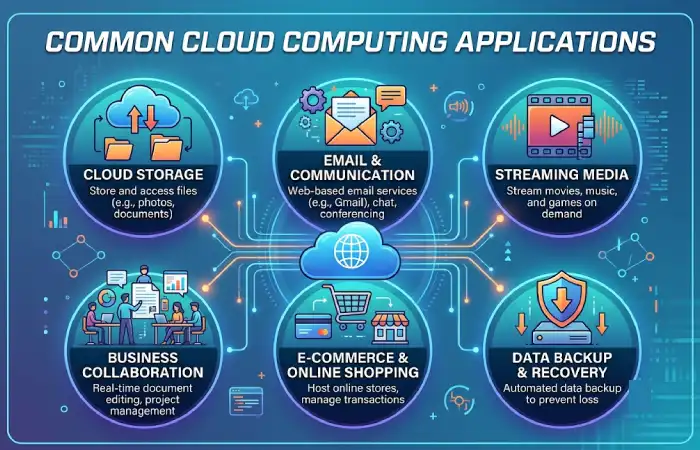
Loads of services we use on a daily basis are powered by Cloud computing.
Business Applications
- CRM systems
- ERP software
- Accounting platforms
Data Storage
- Google Drive
- OneDrive
- Dropbox
Software Development
- Application hosting
- Testing environments
- DevOps pipelines
AI and Machine Learning
Cloud platforms already offer AI tools, GPU infrastructure and machine learning service, for exemple.
Streaming Services
Cloud services such as: Netflix; Spotify.
Backup and Disaster Recovery
Much more is stored securely by organizations.
Cloud Computing Market Statistics (2026)
The Cloud Computing market is still a way out; it is still growing.
| Metric | 2026 Data |
| Enterprise Cloud Adoption | 94% |
| New Cloud-Native Applications | 84% |
| Global Cloud Market Size | $686 Billion+ |
| Top 3 Providers Market Share | 68% |
| Multi-Cloud Adoption | 87% |
Sources indicate that the flow of cloud expenditures is heading toward higher AI workloads, cloud-native applications, and enterprise modernization.
Major Cloud Providers Comparison
| Provider | Strength | Best For | Resource |
| Amazon Web Services | Largest ecosystem | Enterprises | https://aws.amazon.com |
| Microsoft Azure | Microsoft integration | Business environments | https://azure.microsoft.com |
| Google Cloud | AI and analytics | Data-driven companies | https://cloud.google.com |
| Oracle Cloud | Database performance | Enterprise workloads | https://www.oracle.com/cloud |
| IBM Cloud | Hybrid solutions | Regulated industries | https://www.ibm.com/cloud |
Challenges and Limitations of Cloud Computing
However, there are limitations of cloud computing:
Security and Compliance
The organization has a obligation to protect sensitive information and also regulatory compliance.
Vendor Lock-In
Switching providers can also be a costly and a complicated affair.
Downtime Risks
Business can be disrupted by outages.
Recent news indicates a growing level of concern about large cloud outages and infrastructure dependence.
Cost Management
Inefficient utilization of resources expenditure variance.
Internet Dependency
An internet connection is a prerequisite to run cloud services.
Frequently Asked Questions
Is cloud computing the same as the internet?
No. The internet is the network and computing services are what cloud computing ultimately provides over the network.
What are the three main types of cloud computing?
Of the three service models, SaaS, PaaS and IaaS, the latter two are those with the most potential in allowing for a scalable, extensible, flexible and reliable interface.
Is cloud computing secure?
Yes if you have the right setup. Three of the biggest vendors spend huge efforts on security, encryption and compliance structures.
Why do companies use cloud computing?
Businesses are adopting cloud computing solutions for various reasons these include: increasing the ability to scale quickly and flexibility, cost reduction and more rapid innovation.
What is the future of cloud computing?
Future will result in cloud services provided with AI is king, edge computing, hybrid cloud environments, and increased automation.
Conclusion
Cloud computing has fundamentally changed the way people and businesses use technology. Cloud technology offers on-demand flexible and scalable computing resources utilizing the web. These resources can range from anything from data storing and execution of applications to AI and big data computing processing.