
 Kashifa Jafar
Technology Writer & Contributor
Kashifa Jafar is a technology writer and contributor at FutureTechExpert with 4+ years of experience in technology writing and content creation.
Read Full Bio of Author →
Kashifa Jafar
Technology Writer & Contributor
Kashifa Jafar is a technology writer and contributor at FutureTechExpert with 4+ years of experience in technology writing and content creation.
Read Full Bio of Author →
 Sameena Begum
Health, Technology & Digital Content Reviewer
Sameena reviews selected health, wellness, technology, and digital content for clarity, factual presentation, and reader usefulness.
Read Full Bio of Reviewer →
Sameena Begum
Health, Technology & Digital Content Reviewer
Sameena reviews selected health, wellness, technology, and digital content for clarity, factual presentation, and reader usefulness.
Read Full Bio of Reviewer →
Data security in the cloud has become most relevant for business and private users using cloud computing to store, manipulate and transmit sensitive information whatever is the use case of using the cloud storage, having data protected from hackers, accidental breaches and malicious outsiders is fundamental.
The transition onto cloud technology is the most significant disruption to how companies’ function. Now companies can grow much quicker, work with other companies around the globe, and significantly reduce infrastructure costs. But this transition, also creates many new risks and challenges involving security.
Misconfigured storage buckets, stolen credentials, ransomware, insider abuse of access, more complex AI powered cyberattacks, are all factors that make in cloud security, a major business issue.
 This article is part of
Security Resources
Table of Contents
What Is Cloud Data Security?
Cloud data security is concerned with the set of policies, technologies, processes and other controls deployed to protect data which is stored, processed and transmitted in the cloud. Its aim is to maintain the confidentiality, integrity and availability of data.
Cloud data security applies to all major cloud service models:
| Cloud Service Model | Description | Security Focus |
| Infrastructure as a Service (IaaS) | Virtual servers, storage, networking | Virtual machines, network security, storage encryption |
| Platform as a Service (PaaS) | Development platforms | Application security, APIs, identity management |
| Software as a Service (SaaS) | Cloud-hosted applications | User authentication, data privacy, access controls |
Key Objectives of Cloud Data Security
An effective cloud security strategy focuses on three core objectives, commonly known as the CIA Triad:
| Principle | Purpose | Example |
| Confidentiality | Prevent unauthorized access | Encrypting customer databases |
| Integrity | Protect data from unauthorized modification | File integrity monitoring |
| Availability | Ensure data is accessible when needed | Automated backups and disaster recovery |
These three principles comprise the core of all cloud security frameworks.
Cloud Data Security vs. Traditional Data Security
Despite both having the objective of protecting information, different security considerations are required for a cloud environment as opposed to traditional infrastructure.
| Feature | Traditional Security | Cloud Data Security |
| Infrastructure | On-premises | Managed by cloud provider |
| Scalability | Limited | Highly scalable |
| Access | Internal network | Internet-based with secure access |
| Security Responsibility | Organization | Shared between provider and customer |
| Disaster Recovery | Manual planning | Built-in cloud services |
Cloud security also brings a number of new technologies such as identity federation, cloud-native firewalls, API security and monitoring that are not general in a traditional environment.
Why Cloud Data Security Matters
Adoption of the cloud seems unstoppable. All sector and all sized organizations, from the startup to multibillion enterprise, have turned to the cloud to run business applications, archiving information, gain remote Access.
Now cloud adoption has been rapidly increasing, ensuring the security of whatever stored in cloud is crucial to sustainable business practices in not only complying with regulations, but also ensuring customer trust.
Growing Adoption of Cloud Computing
As the industry reports today, cloud adoption is still increasing and technology decisions are driven as companies move IT systems onto the cloud.
| Cloud Trend (2026) | Insight |
| Organizations using cloud services | Over 95% |
| Enterprises adopting multi-cloud strategies | Around 85–90% |
| Remote workforce reliance on cloud collaboration | Continues to grow |
| AI workloads hosted in the cloud | Increasing rapidly |
Protecting Sensitive Information
Organizations store valuable information in the cloud, including:
- Customer databases
- Employee records
- Financial transactions
- Healthcare information
- Source code
- Intellectual property
- Business analytics
- AI training datasets
But even a single breach can compromise millions of records and cause substantial expense, legal liability and damage to a company‘s brand and reputation.
Common Cloud Data Security Risks
Despite the development of these cloud technologies, most of the security breaches are due to false activities from humans and not due to any flaws in cloud platforms.
Understanding the possible threats gives you the number one ingredient of forming a resilient plan for cloud security.
- Misconfigured Cloud Storage
Misconfigured cloud storage is another top cause of breaches. Data stored in a public access bucket, exposed database, overly permissive access controls or storage that is accessible to the entire internet could inadvertently expose sensitive information to anyone on the internet.
How to Reduce the Risk:
- Review storage permissions regularly.
- Enable default encryption.
- Use least-privilege access policies.
- Implement automated configuration scanning.
- Weak Identity and Access Management (IAM)
Ineffective IAM activities negatively influence system security by, for example, emphasizing poor practices in IAM such as sharing accounts, misusing permissions and establishing password weaknesses.
Best Practices:
- Enable multi-factor authentication (MFA).
- Use role-based access control (RBAC).
- Rotate credentials regularly.
- Remove inactive accounts.
- Insider Threats
External threats are not the only risk. Employees, contractors or partners may have legitimate access to the sensitive data and misuse it.
Mitigation:
- Monitor privileged user activity.
- Limit administrative access.
- Conduct security awareness training.
- Review permissions periodically.
- Ransomware and Malware
The use of the cloud connectivity to source has still seen the effect of co2mputer viruses and malwares menace is on the increase. This jumps at users when devices become infected leading to files becoming encrypted on synced to the cloud.
Protection Measures:
- Maintain offline backups.
- Deploy endpoint protection.
- Keep software updated.
- Train users to recognize phishing attempts.
- Insecure APIs
Cloud applications are data-communication powered by APIs. Unprotected APIs can leak out information or provide attackers with unauthorized access.
Recommendations:
- Use API authentication.
- Validate input data.
- Monitor API activity.
- Implement rate limiting.
Core Principles of Cloud Data Protection
Protection principles are the foundation of cloud data security. They are designed to provide security for all your data as it is created, stored, transferred, processed and deleted. The principles are intended to provide assurance to organizations that their data is protected against accidental loss and malicious attacks.
Cloud platforms are different from traditional IT environments in the sense that they are tremendously more dynamic. Resources, for instances, are continually created, changed and scaled. That‘s why, it is recommended to follow security practices which are flexible enough to adapt to workloads and threats.
1. Confidentiality
Confidentiality Confidentiality means that information is not made available or disclosed to any individual, process or environment unless they have the authorized to access the information. Preventing unauthorized access to information is perhaps the most fundamental goal of cloud data security.
Why Confidentiality Matters
Organizations store various types of confidential information in the cloud, including:
- Customer personal information
- Financial records
- Employee data
- Intellectual property
- Healthcare records
- Source code
- Business strategies
A breach of confidentiality can lead to identity theft and a loss to the customer; loss of money; penalties to the bank and the bank‘s reputation.
Techniques to Maintain Confidentiality
| Security Control | Purpose | Example |
| Data Encryption | Protect data from unauthorized viewing | AES-256 encryption |
| Multi-Factor Authentication (MFA) | Verify user identity | Authentication apps, hardware tokens |
| Identity and Access Management (IAM) | Control who can access resources | Role-Based Access Control (RBAC) |
| Data Loss Prevention (DLP) | Prevent accidental sharing | Blocking sensitive file transfers |
| Secrets Management | Protect passwords and API keys | Secure key vaults |
2. Integrity
Integrity that data has not been altered, is accurate, and complete.
Why Integrity Is Important
Compromised data integrity can result in:
- Incorrect financial reports
- Corrupted databases
- Tampered software
- Fraudulent transactions
- Loss of trust in business data
Methods for Protecting Integrity
- File integrity monitoring
- Cryptographic hashing (SHA-256, SHA-3)
- Digital signatures
- Version control
- Database transaction logging
| Technique | Benefit |
| Hashing | Detects unauthorized changes |
| Digital Signatures | Verifies authenticity |
| Versioning | Restores previous file versions |
| Audit Logs | Tracks modifications |
3. Availability
Availability provides that data and applications should be accessible whenever authorized users require access.
Downtime is running the system without being able to do anything, this services can be interrupted by various reasons such as equipment or hardware failure and network problems. This impairment can directly affect important business processes and workflow.
Common Threats to Availability
- Hardware failures
- DDoS attacks
- Ransomware
- Human error
- Natural disasters
- Cloud outages
Best Practices
- Multi-region deployments
- Automated backups
- Load balancing
- Disaster recovery plans
- High-availability architecture
4. Least Privilege Access
PoLP (Principle of Least Privilege) is lowest access necessary for the client in question to accomplish the mission.
Benefits
- Reduces insider threats
- Limits malware spread
- Prevents accidental data deletion
- Simplifies auditing
5. Defense in Depth
Defense in Depth employs several lines of defense so that if one protection doesn‘t succeed, others will still shield the environment.
Example Layers
- Network firewalls
- Web Application Firewalls (WAF)
- IAM
- MFA
- Endpoint Detection and Response (EDR)
- Encryption
- Continuous monitoring
| Security Layer | Purpose |
| Firewall | Blocks unauthorized traffic |
| WAF | Protects web applications |
| IAM | Controls identities |
| Encryption | Secures stored and transmitted data |
| Monitoring | Detects suspicious activity |
Cloud Security Models Explained
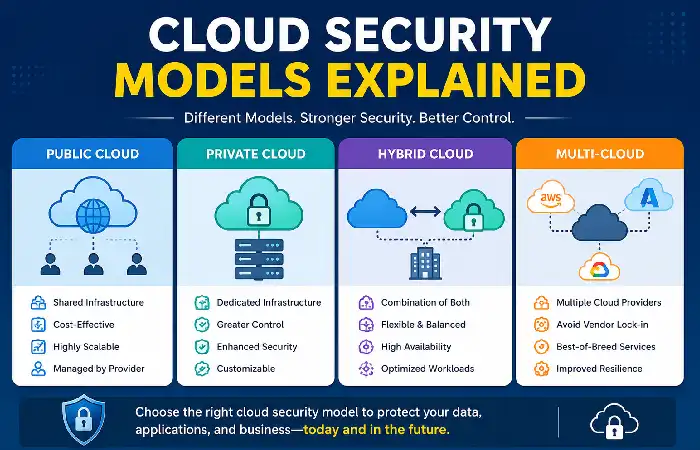
The most suitable model must be considered depending on the security, scalability and compliance needs.
Public Cloud
Services provided by public cloud are hosted and managed by third party vendors and are accessible to multiple end users.
Advantages
- Cost-effective
- Highly scalable
- Global availability
- Rapid deployment
Challenges
- Shared infrastructure
- Compliance considerations
- Misconfiguration risks
Popular Providers
- Amazon Web Services (AWS)
- Microsoft Azure
- Google Cloud Platform (GCP)
Private Cloud
A private cloud is used solely by one organization, giving the organization greater control of the infrastructure and security.
Advantages
- Enhanced customization
- Greater control
- Easier compliance for sensitive workloads
Challenges
- Higher costs
- Requires specialized expertise
- Limited scalability compared to public cloud
Hybrid Cloud
The hybrid cloud merges the use of both private and public cloud environments. Workloads can be transferred between the two can be load based on the required performance, cost or required compliance.
Common Use Cases
- Keeping sensitive data on-premises while using public cloud for less critical applications
- Disaster recovery
- Seasonal workload scaling
Multi-Cloud
Multi-cloud is the use of multiple services from a number of different cloud services.
Benefits
- Avoids vendor lock-in
- Improves resilience
- Optimizes costs
- Enables best-of-breed services
Challenges
- Increased management complexity
- Consistent security policies
- Identity synchronization
Cloud Deployment Comparison
| Feature | Public Cloud | Private Cloud | Hybrid Cloud | Multi-Cloud |
| Cost | Low | High | Medium | Medium–High |
| Scalability | Excellent | Moderate | Excellent | Excellent |
| Control | Moderate | High | High | High |
| Compliance | Good | Excellent | Excellent | Good |
| Security Management | Shared | Customer | Shared | Shared across providers |
| Best For | Startups, SMBs | Regulated industries | Large enterprises | Global organizations |
Essential Cloud Data Security Technologies
Today’s cloud security is made up of a collection of individual specialized technologies working together.
Identity and Access Management (IAM)
IAM defines what users/groups can use the cloud resources and services and what they can do.
Core Features
- User authentication
- Role-Based Access Control (RBAC)
- Attribute-Based Access Control (ABAC)
- Single Sign-On (SSO)
- Privileged Access Management (PAM)
Benefits
- Centralized identity management
- Reduced risk of unauthorized access
- Simplified compliance
Multi-Factor Authentication (MFA)
Multi-Factor Authentication (MFA) None of the clouds support to require two or more types of authentications to access to their cloud resources.
Common authentication factors include:
- Passwords
- Authentication apps
- Security keys
- Biometrics
MFA significantly reduces account compromise caused by stolen credentials.
Encryption
Encryption takes passable data and translates it into undecipherable code known as cipher text with a key, which can only be described by those who are granted the correct key.
Types
Data at Rest
Protects stored data.
Examples:
- Databases
- Cloud storage
- Virtual disks
Data in Transit
Keeps data safe as it travels on networks by using protocols such as TLS.
Data in Use
Confidential computing technologies in the emerging stages of development offer help with data protection during processing during in-memory computation.
One of the most effective ways to protect sensitive information is through cloud data encryption, which secures data both at rest and during transmission.
Key Management Systems (KMS)
Encryption is only as good as how the key is managed.
KMS solutions provide:
- Secure key generation
- Rotation
- Revocation
- Access control
- Auditing
Cloud Access Security Broker (CASB)
Cloud access security brokers constitute security layers covering the user and the cloud services.
Functions
- Visibility into cloud applications
- Policy enforcement
- Data Loss Prevention
- Threat protection
- Compliance monitoring
Cloud Security Posture Management (CSPM)
While, CSPM continually. It investigates the entire cloud environment, continually monitor configuration and evaluates result to maintain secure risk posture.
Detects
- Public storage buckets
- Weak IAM permissions
- Unencrypted resources
- Compliance violations
Security Information and Event Management (SIEM)
SIEMs gather and analyze logs from cloud infrastructure and applications.
Benefits include:
- Centralized monitoring
- Threat detection
- Compliance reporting
- Incident investigation
Extended Detection and Response (XDR)
XDR correlates telemetry from endpoints, identities, email, cloud workloads and networks to identify advanced threats.
Data Loss Prevention (DLP)
L6 solutions prohibit sensitive content from departing registered cloud environments.
Examples:
- Blocking uploads of confidential files
- Preventing unauthorized sharing
- Monitoring email attachments
Implementing cloud data loss prevention (DLP) solutions helps prevent accidental exposure and unauthorized sharing of confidential information.
Endpoint Detection and Response (EDR)
EDR is safeguarding laptops, desktops, and servers connecting to cloud applications and services from malware, ransomware, and detected malicious activity.
Best Practices for Securing Cloud Data
Cloud security is not created by just one tool or technology; it is a combination of layers that include governance, technology, automation, and employee support. Listed below are cloud security best practices that are recommended by AWS, Google Cloud, Microsoft, CISA, CSA, and NIST.
Following proven cloud data security best practices helps organizations reduce risks, improve compliance, and strengthen their overall security posture.
1. Classify and Inventory Your Data
Before we can secure our cloud data we need to know:
Countless organizations might have thousands of files spread out across cloud storage providers, unaware of what those files contain, which makes for potential accidental exposure and failure to adhere.
Steps to Implement
- Create a complete inventory of cloud assets.
- Identify all storage locations (object storage, databases, backups, SaaS platforms).
- Classify data based on sensitivity.
- Assign ownership for each dataset.
- Apply security policies based on classification.
Example Data Classification
| Classification | Examples | Protection Level |
| Public | Marketing materials | Low |
| Internal | Company procedures | Medium |
| Confidential | Customer records | High |
| Restricted | Financial or healthcare data | Very High |
2. Encrypt Data at Rest, in Transit, and in Use
Encryption is also one of the best way to safeguard cloud data. Security breaches won‘t be able to decipher data even if they get access to encrypted data.
Types of Encryption
| Encryption Type | Protects | Example |
| Data at Rest | Stored files and databases | AES-256 |
| Data in Transit | Data moving across networks | TLS 1.3 |
| Data in Use | Data being processed | Confidential Computing |
Best Practices
- Enable encryption by default for all storage services.
- Use customer-managed keys (CMKs) where appropriate.
- Rotate encryption keys regularly.
- Store keys in a secure Key Management Service (KMS).
- Avoid hardcoding encryption keys in applications.
3. Implement Strong Identity and Access Management (IAM)
The new perimeter for security in the cloud, when it comes to identity, security credentials should always be the minimum needed for users, services and other computers or devices.
IAM Best Practices
- Use Role-Based Access Control (RBAC).
- Implement Attribute-Based Access Control (ABAC) where applicable.
- Follow the Principle of Least Privilege (PoLP).
- Review permissions regularly.
- Remove unused accounts promptly.
- Separate administrative and standard user accounts.
Access Control Comparison
| Method | Description | Best Use Case |
| RBAC | Access based on job role | Enterprises |
| ABAC | Access based on user and resource attributes | Dynamic environments |
| DAC | Owner controls permissions | Small teams |
| MAC | Centrally enforced access rules | Government and defense |
4. Enable Multi-Factor Authentication (MFA)
One layer of protection is not enough. It‘s not just passwords anymore. MFA adds another protection.
Common MFA Methods
- Authentication apps
- Hardware security keys
- Biometrics
- SMS codes (less preferred)
- Email verification
Benefits
- Reduces account takeover attacks.
- Protects against phishing.
- Supports Zero Trust strategies.
- Improves compliance.
5. Adopt a Zero Trust Security Model
In this setting the assumption that everyone can be trusted is a safe assumption to make on the network. Zero Trust: Here, this assumption is not made.
Core Principles
- Never trust, always verify.
- Continuously authenticate users.
- Verify device health.
- Monitor user behavior.
- Limit lateral movement.
- Enforce least privilege.
Zero Trust Components
| Component | Purpose |
| Identity Verification | Authenticate users |
| Device Security | Validate endpoint health |
| Network Segmentation | Reduce attack surface |
| Continuous Monitoring | Detect suspicious behavior |
| Risk-Based Access | Adjust permissions dynamically |
Compliance and Regulatory Requirements
Cloud data security isn’t just about keeping data safe from hackers and other malicious threats. It is also about complying with legal, regulatory and industrymandates. Companies that handle customer, employee, financial or medical information in the cloud need to adhere to the relevant mandates or risk fines, loss of customer trust and operational risk.
In 2026, things are becoming more complicated for compliance with newer privacy regulations, limitations on international data movement and more rigorous cybersecurity standards. It doesn’t matter if you have a small retail website or if you are a multinational conglomerate; you need to learn the major compliance frameworks to create a safe, legal cloud environment.
Major Cloud Security Regulations and Standards
General Data Protection Regulation (GDPR)
Overview
Global Data Protection Laws–The GDPR (General Data Protection Regulation) is the EU‘s broad-based law for the processing, collection and transferring of the personal information related to people living in the EU.
Even though GDPR is European legislation, international companies that involve the processing of data of people living in the EU have to comply too.
Primary Objectives
- Protect personal privacy
- Increase transparency
- Give individuals greater control over their personal data
- Standardize privacy rules across EU member states
Key Requirements
- Obtain lawful grounds for processing personal data.
- Collect only necessary data (data minimization).
- Encrypt sensitive information where appropriate.
- Report qualifying data breaches within required timelines.
- Honor data subject rights (access, correction, deletion, portability).
- Maintain records of processing activities.
Cloud Security Best Practices for GDPR
- Encrypt customer information.
- Use role-based access control.
- Enable audit logging.
- Store data only where legally permitted.
- Implement Data Loss Prevention (DLP).
- Regularly review third-party cloud providers.
Health Insurance Portability and Accountability Act (HIPAA)
Overview
The HIPAA governs healthcare information in the US and provides for security and Confidentiality of the PHI.
Providers, payers, and other entities receiving or transmitting PHI in the cloud should have appropriate administrative, physical, and technical safeguards.
Covered Information
- Medical records
- Insurance information
- Patient identifiers
- Treatment history
- Diagnostic reports
Required Cloud Security Controls
| Control | Purpose |
| Encryption | Protect electronic PHI |
| Access Control | Restrict unauthorized access |
| Audit Logs | Record system activity |
| Automatic Logoff | Prevent unauthorized use |
| Backup and Recovery | Ensure data availability |
| Risk Assessments | Identify vulnerabilities |
Every cloud security strategy should include cloud backup and disaster recovery to ensure business continuity during cyberattacks or system failures.
Payment Card Industry Data Security Standard (PCI DSS 4.0)
If an organization collects, stores or transmits payment card data it is a PCI DSS compliant organization.
Objectives
- Secure payment information
- Reduce credit card fraud
- Standardize payment security
PCI DSS Requirements
- Install secure firewalls.
- Protect stored cardholder data.
- Encrypt payment transmissions.
- Use anti-malware solutions.
- Restrict access based on business need.
- Monitor network activity.
- Perform vulnerability scans.
- Conduct penetration testing.
Cloud Security Considerations
- Tokenize payment data.
- Limit administrative privileges.
- Monitor cloud storage continuously.
- Separate payment environments from other workloads.
ISO/IEC 27001
ISO/IEC 27001 is the worldwide accepted standard for an Information Security Management System (ISMS).
Instead of dictating particular technological solutions, it offers a way of managing risk to information security.
Core Components
- Risk management
- Security policies
- Asset management
- Access control
- Incident response
- Business continuity
- Continuous improvement
Benefits
- International recognition
- Improved governance
- Stronger risk management
- Better customer confidence
- Easier regulatory alignment</li>
SOC 2
SOC 2 is an audit standard often utilized by SaaS providers and cloud services organizations to prove they are safeguarding their customers data.
It evaluations focus on the Trust Services Criteria:
- Security
- Availability
- Processing Integrity
- Confidentiality
- Privacy
Cloud Security Controls
- Multi-factor authentication
- Continuous monitoring
- Encryption
- Secure backups
- Vendor risk management
- Change management
These reports are a common request when enterprise customers evaluate a vendor.
Common Cloud Data Security Mistakes
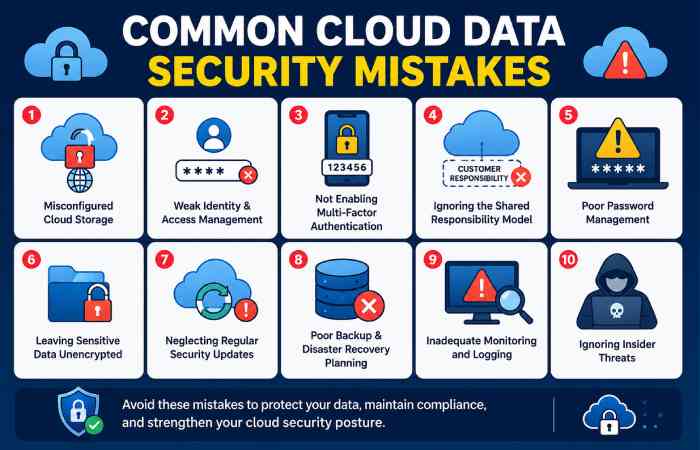
Even organizations that are fully committed to their Cyber Security programs will suffer cloud security breaches which should have been easily preventable. Too often, breaches are not accomplished with hacking techniques but are the result of configuration error, poor security practice and basic access control failures.
By 2026, more and more companies will utilize multi-cloud and hybrid-cloud strategies than ever before,adding a new level of difficulty to effective cloud infrastructure management. Knowing these five common cloud pitfalls can help institutions improve security, ensure compliance and avoid an expensive data breach.
Misconfigured Cloud Storage
The security gaps that exist because of loose cloud storage is another main cause of data loss on the cloud. Databases, buckets and file shares that are open to the world and public can be an easy source of critical information to anyone.
Why It Happens
- Default security settings are not reviewed.
- Public access is enabled for testing and never disabled.
- Permissions are granted too broadly.
- Security reviews are skipped before deployment.
Potential Consequences
- Exposure of customer records
- Financial information leaks
- Intellectual property theft
- Regulatory penalties
- Loss of customer trust
Prevention Tips
- Disable public access by default.
- Review storage permissions regularly.
- Enable automated configuration scanning with CSPM tools.
- Encrypt all stored data.
- Implement least-privilege access controls.
Weak Identity and Access Management (IAM)
Identity is where everything starts for cloud security. Weak administration of user accounts and privileges can lead to a substantial rise in the potential for penetration.
Common IAM Mistakes
- Shared administrator accounts
- Excessive user privileges
- Inactive accounts left enabled
- Weak password policies
- Lack of role-based access control (RBAC)
Best Practices
- Implement the Principle of Least Privilege (PoLP).
- Use Role-Based Access Control (RBAC).
- Remove inactive accounts immediately.
- Conduct quarterly permission reviews.
- Monitor privileged account activity.
Not Enabling Multi-Factor Authentication (MFA)
As the only security measure is the password, the cloud accounts are prone to phishing, credential stuffing, and brute-force.
Risks
- Account takeover
- Unauthorized administrative access
- Data theft
- Ransomware deployment
Recommended MFA Methods
| Authentication Method | Security Level |
| Hardware Security Keys | Very High |
| Authenticator Apps | High |
| Biometrics | High |
| SMS Verification | Moderate |
| Email Verification | Moderate |
Best Practice
Having in place and enforcing the standards for MFA for all privileged accounts and remote access users.
Ignoring the Shared Responsibility Model
One of the most popular misconceptions is to believe that the cloud provider is in charge of securing all parts of the environment.
In reality, cloud providers secure the infrastructure; it is the customers who are tasked with securing their data, identities, applications, and configurations.
Customer Responsibilities
- Configure IAM correctly.
- Encrypt sensitive data.
- Secure applications.
- Manage backups.
- Monitor cloud activity.
- Maintain compliance.
Poor Password Management
Weak or reused passwords are still responsible for a large proportion of cloud account breaches.
Examples of Poor Practices
- Using simple passwords
- Reusing passwords across services
- Sharing credentials
- Never rotating privileged passwords
Best Practices
- Use password managers.
- Enforce strong password policies.
- Rotate administrator credentials regularly.
- Eliminate shared accounts.
- Adopt passwordless authentication where possible.
Future Trends in Cloud Data Security
The security of data in the cloud continues to develop as businesses adopting new technologies such as artificial intelligence (AI), multi-cloud environments, edge computing and cloud-native applications. And at the same time, so are the methods used by cybercriminals including ransomware-as-a-service, attacks using AI and identity-based threats.
Starting in 2026 and continuing into the future, cloud security will be moving toward an intelligent, automated system of security, rather than a reactionary system. Companies who implement these new categories of cloud security protection will be more prepared to secure sensitive data, stay in compliance and lower cyber risk.
Top Cloud Data Security Trends for 2026 and Beyond
AI-Powered Threat Detection
AI [Artificial Intelligence] is changing the face of security by allowing systems to sift through enormous quantities of security data in real time. AI systems can detect anomalies, identify threats earlier and trigger automated responses before malware has a chance to propagate.
How AI Improves Cloud Security
- Detects unusual login patterns
- Identifies insider threats
- Discovers malware variants
- Prioritizes security alerts
- Automates incident response
- Predicts potential attack paths
Benefits
- Faster threat detection
- Reduced false positives
- Improved Security Operations Center (SOC) efficiency
- Continuous monitoring across cloud environments
Challenges
- AI models require high-quality data.
- Attackers are also using AI to develop more advanced phishing and malware campaigns.
Zero Trust Becomes the Default Security Model
Zero Trust has developed from a best practice to a fundamental security strategy.
Instead of relying on the user as being inside the corporate network, it continually authenticates every request.
Key Principles
- Never trust, always verify.
- Authenticate every user and device.
- Apply least-privilege access.
- Continuously monitor user behavior.
- Limit lateral movement through micro-segmentation.
Why It Matters
In the face of a distributed computing environment with employees working locally, at home, and on the road through internet connections, traditional perimeter security is not adequate.
Many organizations are adopting Zero Trust cloud security to verify every user and device before granting access to critical resources.
Growth of Cloud-Native Application Protection Platforms (CNAPP)
Organizations are converging multiple security solutions into one unified CNAPP solution.
CNAPP combines:
- Cloud Security Posture Management (CSPM)
- Cloud Workload Protection (CWPP)
- Identity Security
- Container Security
- Kubernetes Security
- Infrastructure as Code (IaC) scanning
- Runtime Protection
Benefits
- Centralized visibility
- Simplified management
- Reduced tool complexity
- Improved DevSecOps integration
Identity-Centric Security
Identity is now the premier point of attack in the cloud.
Future security strategies will aim at protecting identities in place of networks.
Emerging Technologies
- Identity Threat Detection and Response (ITDR)
- Passwordless authentication
- Adaptive authentication
- Risk-based access control
- Behavioral biometrics
- Continuous identity verification
Benefits
- Reduced credential theft
- Stronger access control
- Better user experience
Password less Authentication
Conventional passwords are still susceptible to phishing, credential stuffing and brute-force attacks.
Organizations are increasingly adopting passwordless authentication methods such as:
- Biometric authentication
- Hardware security keys
- Passkeys
- Mobile authenticator applications
Advantages
- Improved security
- Faster login experience
- Lower password reset costs
- Reduced phishing risk
All of these trends will be driven by AI-enabled defense, Zero Trust implementation, identity-centric security, automation, and tighter security controls on cloud-native applications. Companies that head in this direction early and effectively will be more prepared to confront the future, where tighter controls will be necessary to stay compliant and win customer confidence in a cloud-first world.
Choosing the best cloud security tools enables businesses to monitor threats, automate protection, and improve visibility across cloud environments.
Frequently Asked Questions
- What is cloud data security?
Cloud data security: As the name suggests, it is the practice of keeping the data stored, accessed and moved through the cloud secure from misuse, loss and breach by hackers.
- Why is cloud data security important?
Secure information by deleting unwanted data and confidential data, avoid data piracy and privacy, adhere to regulations, and business continuity.
- Is cloud storage secure?
Yes, you can go with cloud storage, who has arrangements for security with encryption, powerful access controls and appropriate security setting.
- What are the biggest cloud data security risks?
The top threats are misconfigurations, poor password policies, ransomware, insider threats, very insecure APIs and Data breaches.
- What is the Shared Responsibility Model?
It is a security model where the Cloud Provider secures the infrastructure while the customer secures their Data, Identities and Applications.
- What is Zero Trust security?
The Zero Trust model; literally “not trusting anything, even inside the network and a…
- Which cloud provider offers the best security?
When properly managed and configured, all three cloud providers (AWS, Google Cloud, and Microsoft Azure) provide robust security.
Conclusion
Cloud data security is not a luxury but a necessity, this is equally essential for all business enterprise which keeps, shares and process the information on cloud applications. With increasing cloud utilization, enterprises need to diligently secure applications and data from emerging cyber-attacks, accidental disclosures, insider precautions and ever-changing regulatory standards. A good cloud security plan should embrace encryption, IAM, multi-factor authentication, zero-trust security, monitoring, backup, and periodic security audits.
Kashifa Jafar is a technology writer and contributor at FutureTechExpert with 4+ years of experience in technology writing and content creation.
Read Full Bio of Author →Sameena reviews selected health, wellness, technology, and digital content for clarity, factual presentation, and reader usefulness.
Read Full Bio of Reviewer →