
 Kashifa Jafar
Technology Writer & Contributor
Kashifa Jafar is a technology writer and contributor at FutureTechExpert with 4+ years of experience in technology writing and content creation.
Read Full Bio of Author →
Kashifa Jafar
Technology Writer & Contributor
Kashifa Jafar is a technology writer and contributor at FutureTechExpert with 4+ years of experience in technology writing and content creation.
Read Full Bio of Author →
 Sameena Begum
Health, Technology & Digital Content Reviewer
Sameena reviews selected health, wellness, technology, and digital content for clarity, factual presentation, and reader usefulness.
Read Full Bio of Reviewer →
Sameena Begum
Health, Technology & Digital Content Reviewer
Sameena reviews selected health, wellness, technology, and digital content for clarity, factual presentation, and reader usefulness.
Read Full Bio of Reviewer →
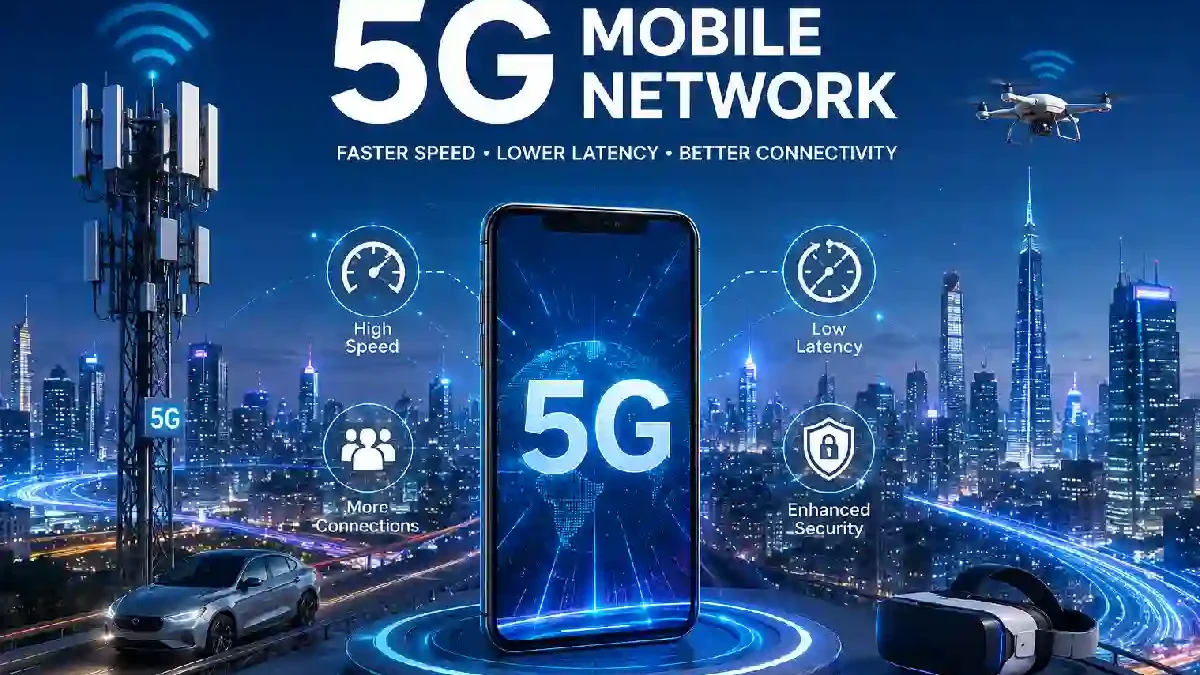
The 5G Mobile Network is revolutionizing the way individuals interact, communicate, do business, and access digital content. 5G, which stands for the fifth generation of mobile network technology, offers wireless internet at speeds and capacity far beyond those of any prior generation of wireless technology.
Wherever you are accessing your data whether it be 4K video, playing a cloud game, smart devices or business applications a 5G mobile network should be understood.
 This article is part of
Mobile Networks Resources
Table of Contents
What Is a 5G Mobile Network?
A 5G Mobile Network is the fifth generation of wireless cellular technology that offers the capacity to deliver markedly increased data transfer rates, lower latency, heightened capacity, and ultra-reliable, ubiquitous connectivity, compared to the prior mobile telecommunications systems like 4G LTE.
It offers the communication of smartphones, tablets, Internet of Things (IoT), automobiles and smart infrastructure to take place faster and with compatibility to send and receive vast amounts of information quickly and efficiently.
While previous generations of mobile networks were designed to facilitate communication between humans, the architecture of 5G is designed to connect people, devices, machines and entire digital environments.
5G network technology is enabling a new generation of innovations including smart cities, autonomous vehicles, cloud gaming, VR, AR, remote healthcare and manufacturing automation.
Key Features of 5G
| Feature | 4G LTE | 5G Network |
| Peak Speed | Up to 1 Gbps | Up to 20 Gbps |
| Typical Speed | 20–100 Mbps | 100 Mbps–2 Gbps |
| Latency | 30–50 ms | 1–10 ms |
| Device Capacity | Thousands | Millions |
| Network Efficiency | Standard | Highly Optimized |
Why 5G Matters
- Faster downloads
- Better streaming quality
- Improved gaming experiences
- Enhanced video conferencing
- Smart city applications
- Industrial automation
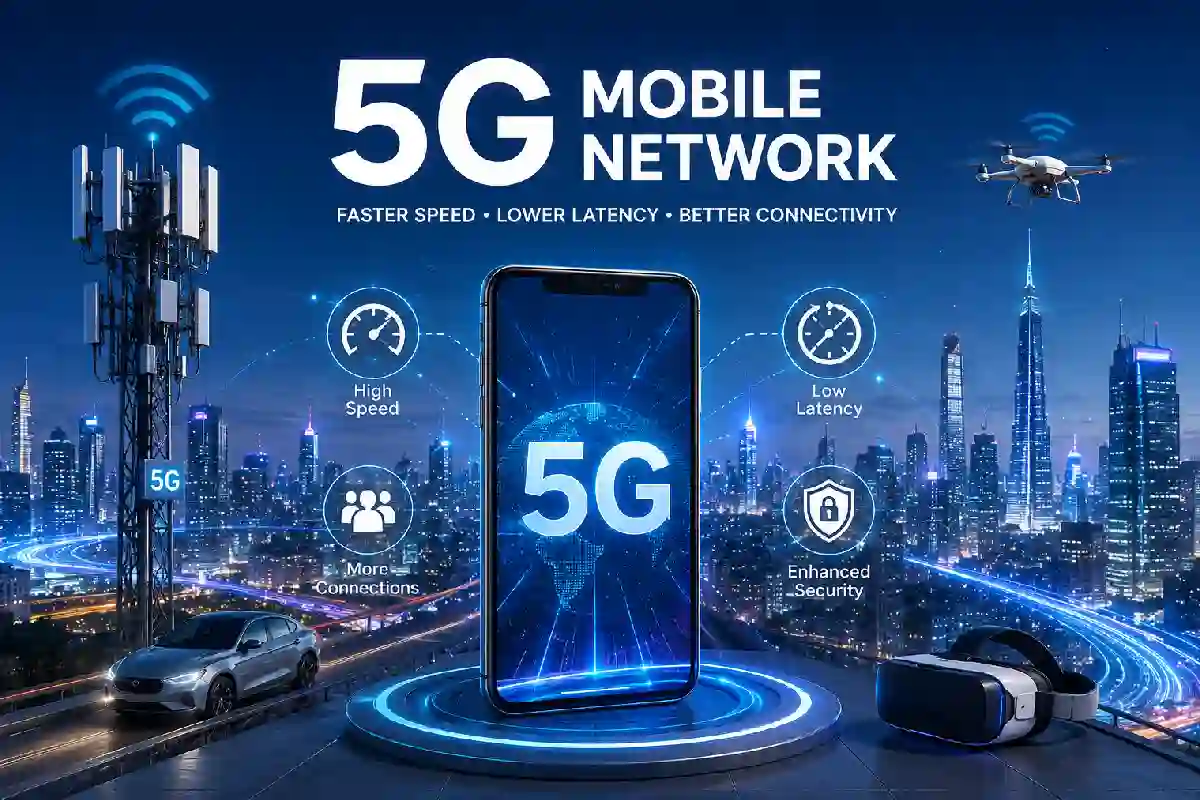
5G represents the next major advancement in mobile network technology, offering faster data speeds, lower latency, and improved connectivity for consumers and businesses alike.
How Does 5G Technology Work?
5G relies on state of the art wireless technologies where information is transmitted at a much faster rate than older generation standards.
Core Technologies
| Technology | Purpose |
| Massive MIMO | Increases network capacity |
| Beamforming | Directs signals to devices |
| Network Slicing | Creates dedicated virtual networks |
| Edge Computing | Reduces latency |
| Small Cells | Improves coverage in dense areas |
Simplified Process
- Device connects to nearest 5G tower.
- Data travels through fiber backhaul.
- Edge servers process information closer to users.
- Optimized routing reduces delays.
This architecture enables implementation of an ultra fast communication as well as a real time behaviors.
Compared with 4G mobile networks, 5G provides significantly higher bandwidth and can support a much larger number of connected devices simultaneously.
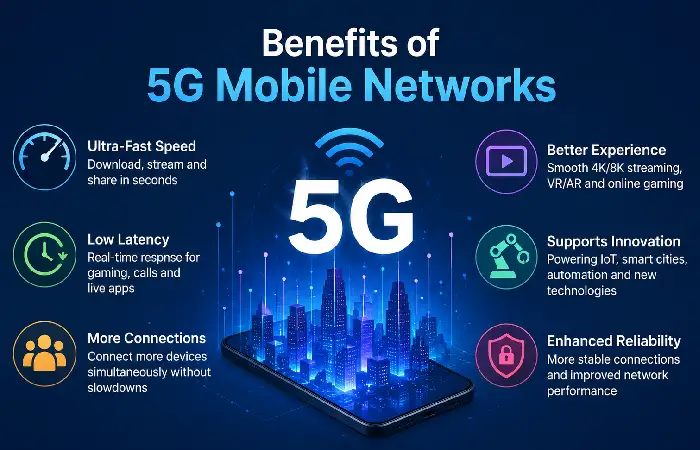
Benefits of 5G Mobile Networks
Faster Mobile Internet
The files that used to take minutes to download are now high-speed news.
Ultra-Low Latency
Reduced latency improves:
- Online gaming
- Video calls
- Autonomous vehicles
- Remote operations
Better Connectivity
It can support billions of devices to connect the network. 5G is expected to connect billions of devices.
Improved Business Applications
Organizations benefit from:
- IoT deployments
- Smart factories
- AI-powered automation
- Remote workforce solutions
5G Network Speed and Latency
Speed and latency are one of the major factors driving consumers into adopting 5G.
Speed Comparison
| Network Type | Average Speed |
| 3G | 1–8 Mbps |
| 4G LTE | 20–100 Mbps |
| 5G Sub-6 GHz | 100–900 Mbps |
| 5G mmWave | 1–10+ Gbps |
Latency Comparison
| Network | Latency |
| 4G LTE | 30–50 ms |
| 5G | 1–10 ms |
Real-World Applications
- Cloud gaming
- AR/VR experiences
- Live video streaming
- Smart healthcare systems
One of the biggest benefits of 5G is its ability to improve mobile network speed, enabling smoother streaming, faster downloads, and responsive cloud gaming experiences.
5G Coverage and Availability
5G continues to roll out worldwide in 2026.
Types of Coverage
| Coverage Type | Range | Speed |
| Low-Band | Long | Moderate |
| Mid-Band | Medium | High |
| High-Band (mmWave) | Short | Very High |
Major Deployment Areas
- Urban centers
- Business districts
- Transportation hubs
- Stadiums
- Smart city projects
How to Check Coverage
- Visit your carrier’s coverage map.
- Verify your device supports local bands.
- Enable 5G settings on your smartphone.
The actual performance of a 5G connection depends heavily on local mobile network coverage, available spectrum, and infrastructure deployment.
5G Frequency Bands
Various bands’ frequency ranges are used to define speed and coverage.
Frequency Band Comparison
| Band Type | Frequency Range | Advantages |
| Low-Band | Below 1 GHz | Wide coverage |
| Mid-Band | 1–6 GHz | Balanced performance |
| High-Band (mmWave) | Above 24 GHz | Extreme speed |
Which Band Is Best?
There is no single “best” band.
- Rural areas benefit from low-band.
- Cities benefit from mid-band.
- Dense locations benefit from mmWave.
5G Network Infrastructure
The backbone of a 5 G mobile network consists of several technologies working in tandem.
Infrastructure Components
| Component | Function |
| Cell Towers | Wireless signal transmission |
| Small Cells | Localized coverage |
| Fiber Networks | High-speed backhaul |
| Data Centers | Data processing |
| Edge Nodes | Low-latency computing |
Infrastructure Challenges
- High deployment costs
- Spectrum availability
- Regulatory approvals
- Rural expansion requirements
5G and Mobile Devices
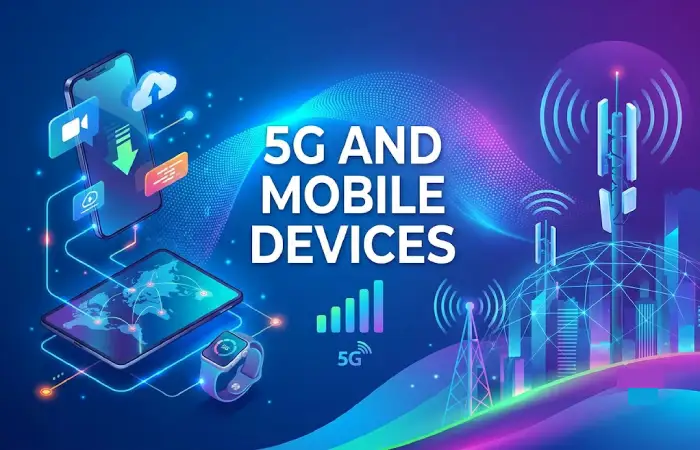
Several smartphones do not support 5G fully.
Features to Look For
- Multi-band 5G support
- Carrier compatibility
- Latest modem technology
- Wi-Fi 7 integration
- Efficient battery management
Device Categories
| Category | Typical Price Range |
| Budget 5G Phones | $150–$350 |
| Mid-Range 5G Phones | $350–$700 |
| Premium Flagships | $700+ |
5G Network Security
With the increase of Connectivity, becomes increasingly vital.
Security Improvements
- Enhanced encryption
- Better identity management
- Network slicing isolation
- Secure authentication
Potential Risks
| Risk | Mitigation |
| IoT vulnerabilities | Device management |
| Misconfigured networks | Continuous monitoring |
| Data privacy concerns | Strong encryption |
| Supply chain threats | Vendor assessments |
Best Practices
- Keep devices updated.
- Use strong authentication.
- Avoid unsecured public networks.
- Install security updates promptly.
The rollout of 5G services is being driven by major mobile network operators, which continue to expand infrastructure and enhance service availability.
The Future of 5G
The future of 5G is a lot broader than super high-speed downloads for your smartphone. Starting in 2026, commercial 5G networks will evolve from simple network build-outs into intelligent, AI-enabled programmable networks that power next-generation business applications, smart cities, autonomous vehicles, and creative virtual environments. Leading analysts predict that 5G will evolve into the next-think of next-generation rather than the evolution of mobile connectivity.
Emerging Trends
- Private 5G networks
- Smart manufacturing
- Connected transportation
- Remote healthcare
- AI-powered network optimization
- Extended Reality (XR)
Intelligence, automation, and broad connectivity will be core to the future 5G era. As 5G-Advanced, automated (AI-enabled) operations, private networks, and edge computing become more prevalent, mobile networks will emerge as essential infrastructure for both consumers and enterprises. Future 5G networks will not be in any way defined by high speed: instead, they will facilitate brand new digital worlds and set the stage for 6G innovation.
To better understand how wireless technology has evolved, it is useful to explore previous mobile network generations, from 1G through 4G before the arrival of 5G.
FAQs
Is 5G faster then 4 G?
Yes. 5G can provide much faster speeds and lower latency compared to 4G LTE.
Will I have to buy a new phone to use 5G?
Absolutely. You need a 5G phone.
Can I access 5G from anywhere?
Coverage is still growing, but the programming is not offered everywhere nor by every carrier.
Will 5G enhance gaming?
Yes. Faster network speeds lead to smoother online gameplay due to reduced lag.
Is 5 G secure?
The 5G package provides advanced security features but users are advised to also employ general cybersecurity practices.
Which sectors of industry will gain the most from 5 G?
All of the busy areas (healthcare, manufacturing, transportation, education, entertainment and smart city projects) enjoy its benefits.
Conclusion
The 5 G Mobile Network is not simply a step up from 4 G, but the backbone of the future of digital networking. With promises of faster connection speeds, ultra-low latency, more network capacity and various targeted enhancements for up-and-coming technologies like IoT, artificial intelligence, cloud gaming and smart cities, 5 G is transforming human and business relation to technology.
Kashifa Jafar is a technology writer and contributor at FutureTechExpert with 4+ years of experience in technology writing and content creation.
Read Full Bio of Author →Sameena reviews selected health, wellness, technology, and digital content for clarity, factual presentation, and reader usefulness.
Read Full Bio of Reviewer →