
 Kashifa Jafar
Technology Writer & Contributor
Kashifa Jafar is a technology writer and contributor at FutureTechExpert with 4+ years of experience in technology writing and content creation.
Read Full Bio of Author →
Kashifa Jafar
Technology Writer & Contributor
Kashifa Jafar is a technology writer and contributor at FutureTechExpert with 4+ years of experience in technology writing and content creation.
Read Full Bio of Author →
 Sameena Begum
Health, Technology & Digital Content Reviewer
Sameena reviews selected health, wellness, technology, and digital content for clarity, factual presentation, and reader usefulness.
Read Full Bio of Reviewer →
Sameena Begum
Health, Technology & Digital Content Reviewer
Sameena reviews selected health, wellness, technology, and digital content for clarity, factual presentation, and reader usefulness.
Read Full Bio of Reviewer →
Mobile Network Operators (MNOs) are the telecom companies who develop, run, and maintain the network infrastructures used to support mobile phones and connected devices so users can make calls, send SMSs, and enjoy internet access. All interactions of mobile data usage, video streaming, and voice calling are powered by a mobile network operator.
In 2026, the mobile operators across are facilitate 5G coverage, increasing network speeds and dramatically invest in the new-generation telecommunications technologies. The Indian telecom sector remains one of the biggest the world today. More than 1.3 billion subscribers.
 This article is part of
Mobile Networks Resources
Table of Contents
What Is a Mobile Network Operator?
A Mobile Network Operator (MNO) is a company that owns and operates a wireless network.
Unlike Mobile Virtual Network Operators (MVNOs), MNOs own:
- Radio spectrum licenses
- Cellular towers
- Core network infrastructure
- Data centers
- Transmission equipment
Examples include:
- Reliance Jio
- Bharti Airtel
- Vodafone Idea (Vi)
- BSNL
These operators supply voice, SMS, mobile internet, enterprise connectivity, IoT services and they offer 5G based services.
Mobile network operators play a crucial role in providing wireless communication services to consumers and businesses. These companies depend on advanced mobile network technology to maintain reliable connectivity across different regions and devices.
How Mobile Network Operators Work
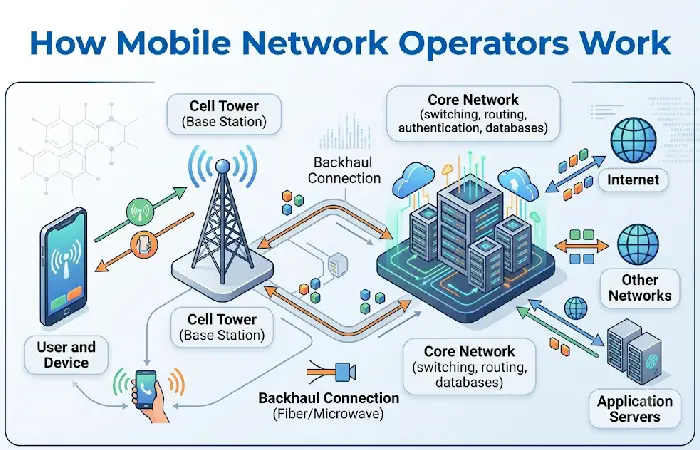
Mobile operators link the subscriber with the network of interrelated elements.
Basic Network Flow
User Device → Cell Tower → Base Station → Core Network → Internet/Phone Network
Key Components
| Component | Function |
| Spectrum | Wireless frequencies used for communication |
| Cell Towers | Connect devices to the network |
| Base Stations | Manage radio communication |
| Core Network | Routes voice and data traffic |
| Data Centers | Process and store network information |
| Fiber Backhaul | Connects towers to the internet |
Current operators are progressively adopting cloud-native architectures of networks and optimization systems based on artificial intelligence.
Types of Mobile Network Operators
- Traditional MNOs
Own all infrastructure and spectrum licenses.
Examples:
- Jio
- Airtel
- Vodafone Idea
- BSNL
- MVNOs (Mobile Virtual Network Operators)
Lease network access from MNOs and provide services using own brand.
Advantages:
- Lower operating costs
- Competitive pricing
- Niche market offerings
MNO vs MVNO Comparison
| Feature | MNO | MVNO |
| Owns Towers | Yes | No |
| Owns Spectrum | Yes | No |
| Controls Network | Full Control | Limited |
| Infrastructure Cost | High | Low |
| Service Flexibility | Medium | High |
Major Mobile Network Operators in India
India has four operators having maximum presence in the telecom market.
Mobile Network Operator Market Snapshot (2026)
| Operator | Broadband Subscribers (Millions) | Position |
| Reliance Jio | 515.14 | #1 |
| Bharti Airtel | 365.13 | #2 |
| Vodafone Idea | 129.21 | #3 |
| BSNL | 23.02 | #4 |
Source: TRAI Telecom Subscription Data (May 2026).
Official Resources
| Operator | Website |
| Reliance Jio | 5G, broadband, enterprise services |
| Bharti Airtel | Mobile, fiber, business solutions |
| Vodafone Idea (Vi) | Mobile and digital services |
| BSNL | Government-owned telecom provider |
Mobile Network Infrastructure
Nationwide mobile network requires a lot of money to build.
Infrastructure Includes
- Cell towers
- Small cells
- Fiber-optic networks
- Edge computing nodes
- Cloud infrastructure
- Spectrum assets
In this last decade 5G has relied heavily on a dense web of towers with fiber connected backhauls providing the ultra-low latency service.
Understanding the evolution of mobile network generations helps explain how operators have progressed from early cellular technologies to today’s advanced high-speed networks.
Network Coverage and Operators
Coverage is still the most valued aspects when selecting a mobile operator.
Coverage Comparison (India 2026)
| Operator | Coverage Strength | Rural Reach | Urban Performance |
| Jio | Excellent | Excellent | Excellent |
| Airtel | Excellent | Very Good | Excellent |
| Vi | Good | Moderate | Good |
| BSNL | Moderate | Good | Moderate |
As per the report of Opensignal 2026, Jio continues to hold the number one position in the Coverage Experience rankings in India. Airtel was still holding the number two position and was close by.
When comparing providers, consumers often evaluate mobile network coverage to determine how well a network performs in urban, suburban, and rural locations.
4G and 5G Services
Find evidence that contemporary mobile operators now provide both 4G LTE and 5G connection.
4G vs 5G Comparison
| Feature | 4G LTE | 5G |
| Speed | Up to 100 Mbps | Up to multi-Gbps |
| Latency | 30-50ms | Under 10ms |
| Capacity | High | Very High |
| IoT Support | Limited | Extensive |
| Gaming Performance | Good | Excellent |
5G Availability (2026)
| Operator | 5G Availability Score |
| Jio | 69.2% |
| Airtel | 67.4% |
| Vi | 32.0% |
As demand for faster internet grows, operators are rapidly deploying 5G mobile networks while continuing to strengthen their 4G network infrastructure to support existing users.
Mobile Plans and Network Services
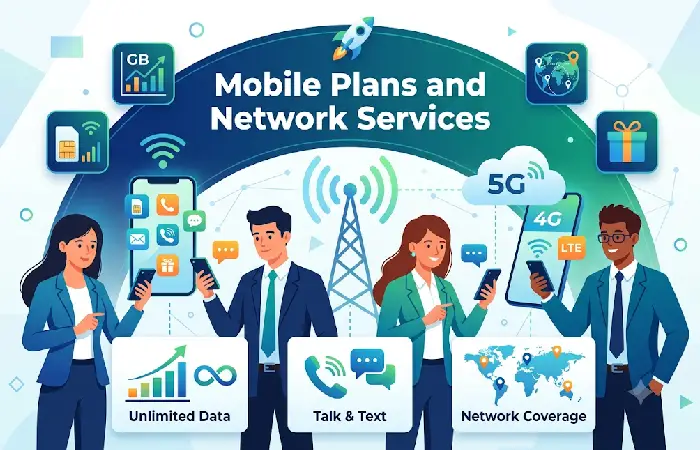
Today‘s operators offer a wide range of services.
Common Services
- Voice calling
- SMS services
- Mobile broadband
- Unlimited data plans
- International roaming
- IoT connectivity
- Enterprise networking
- Fixed Wireless Access (FWA)
Typical Plan Comparison
| Feature | Budget Plan | Mid-Tier Plan | Premium Plan |
| Data | 1-1.5GB/day | 2GB/day | Unlimited |
| 5G Access | Limited | Included | Included |
| OTT Benefits | No | Some | Multiple |
| Roaming | Standard | Enhanced | Global |
How to Choose a Mobile Network Operator
Before selecting an operator, consider:
- Coverage
Check signal strength in:
- Home
- Office
- Frequently traveled areas
- Network Speed
Review:
- 4G performance
- 5G availability
- Peak-hour congestion
- Pricing
Compare:
- Monthly cost
- Data allowances
- OTT subscriptions
- Roaming fees
- Customer Support
Evaluate:
- App functionality
- Service centers
- Complaint resolution
Another important factor is mobile network speed, which directly impacts streaming quality, online gaming performance, video calls, and everyday browsing.
Future Trends in Mobile Networks
The mobile network sector is growing rapidly as operators develop new networks to cope with the ever increasing need for speed, smarter devices, and more reliable service. As telecom companies roll out of 5G worldwide, they are also strategizing on what the ten years to come may have in store in terms of developments.
Key Trends for 2026 and Beyond
AI-Powered Networks
Operators are also making more use of artificial intelligence for optimization and predictive maintenance.
5G Standalone Networks
5G standalone can provides the low latency and more sophisticated enterprise use cases.
Private 5G
Manufacturing and automation are served by dedicated networks.
Satellite Connectivity
Hybrid systems of terrestrial-satellite networks extend the coverage.
6G Research
Simultaneously, major operators and governments are backing the development of 6G technologies that are being anticipated that are likely to be rolled out within a decade.
Taking the fundamentals above in to consideration, mobile networks of the future will offer higher speeds, reduced latency, enhanced security, wider coverage and the enablement of new technologies that will revolutionise the way we live and work such as smart homes, connected mobility, remote healthcare and immersive entertainment. Mobile network operators will be at the heart of this digital future.
FAQ
What is a Mobile Network Operator?
An MNO is a telecom operator with their own network equipment and spectrum license.
What is the top mobile service provider in India in 2026?
The bolstering of the Indian telecom network was led by Reliance Jio, which now has a customer base of over 515 million.
How does an MNO differ from an MVNO?
MNOs have ownership of the network infrastructure, while MVNOs have access to the network which they rent from the MNOs.
What is the operator with the best 5G coverage in India?
According to latest network experience data, Jio and Airtel are on top of India‘s 5G coverage and availability numbers.
Is 5G better than 4G?
Yes. 5G has higher speeds, lower latency, and increased capacity than 4G.
Conclusion
Mobile Network Operators are at the heart of every digital communication, providing mobile telephony and internet, enterprise cloud computing, internet of things, and high definition 5G connectivity. Telecom operators worldwide invested billions in network infrastructure, spectrum licenses and future technologies in order to develop the fastest, biggest and most reliable networks.
Kashifa Jafar is a technology writer and contributor at FutureTechExpert with 4+ years of experience in technology writing and content creation.
Read Full Bio of Author →Sameena reviews selected health, wellness, technology, and digital content for clarity, factual presentation, and reader usefulness.
Read Full Bio of Reviewer →