
 Kashifa Jafar
Technology Writer & Contributor
Kashifa Jafar is a technology writer and contributor at FutureTechExpert with 4+ years of experience in technology writing and content creation.
Read Full Bio of Author →
Kashifa Jafar
Technology Writer & Contributor
Kashifa Jafar is a technology writer and contributor at FutureTechExpert with 4+ years of experience in technology writing and content creation.
Read Full Bio of Author →
 Sameena Begum
Health, Technology & Digital Content Reviewer
Sameena reviews selected health, wellness, technology, and digital content for clarity, factual presentation, and reader usefulness.
Read Full Bio of Reviewer →
Sameena Begum
Health, Technology & Digital Content Reviewer
Sameena reviews selected health, wellness, technology, and digital content for clarity, factual presentation, and reader usefulness.
Read Full Bio of Reviewer →
The Internet Satellite is revolutionizing broadband internet access, particularly in rural and Remote location. We all are more and more depended on online browsing, yet not everyone has the coverage in place for high speed broadband. In cities and major population centers, cable, fiber and mobile networks are usually available, but how about the millions of other users located in more isolated areas?
This technology has advanced markedly in recent years: rather than the well-known conventional geostationary satellite systems, new and modern LEO satellite constellations are emerging, such as Starlink, bring much lower latency, higher speeds and wider coverage.
Following developments in India‘s satellite Internet policy as well as worldwide broadband trends, satellite broadband is anticipated to be significantly instrumental in reducing the digital divide and extending Internet accessibility to marginalized communities.
In a remote village, running a business in an isolated place, traveling everywhere, or really just needing a backup Internet access, knowing all about satellite Internet is crucial.
 This article is part of
Emerging Telecom Technology Resources
Table of Contents
What Is Satellite Internet?
Satellite Internet is another example of broadband that involves the use of communication satellites orbiting in space whereby internet data is transferred between the ground network infrastructure and end users.
The other major difference is that satellite internet, because it doesn‘t need a physical cable like, fiber, cable or DSL is transmitted wirelessly to and from the satellite orbiting the earth. This is achieved with a dish at your end communicating with the satellite network.
Key Components
| Component | Function |
| User Terminal (Dish) | Sends and receives signals |
| Modem | Converts satellite signals into internet access |
| Satellite | Relays data between Earth and space |
| Ground Station | Connects satellite traffic to the internet backbone |
This technology allows internet access virtually anywhere with a clear view of the sky.
If you’re new to this technology, our guide on satellite internet technology explained covers the complete connection process from space to your home.
How Does Satellite Internet Work?
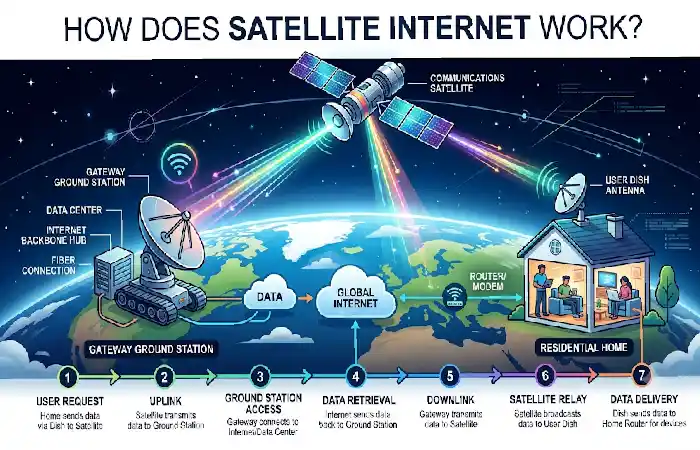
How does satellite internet work? Satellite internet works by transmitting data between your device and antenna, then to a satellite in space, onto a GSO or Ground based Station internet connection and back to your device. Unlike regular fiber or cable broadband, the data is not transmitted via a physical cable but via radio signals.
This process takes only a few hundred milliseconds on an up-to-date LEO network. It can be significantly longer in older GEO satellites however as those satellites are significantly further away from the ground.
Step 1: User Sends Request
A user opens a website or application.
Step 2: Dish Transmits Signal
The request travels from the router to the satellite dish.
Step 3: Satellite Relay
The dish transmits the request to a satellite orbiting Earth.
Step 4: Ground Station Processing
The satellite forwards the request to a ground gateway connected to the internet.
Step 5: Response Sent Back
Data follows the reverse route back to the user.
Satellite Internet Signal Flow
| Step | Path |
| 1 | Device → Router |
| 2 | Router → Satellite Dish |
| 3 | Dish → Satellite |
| 4 | Satellite → Ground Station |
| 5 | Ground Station → Internet |
| 6 | Response returns via satellite |
Modern LEO systems drastically cut down on travelling distance, drastically improving responsiveness, when compared to GEOs.
Researching the best satellite internet providers can help you identify services that match your location and internet needs.
Why Satellite Internet Is Important for Rural Areas
Implementing terrestrial broadband infrastructure is often challenging in remote, sparsely populated, or hard-to-reach areas.
Many of these physical limitations can also be avoided through the use of Satellite internet.
For example, a rural household may not be able to get fiber as an affordable solution because of the need to run many kilometers of cable for fairly few homes. A satellite terminal would be able to connect that house without a cable path all the way to the house.
This makes satellite broadband particularly useful for:
- Rural homes
- Farms
- Mountain communities
- Remote businesses
- Construction sites
- Ships and maritime operations
- Emergency and disaster-response locations
Types of Satellite Internet
Broadly, satellite internet can be distinguished based on the orbit, the architecture of the network and the user segment. The three main orbits used for satellite internet are Geostationary (GEO), Medium (MEO) and Low Earth (LEO). LEO has garnered a lot of attention, as newer constellations can achieve broadband like experience with lower latency.
Being aware of the distinction can help when evaluating various satellite internet service providers on numerous aspects such as speed, latency, coverage, stability, hardware needed and usage context.
| Type | Orbit Height | Typical Latency |
| GEO | 35,786 km | 500–700 ms |
| MEO | 8,000–20,000 km | 100–200 ms |
| LEO | 400–2,000 km | 20–50 ms |
Geostationary Orbit (GEO) Satellite Internet
The GEO satellite internet is provided with satellites to be situated about 35,786 kilometers above the earth‘s equator.
At this height, a satellite orbits the Earth in about the same time as the Earth‘s rotation. Therefore, the satellite seems to stay in approximately the same place.
Which makes MEOS systems ideal to provide wide area coverage by only a few satellites.
GEO satellites have primarily been used for conventional (traditional) satellite broadband services.
Advantages:
- Very broad geographic coverage
- Mature and established technology
- A relatively small number of satellites can cover large areas
- Useful for remote and rural connectivity
Limitations:
- High latency because of the long distance between Earth and the satellite
- Less suitable for latency-sensitive applications
- Severe weather can affect signal quality
- Performance can vary with network congestion
Traditional satellite broadband services have historically relied heavily on GEO satellites.
Low Earth Orbit (LEO) Satellite Internet
LEO satellite internet. Satellites in Low Earth Orbit (LEO) are closer to the earth than many other forms of satellite internet. They are usually anywhere from a few hundred miles up to approximately 2,000 miles.
As each of the individual LEO satellites traverse over a relatively small part of the worldwide user base and are moving so fast with respect to the local user, result is a need for more (constellation of) satellites to continually provide service.
This method has become fashionable with services like Starlink.
The shorter travel distance between Earth and space means that the travel time of signals traveling to and from space are much shorter. This allows for more communication.
Advantages:
- Much lower latency than traditional GEO systems
- High broadband speeds are possible
- Better suited to video calls, cloud applications, and gaming
- Large constellations can provide extensive geographic coverage
Limitations:
- Requires many satellites
- Satellites move constantly relative to ground users
- Network handovers are required
- User terminals generally need a suitable view of the sky
- Service availability varies by location
LEO satellite internet is one of the biggest developments in Satellite broadband.
Medium Earth Orbit (MEO) Satellite Internet
Medium Earth Orbit, generally known as MEOs are satellites that orbit between GEOs and LEOs.
MEO systems can also offer a trade-off between latency and coverage. They are better than LEO systems in terms of latency, because they are higher than LEO satellites. They also offer better coverage than LEO systems, because the distance to the satellite is greater, resulting in a greater coverage area per satellite.
MEO has traditionally been used for navigation and communications, though it is less significant to consumer broadband than GEO and LEO.
Key characteristics include:
- Greater coverage per satellite than LEO
- Lower latency than GEO
- Fewer satellites may be required compared with LEO
- Can support specialized communications applications
Use our guide to compare satellite internet plans and find the most cost-effective option for your household.
Low Earth Orbit vs Geostationary Satellite Internet
The main distinguishing feature between LEO and GEO satellite internet services is the height of their satellites in orbit. While satellites for LEO are in orbit close to the Ground, those for GEO are situated about 35786 km from the Equator.
It makes a difference in virtually all aspects of a user‘s experience; latency, types of network, coverage, number of satellites, equipment, speed, and whether a connection is appropriate for gaming, video conferencing, and so on.
Comparison Table
| Feature | LEO | GEO |
| Altitude | 400–2,000 km | 35,786 km |
| Latency | 20–50 ms | 500–700 ms |
| Speed | 50–300+ Mbps | 25–150 Mbps |
| Gaming | Excellent | Poor |
| Video Calls | Excellent | Moderate |
| Coverage | Requires many satellites | Few satellites needed |
| Reliability | High | High |
Winner for Most Users
LEO satellite internet offers a significantly better experience for:
- Gaming
- Remote work
- Video conferencing
- Streaming
GEO remains useful where lower infrastructure costs are important.
Which Is Better: LEO or GEO?
In general for most potential users requiring the current high speed modern satellite broadband, LEO is the better alternative due to its more interactive nature given its lower latency.
GEO, on the other hand, will still be useful because of its large coverage area and extensive infrastructure.
Choose LEO If You Need:
- Lower latency
- Online gaming
- Video conferencing
- Remote work
- Cloud applications
- More responsive web browsing
- Modern broadband performance
Choose GEO If You Prioritize:
- Broad geographic coverage
- Established satellite infrastructure
- Connectivity in areas served by existing GEO providers
- Services where latency is less important
Satellite Internet Speed and Performance
The facilities of satellite internet speed and performance has a significant increase significantly with the development of Large Earth Orbit (LEO) satellite network. Past GEO satellite services were frequently constrained by high latency; but the innovations of current LEO systems can make broadband speed and quicksiness enough for example stream, video call, cloud computing and online game.
But satellite internet performance is not just about download speed. Many other aspects can have an impact on speed from latency, upload speed, jitter, congestion, signal quality, weather conditions, network capacity and your location.
Speed depends on:
- Satellite type
- Network congestion
- Weather conditions
- Equipment quality
- Service plan
Typical Performance in 2026
| Connection Type | Download Speed | Upload Speed |
| GEO Satellite | 25–150 Mbps | 3–20 Mbps |
| LEO Satellite | 50–300+ Mbps | 10–40 Mbps |
| Fiber | 100 Mbps–10 Gbps | 100 Mbps–10 Gbps |
| Cable | 100–1,200 Mbps | 10–100 Mbps |
| 5G Home Internet | 100–1,000 Mbps | 20–100 Mbps |
Latency Comparison
| Technology | Latency |
| Fiber | 5–20 ms |
| Cable | 10–40 ms |
| 5G | 15–50 ms |
| LEO Satellite | 20–50 ms |
| GEO Satellite | 500–700 ms |
Our article on understanding satellite internet speeds explains download rates, latency, and real-world performance.
Satellite Internet Coverage
Satellite internet coverage:The areas of the world in which a satellite system can offer internet service. It is important to note the differences between satellite broadband and other forms of broadband including fiber, cable and terrestrial broadband. Unlike these services, satellite internet does not have to be wired to the customer and can provide a large amount of coverage geographically which makes it useful for rural areas, remote villages, islands and mountainous regions among other locations.
Indeed, contemporary Low Earth Orbit (LEO) satellite networks have all but created an entirely new possible target market of satellite broadband within their scope. The current Starlink network, for instance, claims coverage of ‘land, ocean, and polar regions (where permitted by local authorities)’.
How Satellite Internet Provides Wide Coverage
The reason why satellite internet is capable of providing wide coverage? Because it is not entirely depending on local terrestrial infrastructure and the connection is being transferred from the user terminal to orbiting satellites.
A simplified coverage path looks like this:
User Terminal → Satellite → Ground Station → Internet
There are many satellites in the constellation for LEO networks. When satellites are in the relation, user terminal could switch to new satellites until the moving of satellites.
GEO networks operate differently. A satellite in geostationary orbit is situated over a nearly fixed position on the Earth, and can thus provide coverage to a much larger geographic area.
LEO vs GEO Satellite Internet Coverage
Coverage depends greatly on the type of orbit of the satellite.
| Feature | LEO Satellite | GEO Satellite |
| Orbital altitude | Hundreds to ~2,000 km | ~35,786 km |
| Coverage per satellite | Smaller | Very large |
| Satellites required | Large constellation | Relatively few |
| Satellite movement | Moves across sky | Appears fixed |
| Network handovers | Frequent | Usually minimal |
| Potential coverage | Very broad with enough satellites | Very broad |
| Latency | Lower | Higher |
Satellite internet can deliver access in locations where it is not economically feasible to lay fiber.
Learn about satellite internet availability and coverage to see how providers serve rural and remote locations.
Satellite Internet Equipment and Installation
The equipment and installation of satellite internet are essential considerations that affect the quality, speed and the performance of satellite broadband connection. By using satellite broadband internet rather than fiber or cable broadband, you are installing a satellite terminal that connects to satellites orbiting in space and links to the network.
Unlike the more complex satellite broadband systems, modern LEO systems have been designed to be easy to install. Nevertheless, a suitable location for the terminal must be found, a clear view of the sky maintained, the network components correctly connected and the installation protected from the elements.
Required Equipment
| Equipment | Purpose |
| Satellite Dish | Connects to orbiting satellites |
| Mounting Hardware | Secures dish |
| Satellite Modem | Converts signal |
| Wi-Fi Router | Shares internet connection |
| Power Supply | Operates equipment |
Installation Process
- Site survey
- Dish mounting
- Satellite alignment
- Cable routing
- Modem setup
- Network activation
- Speed testing
Benefits and Limitations of Satellite Internet
Satellite-based access has emerged as an important broadband option for residences, enterprises, travelers and hard-to-reach populations. New LEO-based satellite systems have dramatically increased the performance capabilities of satellite access by delivering much higher speeds at Latencies far below those of conventional GEO-based satellite services. The FCC writes, Today‘s satellite systems offer high-speed, low-latency connectivity and are especially useful in rural areas and in times of disaster.
Despite this, satellite internet is not presupposed as the ideal solution for all households. It might be affected with: Depending on the satellite technology, network congestion, weather conditions, installation conditions and time availability, terminal connection quality to the sky..
Benefits
Available Almost Everywhere
Coverage extends to locations unreachable by fiber or cable.
Fast Deployment
No trenching or extensive infrastructure required.
Useful Backup Connectivity
Businesses often use satellite as a failover connection.
Supports Remote Communities
Bridges the digital divide.
Limitations
Weather Sensitivity
Heavy rain can affect signal quality.
Equipment Costs
Initial hardware costs can be higher.
Network Congestion
Performance may vary during peak usage periods.
Line-of-Sight Requirements
Obstructions can reduce signal quality.
Discover the essential satellite internet equipment required for installation and optimal network performance.
Satellite Internet vs Fiber, Cable, and 5G
Getting online is certainly not just a matter of picking the fastest published download speed. Satellite Internet, fiber, cable, and 5G utilize very different technologies, and can all be beneficial depending on location, access, use, and cost.
On the whole, fiber is expected to offer the best performance; cable is also a viable option, where cable networks are already established. 5G and 5 G Fixed Wireless Access (FWA) will be able to provide broadband without the need for a wired lead to the home, but satellite internet will have a significant edge in locations where terrestrial infrastructure is not and can not be provided.
Satellite Internet vs Fiber vs Cable vs 5G
| Feature | Satellite Internet | Fiber Internet | Cable Internet | 5G / 5G FWA |
| Connection type | Wireless via satellite | Fiber-optic cable | Coaxial/fiber hybrid | Wireless cellular |
| Coverage | Excellent for remote areas | Excellent where deployed | Strong in covered areas | Strong in areas with 5G coverage |
| Typical latency | Low with LEO, higher with GEO | Very low | Low | Low to moderate |
| Download performance | Good to very high depending on provider | Very high | High | High, but variable |
| Upload performance | Usually lower than fiber | Excellent | Usually lower than fiber | Variable |
| Installation | Outdoor terminal required | Physical cable installation | Cable connection required | Indoor/outdoor 5G gateway |
| Weather sensitivity | Can be affected by severe conditions | Very low | Very low | Can vary with radio conditions |
| Mobility | Some plans support mobility | Very limited | Very limited | Strong |
| Rural suitability | Excellent | Depends on deployment | Depends on deployment | Good where 5G coverage exists |
| Best use case | Remote and underserved locations | Maximum performance | High-speed mainstream broadband | Fast wireless home connectivity |
Best Choice
| Scenario | Recommended Option |
| Urban Area | Fiber |
| Suburban Area | Fiber or Cable |
| Rural Area | Satellite |
| Remote Locations | Satellite |
| Mobile Connectivity | 5G |
Satellite Internet for Rural and Remote Areas
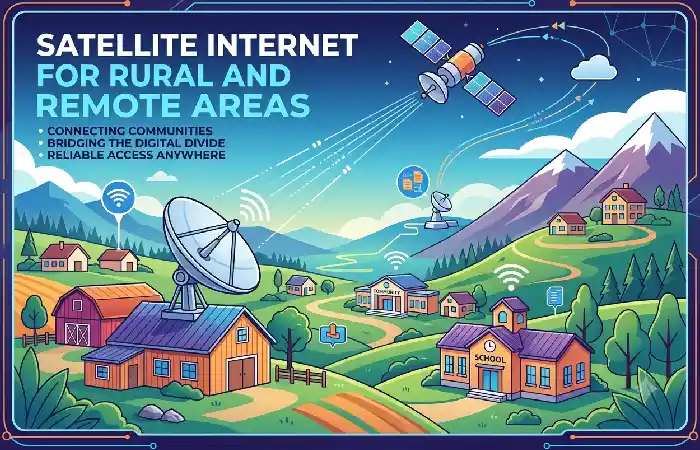
The satellite Internet would be compatible for the rural, or far away locations.. In rural areas Satellite Internet could be used to bring broadband services to homes, business, schools, farms and communities where it would be prohibitively expensive or impractical to put other networks. Unlike fiber, cable, fixed wireless networks no last mile cable exist to the customer premise and no cellular tower exists near the customer premise.
Satellite internet is especially valuable in mountainous regions, on islands, in forests, deserts, in very sparsely inhabited villages, border areas, and other hard-to-access places.
Contemporary satellite networks in low earth orbit (LEO) have further enhanced satellite broadband. The FCC states that new LEO constellations are capable of delivering high bandwidth, low latency connectivity over sparsely populated and rugged rural areas.
Satellite broadband is often the only practical solution for:
- Villages
- Mountain communities
- Forest regions
- Border areas
- Islands
- Agricultural operations
The digital inclusion projects apply that envisage satellite Internet as a way of extending broadband access to remote areas.
How to Choose a Satellite Internet Service
You should note that it is not only the maximum advertised download speeds you should consider when choosing the right plan and Satellite Internet provider. You also need to take into account your area‘s coverage, the satellite technology used, amount of download you expect to do, equipment you need, latency, price and terms of service.
Contemporary LEO satellite services have resulted in satellite broadband being closer to parity with potentially less costly land based broadband. For example, the current Starlink specification shows typical land based latency of around 25–60 ms (although a more accurate measure depends on location/time of day/devices/plan etc).
Evaluation Checklist
Speed Requirements
| Activity | Recommended Speed |
| Browsing | 10 Mbps |
| HD Streaming | 25 Mbps |
| Remote Work | 50 Mbps |
| 4K Streaming | 100 Mbps |
| Multiple Users | 100+ Mbps |
Compare
- Monthly price
- Equipment cost
- Installation fees
- Data limits
- Coverage availability
- Customer support
- Latency performance
Popular Global Providers
| Provider | Technology | Resource |
| Starlink | LEO | https://www.starlink.com |
| OneWeb | LEO | https://www.oneweb.net |
| Project Kuiper | LEO | https://www.aboutamazon.com/project-kuiper |
| Viasat | GEO | https://www.viasat.com |
| HughesNet | GEO | https://www.hughesnet.com |
Future of Satellite Internet
The future of Satellite Internet is moving beyond simply providing broadband to remote homes. New generations of Low Earth Orbit (LEO) satellites, direct-to-device connectivity, improved satellite capacity, optical links, multi-orbit networks, and closer integration with 5G and future 6G networks are transforming satellites into an important part of the global communications infrastructure.
The technology is also becoming increasingly relevant in India. ISRO’s 2025–26 annual report states that satellite communication remains an important connectivity method for remote and difficult-to-access regions and reports 19 operational communication satellites over India, providing 73 Gbps of High Throughput Satellite (HTS) capacity.
Rather than replacing fiber and mobile networks, future satellite networks are more likely to work alongside terrestrial infrastructure, providing connectivity where conventional networks are unavailable, congested, damaged, or difficult to deploy.
The future of satellite internet is centered around:
- Massive LEO constellations
- Direct-to-device connectivity
- AI-driven network optimization
- Higher-capacity satellites
- Global broadband coverage
- Lower latency services
Developments in the industry in 2026 indicate fierce competition in between Starlink, OneWeb, Jio Satellite, and Project Kuiper, creating rapid innovation and more accessible services globally.
FAQ: Satellite Internet
Is satellite internet faster than DSL?
Yes. Modern satellite internet generally offers significantly higher speeds than DSL.
Can I use satellite internet for gaming?
LEO satellite services can support gaming. GEO satellite systems may experience high latency.
Does weather affect satellite internet?
Heavy rain, snow, or storms can impact performance.
Is satellite internet available everywhere?
Coverage is available in most regions with a clear view of the sky.
What is the biggest advantage of satellite internet?
Near-universal availability.
Is satellite internet good for remote work?
Yes, especially modern LEO services.
Conclusion
Satellite Internet has transitioned from its niche use for connectivity into an intrinsic part of our broadband world. With the leap in capacity and performance brought by the advent of all-Low Earth Orbit satellite networks, satellite broadband has become an electronic option comparable to others.
Satellite-based internet offers an affordable means for rural communities, remote businesses, travelers, and locations that lack fiber architecture to get online. With thriving competition among providers and advanced satellite constellations emerging, speeds and coverage will accelerate and costs will decline through the rest of the decade.
Kashifa Jafar is a technology writer and contributor at FutureTechExpert with 4+ years of experience in technology writing and content creation.
Read Full Bio of Author →Sameena reviews selected health, wellness, technology, and digital content for clarity, factual presentation, and reader usefulness.
Read Full Bio of Reviewer →