

 Kashifa Jafar
Technology Writer & Contributor
Kashifa Jafar is a technology writer and contributor at FutureTechExpert with 4+ years of experience in technology writing and content creation.
Read Full Bio of Author →
Kashifa Jafar
Technology Writer & Contributor
Kashifa Jafar is a technology writer and contributor at FutureTechExpert with 4+ years of experience in technology writing and content creation.
Read Full Bio of Author →
 Sameena Begum
Health, Technology & Digital Content Reviewer
Sameena reviews selected health, wellness, technology, and digital content for clarity, factual presentation, and reader usefulness.
Read Full Bio of Reviewer →
Sameena Begum
Health, Technology & Digital Content Reviewer
Sameena reviews selected health, wellness, technology, and digital content for clarity, factual presentation, and reader usefulness.
Read Full Bio of Reviewer →
Today, migrating to the cloud for your business is not simply a case of moving from server located within the office data center to one hosted on the internet it is about selecting the most suitable location for applications, data and processing and considering all relevant factors and requirements such as cost, scalability, security, compliance, performance and business needs.
As we move toward 2026, that decision becomes even more vital as businesses adopt AI, move their apps, and operate on the ever-increasingly complex cloud platform. In 2026, Gartner estimates India alone will spend $17.5B on public-cloud computing, up 28.1% from 2025.
 This article is part of
Deployment Models Resources
Table of Contents
What Is Cloud Deployment for Business?
Cloud deployment refers to the location of a company‘s cloud infrastructure and cloud workloads that are hosted by a cloud provider, who manages and has ownership of cloud resources, as well as the way in which consumers access those resources.
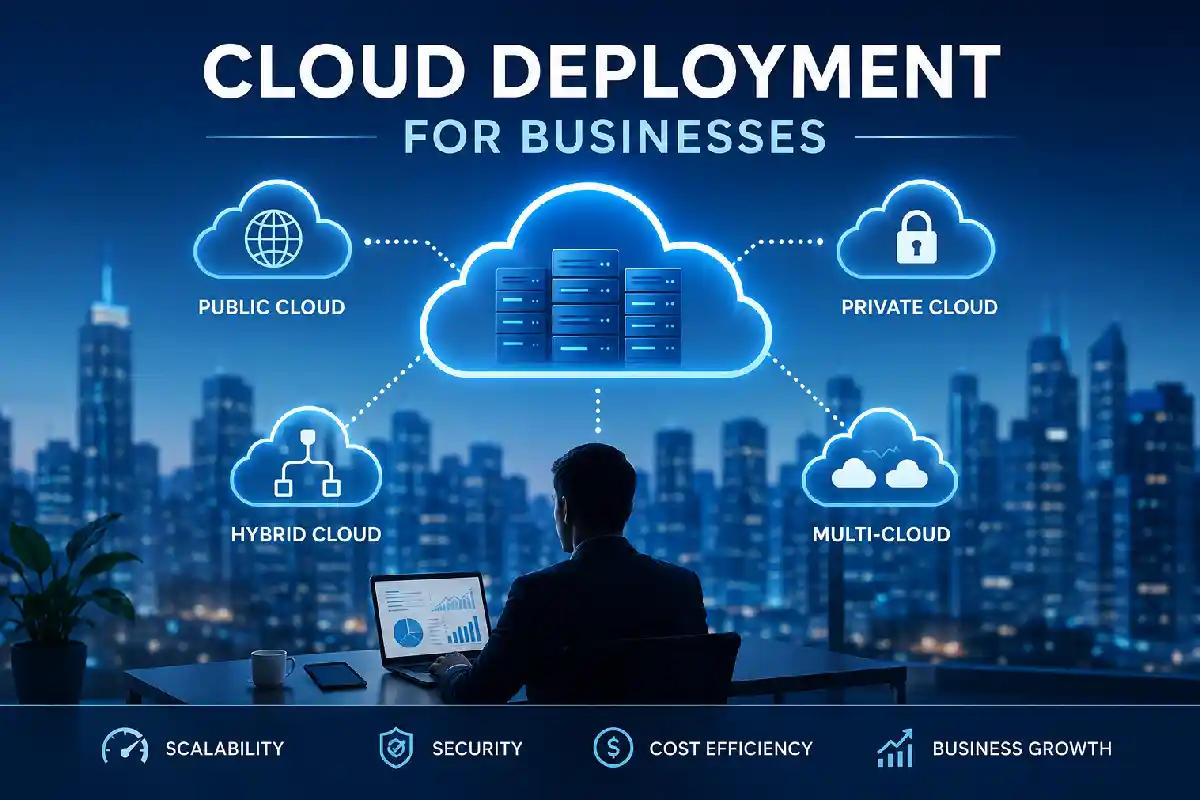
The main deployment approaches are:
- Public cloud: Infrastructure operated by a third-party provider.
- Private cloud: Dedicated infrastructure for one organization.
- Hybrid cloud: A connected combination of private/on-premises and public cloud.
- Multi-cloud: Use of services from multiple cloud providers.
Note: deployment models are not to be confused with service models, e.g. IaaS, PaaS and SaaS. Deployment is about where and how you run your environment. Service models describe the type of cloud service which you use.
Businesses can choose from several cloud deployment models based on their security, scalability, budget, and infrastructure requirements.
Benefits of Cloud Deployment for Organizations
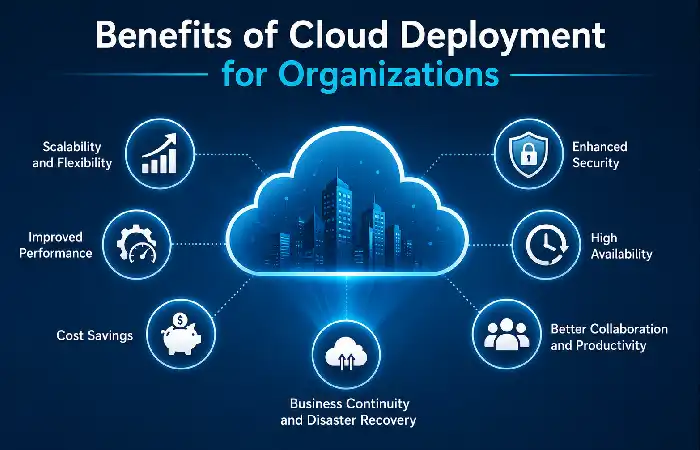
A well-planned cloud deployment can help businesses:
- Scale faster when traffic or workloads increase.
- Reduce infrastructure overhead by shifting some hardware responsibilities to providers.
- Launch applications faster using managed infrastructure and platform services.
- Improve business continuity through redundancy and geographically distributed resources.
- Support remote work with secure access to applications and data.
- Adopt AI and analytics without purchasing all required infrastructure upfront.
However, cloud does not inherently lower costs. According to a 2026 survey from Flexera, on average, organizations are consuming 29% more IaaS and PaaS cloud services than they should, underscoring the significance of FinOps, monitoring and optimizing workloads.
Public Cloud for Businesses
Public Cloud is delivering of computing, storage, database and other services provided by third-party.
It is particularly useful for:
- Startups and growing companies
- E-commerce websites
- SaaS applications
- Development and testing
- Variable workloads
- AI and data-processing workloads
The most significant benefits are quick provisioning, elasticity and the availability of a large ecosystem of managed services.
The trade-offs are for continual consumption cost, provider dependability, charges for data-transfer and the requirement for high cloud security setting.
Public cloud deployment is a practical option for businesses that need scalable computing resources without maintaining their own physical infrastructure.
Private Cloud for Businesses
A private cloud offers the infrastructure for use by a single organization. It may be an internal data center, or hosted by a provider.
Private cloud can make sense when an organization requires:
- Greater infrastructure control
- Specialized security configurations
- Predictable workloads
- Strict governance requirements
- Specific compliance or data-residency controls
The drawback is that the organization may inccur more infrastructure management, operation responsibility as well as capital expense.
Organizations with strict security, compliance, or customization requirements may benefit from private cloud deployment.
Hybrid Cloud for Businesses
Hybrid cloud connects private or on-premises resources to the public cloud.
However, as an example, sensitive data could be kept in a private area within your own facility, while a customer-facing app has been run in the public cloud.
Hybrid Cloud will counts in 2026. The paper published by Flexera explains that73%of the companies that responded to their survey (those that adopt hybrid cloud architectures).
Hybrid cloud deployment combines private infrastructure with public cloud resources, giving businesses greater flexibility over where applications and data are hosted.
Multi-Cloud for Businesses
Multi-cloud refers to the usage of cloud-computing services obtained from multiple public-cloud providers.
One business may also choose a completely different provider for the analytics and have a different provider for an additional specialised AI provision.
Potential advantages include:
- Reduced dependence on one provider
- Access to best-fit services
- Geographic flexibility
- Business continuity options
However, multi-cloud can also add to identity, networking, monitoring, skills and cost-management complexity. According to FINRA, a mulit-cloud environment can cause additional operational and potential duplicate service complexity.
Businesses can also adopt multi-cloud deployment to use services from multiple cloud providers and reduce dependence on a single vendor.
Cloud Security and Compliance
Secure should be implemented directly into deployment architecture and not added upon migration.
Businesses should evaluate:
- Identity and access management
- Encryption at rest and in transit
- Network segmentation
- Backup and disaster recovery
- Security monitoring
- Vulnerability management
- Data residency
- Regulatory requirements
- Logging and auditability
For regulated organizations, the deployment model can directly impact governance and compliance requirements. A public, private or hybrid model should therefore be chosen according to the work load and data rather than standard company preferences.
Community cloud deployment can be useful when multiple organizations have similar security, compliance, or industry-specific infrastructure requirements.
Cloud Deployment and Business Scalability
One of the most powerful advantages of running workloads in the cloud is elasticity.
A business can add additional computing resources during periods of increased demand and remove these resources when the demand diminishes. This is particularly beneficial for seasonal e-commerce, media services, financial applications and rapidly growing SaaS companies.
This momentum is reflected in the 2026 India cloud market, where Gartner expects IaaS spend to increase 40% in 2026, in part by the need for AI-enabled infrastructure.
2026 Cloud Deployment Snapshot
| Metric | 2026 figure | Why it matters | Resource |
| Organizations using hybrid cloud | 73% | Hybrid is a dominant enterprise architecture | Flexera 2026 State of the Cloud |
| India public-cloud spending | $17.5B | Shows strong business cloud investment | Gartner India Cloud Forecast |
| India public-cloud growth | 28.1% | Cloud investment continues accelerating | Gartner India Cloud Forecast |
| India IaaS growth | 40% | AI and infrastructure modernization are increasing demand | Gartner India Cloud Forecast |
| Estimated wasted IaaS/PaaS spend | 29% | Cost governance remains critical | Flexera 2026 State of the Cloud |
| Indian cloud-native developers | 2.25M | Indicates expanding cloud-native ecosystem | CNCF India 2026 Report |
| Hybrid adoption among Indian cloud-native developers | 44% | Hybrid is significant in India’s ecosystem | CNCF India 2026 Report |
Common Business Cloud Deployment Challenges
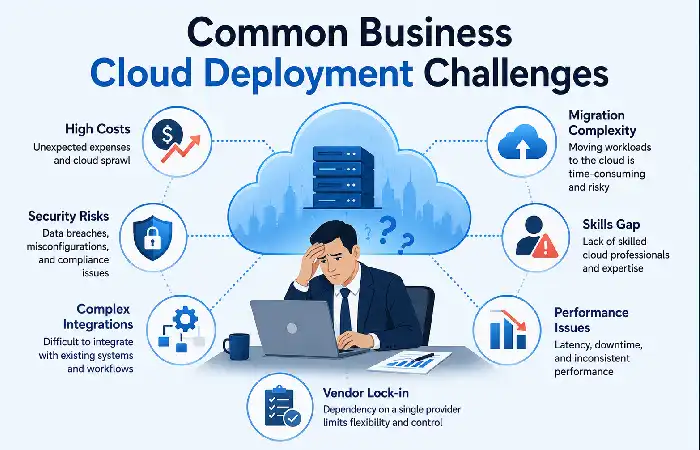
Cloud adoption can introduce challenges such as:
Unexpected costs: Additional mileage through inefficient use of resources, underutilized services, or excess replication, will add to your bill.
Security misconfiguration: out-of-date software, misconfigured security controls. Incorrect IAM permissions, exposed storage, or inappropriate network controls can lead to this problem.
Migration complexity: existing applications have to be redeveloped to use cloud services effectively.
Skills shortages: This is likely to be specific and the teams required could include subject matter experts in cloud architecture, security, DevOps, FinOps and automation.
Multi-environment sophistication: Modern hybrid and multi-cloud infrastructures demand uniform tracking, identity, and governance.
Vendor lock-in: A high reliance on provider services (e.g. proprietary, non-standard based services) may cause problems of migration at later date.
How to Choose the Right Deployment Model for Your Business
Pick a deployment model just because it‘s popular. Benchmark all critical workloads against business needs.
| Business requirement | Recommended starting point |
| Rapid growth and variable demand | Public cloud |
| Maximum infrastructure control | Private cloud |
| Existing on-premises infrastructure + cloud modernization | Hybrid cloud |
| Multiple providers have strategic advantages | Multi-cloud |
| Strict governance or specialized requirements | Private/Hybrid |
| Fast application development | Public cloud |
| Need to combine legacy and modern applications | Hybrid cloud |
FAQ: Cloud Deployment for Businesses
What is the most suitable cloud deployment model for a company?
We believe there is no ‘one size fits all’ best model. Public cloud is fine for most scalable workloads, whereas private and hybrid environments may be more appropriate for workloads that require additional control or governance.
Which is the better platform hybrid cloud or public cloud?
Not really. Hybrid cloud is applicable when an enterprise needs to link private infrastructure with public cloud infrastructure. If workloads do not require private infrastructure, then a fully public-cloud strategy may be easier.
Is multi-cloud safer?
Having several providers does not necessarily mean that an enterprise is more secure. Responsible for security are architecture, controls of identity, configuration, monitorization and governance.
How much does business cloud deployment cost?
The costs have distinct differences according to compute, storage, networking, applications, and data transfer, support and management. The overall cost of ownership must be estimated by the organizations rather than only compare it by advertised infrastructure cost.
What is the most significant mistake in cloud deployments?
Select a deployment model before understanding your workload. Assess security, compliance, performance, scalability and five-year cost before making a decision.
Final Takeaway
Cloud deployment for a business should be viewed ultimately as a business decision rather than purely an IT decision. Public cloud provides speed and elasticity. Private cloud provides control. Hybrid cloud offers elasticity and control, and multi cloud allows for provider diversity when there is a clear business reason for so.
Additional details from the 2026 markets confirm the high-priority decision that is the hybrid cloud: it is still the top trend worldwide; India will continue to see the highest growth in public-cloud expenditures; and cloud waste will continue as a serious cost-management issue.
Kashifa Jafar is a technology writer and contributor at FutureTechExpert with 4+ years of experience in technology writing and content creation.
Read Full Bio of Author →Sameena reviews selected health, wellness, technology, and digital content for clarity, factual presentation, and reader usefulness.
Read Full Bio of Reviewer →