
 Kashifa Jafar
Technology Writer & Contributor
Kashifa Jafar is a technology writer and contributor at FutureTechExpert with 4+ years of experience in technology writing and content creation.
Read Full Bio of Author →
Kashifa Jafar
Technology Writer & Contributor
Kashifa Jafar is a technology writer and contributor at FutureTechExpert with 4+ years of experience in technology writing and content creation.
Read Full Bio of Author →
 Sameena Begum
Health, Technology & Digital Content Reviewer
Sameena reviews selected health, wellness, technology, and digital content for clarity, factual presentation, and reader usefulness.
Read Full Bio of Reviewer →
Sameena Begum
Health, Technology & Digital Content Reviewer
Sameena reviews selected health, wellness, technology, and digital content for clarity, factual presentation, and reader usefulness.
Read Full Bio of Reviewer →
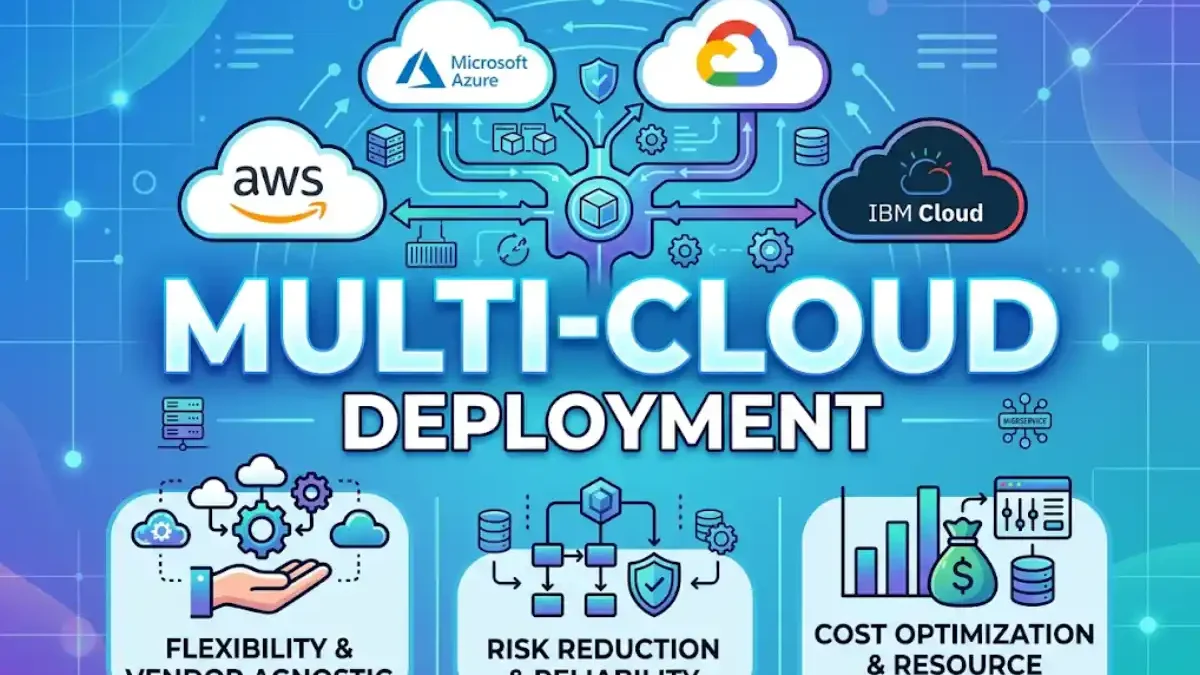
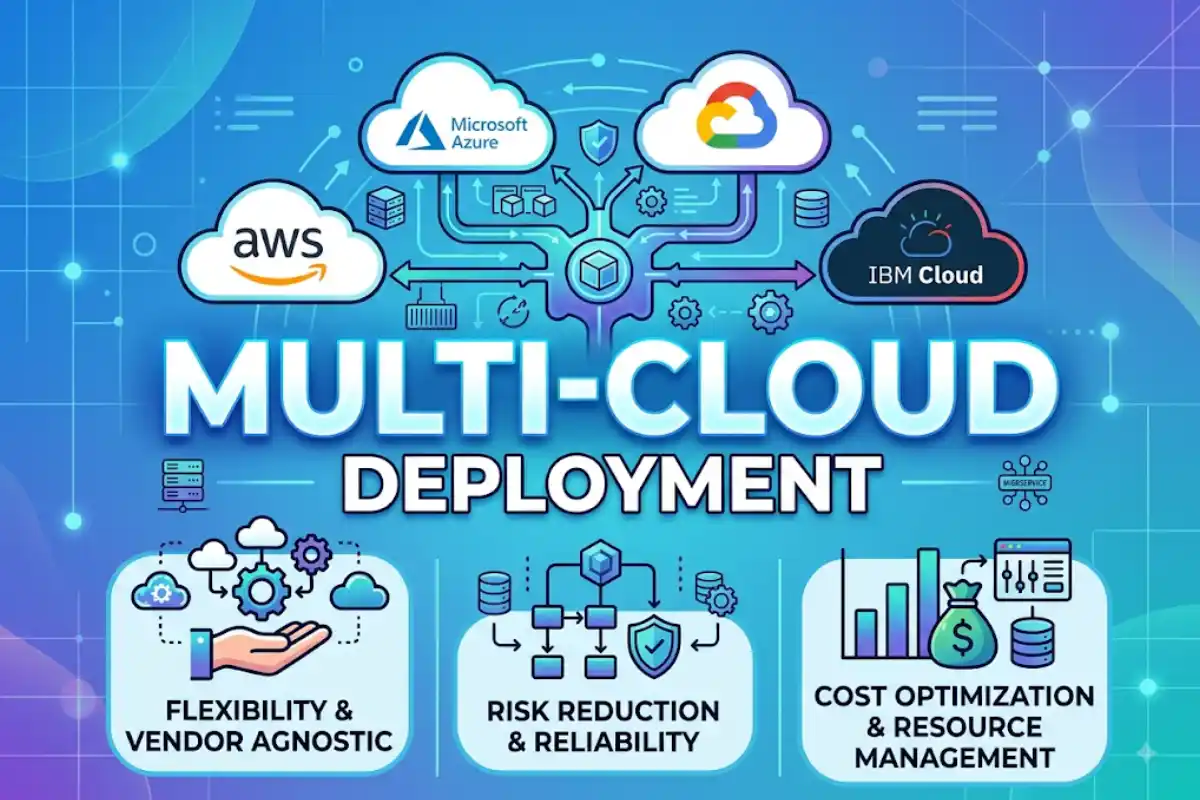
Multi-Cloud Deployment Multi-cloud deployment is thedistribution of applications, data, workload or cloud services across multiple providers (AWS, GCP, MS Azure, …). Multi-Cloud Deployment allows companies toeliminate vendor lock-in, enhance fault-tolerance, enforce data residency requirements, and run software on the most appropriate cloud.
In 2026, multi-cloud is becoming more complicates as businesses are deploying AI workloads and the costs of migrating to the cloud are higher. Multi-cloud adoption grown by 2% in 2026 over 2025 states the State of the Cloud Report published in 2026 by Flexira and 73% of the businesses are deploying hybrid cloud.
 This article is part of
Deployment Models Resources
Table of Contents
What Is Multi-Cloud Deployment?
Multi-cloud deployment. This involves using cloud providers other than one provider to deploy services.
For example, a company might:
- Run its customer application on AWS.
- Use Google Cloud for AI and machine learning.
- Use Azure for Microsoft-centric enterprise applications.
- Store backup data in another cloud.
- Use SaaS applications from several providers.
A multi-cloud may not mean all applications need to be deployed at the same time on all clouds. Several workloads could be deployed to different providers, depending on performance, price, regulation, location or technology.
Another more sophisticated cross-cloud model will have components, or extra instances of an application, spread over providers.
Before choosing a multi-cloud strategy, it is important to understand the different cloud deployment models and how each approach affects infrastructure, security, and scalability.
Multi-Cloud vs. Hybrid Cloud
Common confusion between the two. Although the terms are often confused, they mean different things:
| Feature | Multi-Cloud | Hybrid Cloud |
| Main idea | Multiple cloud providers | Combination of cloud and private/on-premises infrastructure |
| Public clouds | Usually two or more | At least one may be involved |
| Private cloud/on-premises | Not required | Commonly included |
| Primary benefit | Provider choice and workload flexibility | Integration and workload portability |
| Example | AWS + Azure + Google Cloud | Private cloud + AWS |
| Best for | Provider diversification | Organizations balancing legacy and cloud systems |
| Resource | Cloudflare Multicloud Explanation | TechTarget Hybrid vs. Multi-Cloud |
A company can also own both a hybrid and a multi-cloud environment for instance an on-premise environment using infrastructure attached to AWS and Azure.
Organizations that need flexible resources and rapid scalability can consider public cloud deployment as part of their overall cloud strategy.
Why Businesses Use Multi-Cloud Strategies
Multi-cloud adoption is not that of using more clouds for no reason. It‘s nearly always for a business/technical reason.
Common drivers include:
- Avoiding vendor lock-in
- Improving resilience
- Meeting data residency requirements
- Choosing specialized cloud services
- Improving application performance
- Supporting mergers and acquisitions
- Optimizing workload placement
- Supporting AI and high-performance workloads
As depicted in the 2026 Flexera report, mergers, siloed apps, SaaS proliferation and intentional workload placement are trends further defining multi-cloud in 2026.
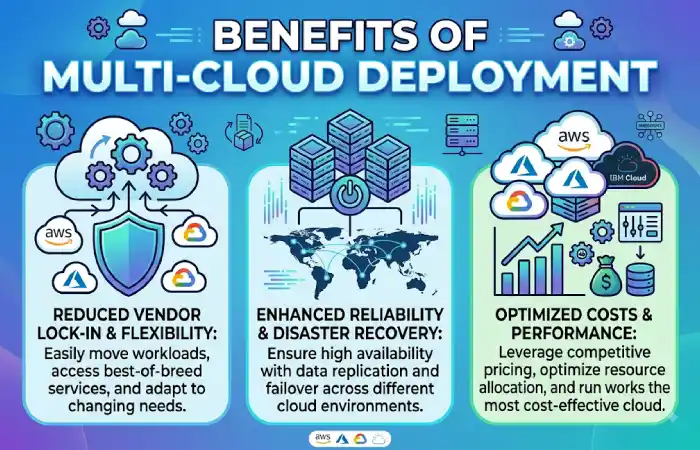
Benefits of Multi-Cloud Deployment
Greater flexibility
Organizations can pick the provider that perfectly fits each workload instead of trying to get every workload onto the same platform.
Reduced vendor dependency
In addition having multiple vendors may make it easier to shift workloads if pricing, quality of delivery, policy or business requirements change.
Improved resilience
One must agree that a multi-cloud architecture can be designed to ensure the degree of self sufficiency. Still, the mere existence of several accounts with different providers shall not define disaster recovery.
Better workload optimization
One might be good at AI features; another can be better at enterprise integration and yet another provide the infrastructure in some required geographical area.
Business continuity
Critical applications may be built with backup or duplicated infrastructure on different providers where the added complexity is acceptable.
Businesses with strict security, compliance, or data-control requirements may benefit from private cloud deployment alongside other cloud environments.
Challenges of Multi-Cloud Deployment
Multi-cloud offers the apparent advantage of flexibility, but in the process introduces yet another layer of operational intricacy.
| Challenge | Business Impact | Recommended Control | Resource |
| Multiple APIs | More development and integration work | Standardize through IaC/APIs | AWS Terraform & Kubernetes comparison |
| Security differences | Inconsistent policies | Central IAM and security policies | Okta Multi-Cloud Security Analysis |
| Cost visibility | Difficult consolidated billing | FinOps and unit economics | Flexera 2026 State of the Cloud |
| Network complexity | Latency and connectivity problems | Centralized networking/observability | F5 Multi-Cloud Challenges |
| Skills shortage | Higher operational overhead | Cross-cloud training and automation | Cloudflare Multi-Cloud Management |
The greatest error is presuming that multi-cloud inherently reduces expenses. Transferring data, duplicating utilities, underutilized Infrastructure, and the expense of employing operations can all actually make the total invoice higher.
Multi-Cloud Security and Access Management
Security should be implemented for the whole environment, not in isolation for each cloud.
A strong multi-cloud security strategy should include:
- Single sign-on (SSO)
- Multi-factor authentication (MFA)
- Role-based access control
- Least-privilege permissions
- Centralized identity governance
- Encryption at rest and in transit
- Consistent security policies
- Centralized logging
- Continuous configuration monitoring
- Automated compliance checks
Between the cloud providers, each has its own IAM model and permissions system. Using a single identity strategy minimizes this inconsistency.
A hybrid cloud deployment can connect private infrastructure with public cloud resources, giving organizations greater flexibility over where workloads run.
Multi-Cloud Cost Management
Cost management across multiple clouds involves something beyond just comparing the prices of providers.
Track:
- Compute utilization
- Storage consumption
- Network egress
- Managed-service charges
- Reserved or committed capacity
- Idle resources
- Licensing
- Backup costs
- Monitoring and security tools
According to 2026 research by Flexera, 85% of organizations felt that managing cloud spend was a major challenge and wasted cloud spend was 29%. It also reported that 49% of organizations measure cloud costs through unit economics.
Multi-Cloud Monitoring and Management
Multi-cloud management with, multiple dashboards, can provide visibility gaps.
A mature approach should centralize:
- Infrastructure monitoring
- Application performance monitoring
- Security events
- Logs
- Network telemetry
- Cost data
- Compliance reporting
- Availability alerts
Kubernetes, CI/CD and infrastructure as code, cloud management and observability platforms, and converged identity platforms can enable consistent operational workflows. For example, Google Cloud describes multi-cloud management of Kubernetes on AWS and Azure through a single management model.
Organizations with similar regulatory or operational requirements can also explore community cloud deployment to share infrastructure and resources.
Common Multi-Cloud Use Cases
AI and machine learning
Cloud providers can be chosen according to GPU availability, AI offerings, data positioning, and economics of workload.
Disaster recovery
A secondary provider may be used as one component of a comprehensive business continuity plan.
Data sovereignty
Similarly, an organization with a multinational business may require work or information located in a certain geographical area.
Application modernization
Different applications may well find that they migrate to different vendors, based on their technical criteria.
Mergers and acquisitions
Companies that are acquiring other businesses might find that some of the workloads they are bringing in are hosted on a separate cloud.
Global applications
Organizations have the option of using a combination of cloud regions and providers in order to cover more geographic locations and enhance performance.
For companies evaluating multiple cloud environments, cloud deployment for businesses can provide useful guidance on choosing an approach based on cost, workload, security, and scalability.
How to Build a Multi-Cloud Strategy
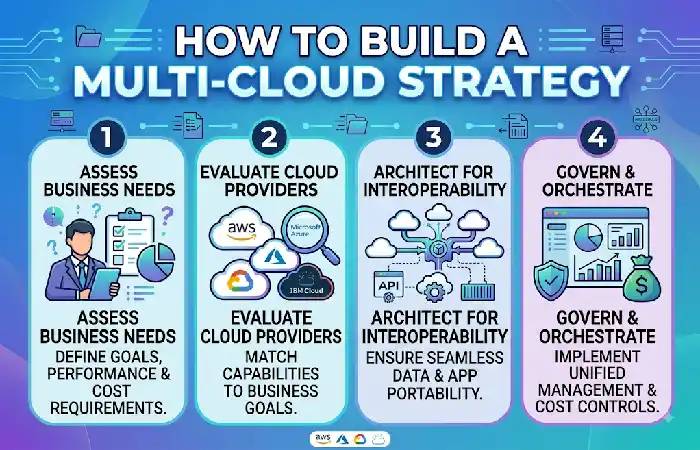
The following point is very key and is the primary focus of the author, a good deployment would be based on business requirements not cloud providers.
Step 1: Define the objective.
Decide whether the objective is resilience, cost savings, compliance, performance, AI, or lock-in avoidance.
Step 2: Inventory workloads.
Capture the application, database, dependencies, data location, performance requirements, and recovery objectives.
Step 3: Select the right cloud for each workload.
Balanced capabilities, regions, pricing, compliances, networking, AI services and operations.
Step 4: Standardize deployment.
Apply Infrastructure as Code and define Reusable CI/CD workflows while possible.
Step 5: Build identity and security controls.
Define centralized authentication, least privilege, encryption, logging, and policy enforcement.
Step 6: Establish FinOps.
Track the cost by application, by team, by environment, by business impact.
Step 7: Implement observability.
Ensure all levels of the monitor infrastructure, applications, security, networking, and cost from a single operating model.
Step 8: Start small.
According to Google, start with a non-mission critical workload to “allow your teams to develop a repeatable deployment pattern before expanding to the rest of your applications.
Frequently Asked Questions
Is multi–cloud better than single–cloud?
Not in an instant. Multi-cloud can be valuable if the advantages of provider diversification, resilience, advanced services, lower compliance risk or workload optimization outweigh the additional complexity.
Multi-cloud: more costly?
It can be. You need to consider egress, replicated services, tooling, skills, monitoring and operational overhead. FinOps is critical.
Can I run in multi clouds with Kubernetes?
Yes. Kubernetes can offer a common application orchestration layer across the supported platforms, though it doesn‘t reduce differences between provider-specific networking, storage, security, and operational practices.
Who goes multi-cloud?
Multi-cloud is likely to be especially advantageous to organizations that have particularly high requirements for resilience, geographical deployment, regulator coverage, workload specialization or vendor flexibility.
Final Takeaway
Multi-Cloud Deployment offers more flexibility, higher resiliency, more choices of providers, and access to cloud-specific features. However, multi-cloud usage introduces added complexity in security, networking, monitoring, skills and cost management.
The strongest 2026 strategy is therefore not “use multiple clouds.” It is “use each cloud deliberately, standardize what can be standardized, centralize governance, automate deployment and measure business value continually”.
For organizations designing a modern cloud architecture, multi-cloud is a methodology that works best if you treat it as a long term operating model as opposed to solely a technology decision.
Kashifa Jafar is a technology writer and contributor at FutureTechExpert with 4+ years of experience in technology writing and content creation.
Read Full Bio of Author →Sameena reviews selected health, wellness, technology, and digital content for clarity, factual presentation, and reader usefulness.
Read Full Bio of Reviewer →