
 Kashifa Jafar
Technology Writer & Contributor
Kashifa Jafar is a technology writer and contributor at FutureTechExpert with 4+ years of experience in technology writing and content creation.
Read Full Bio of Author →
Kashifa Jafar
Technology Writer & Contributor
Kashifa Jafar is a technology writer and contributor at FutureTechExpert with 4+ years of experience in technology writing and content creation.
Read Full Bio of Author →
 Sameena Begum
Health, Technology & Digital Content Reviewer
Sameena reviews selected health, wellness, technology, and digital content for clarity, factual presentation, and reader usefulness.
Read Full Bio of Reviewer →
Sameena Begum
Health, Technology & Digital Content Reviewer
Sameena reviews selected health, wellness, technology, and digital content for clarity, factual presentation, and reader usefulness.
Read Full Bio of Reviewer →
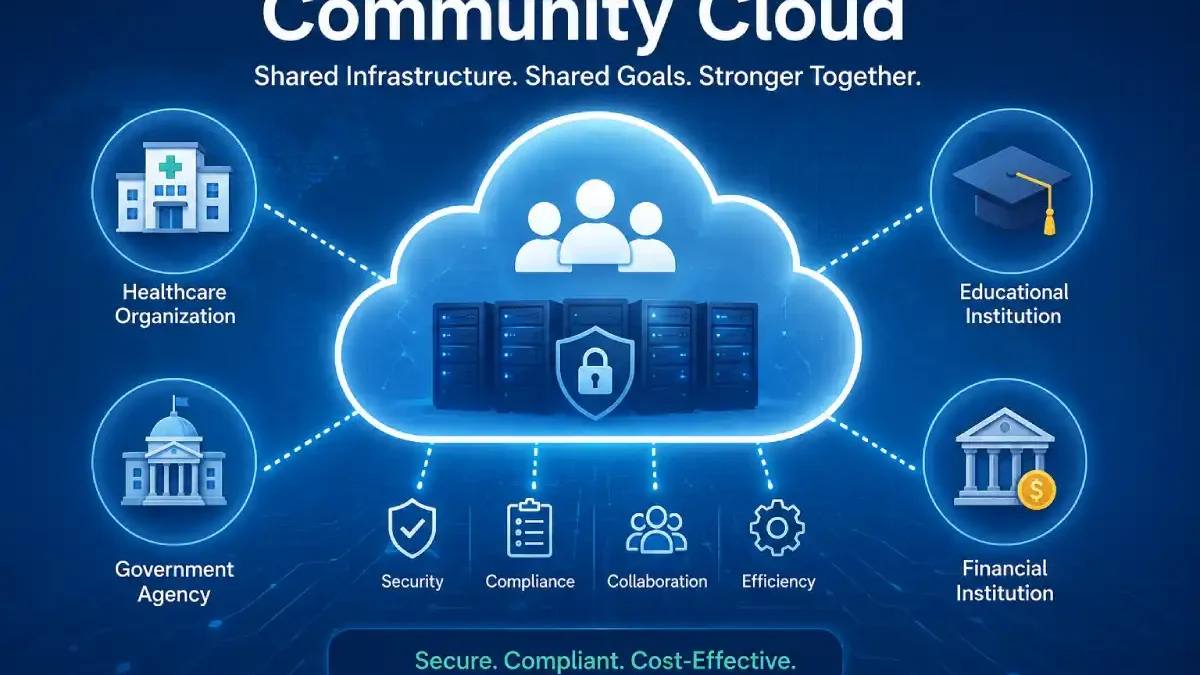
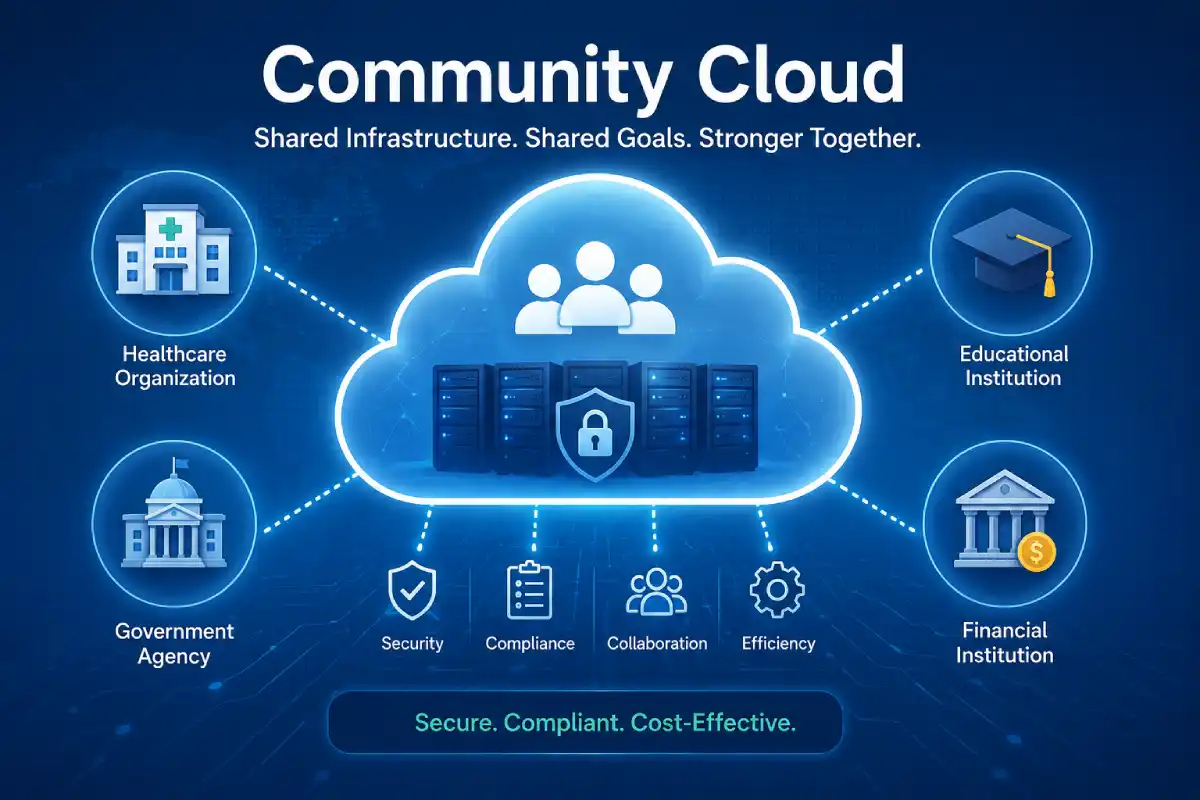
Community Cloud is a Cloud framework established for a shared environment among several different organizations with common interests such as business goals, security, policies, and compliance. Rather than exposing infrastructure for public use or dedicating an entire cloud for an organization, a Community Cloud establishes a shared environment within the group.
Has applications in sectors such as health care, government, financial services, education and research where organizations seeking to collaborate do so under the right security and governance controls.
NIST: A community cloud is one that is provisioned for exclusive use by a specific community of organizations that have shared concerns (e.g., mission, security requirements, policy, and compliance considerations).
 This article is part of
Deployment Models Resources
Table of Contents
What Is Community Cloud?
A community cloud is a multi-tenant cloud infrastructure specifically designed to serve a number of organizations that have shared concerns.
For instance, multiple organizations within a healthcare industry sector could share a cloud system built to support all healthcare security, privacy and compliance needs. Similarly, multiple government agencies with comparable security policies could use the same infrastructure but have different access policies and workload management.
The infrastructure could be operated or maintained by an entity (owner or administrator) that is one organization, several members of the community, or a third-party provider. It could be on-premises or off-premises.
This is where community cloud gets its advantage, it is the bridging between public cloud and private cloud.
Before choosing a community cloud, it is important to understand how different cloud deployment models differ in terms of ownership, accessibility, security, and resource management.
How Community Cloud Works
A community cloud generally works through four layers:
- Shared infrastructure – participating organizations use common computing, storage and networking resources.
- Identity and access management – each organization receives controlled access to the resources it is authorized to use.
- Data isolation – logical separation helps prevent one member from accessing another member’s restricted information.
- Centralized governance – community-wide policies define security, compliance, access, monitoring and resource usage.
The hardware architecture varies and depends on the subscribing agencies and provider.
Key Features of Community Cloud
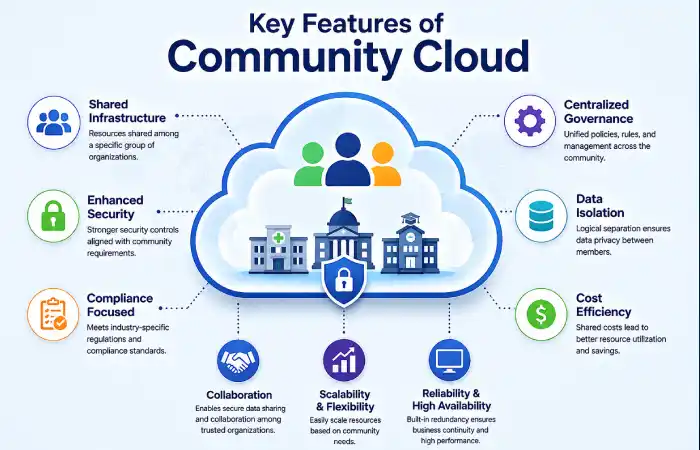
Important community cloud features include:
- Shared infrastructure for a defined group
- Industry-specific security controls
- Role-based access control
- Centralized governance
- Data segregation
- Auditing and monitoring
- Compliance-focused policies
- Shared operational costs
- Integration between participating organizations
- Customizable security requirements
One of four cloud deployment models that according to Cloud Computing Framework is classified by NIST is a community cloud.
Organizations that need broad scalability and shared infrastructure may prefer public cloud deployment, which provides cloud resources through third-party providers.
Benefits of Community Cloud
- Shared Costs
Organizations can share the expense of infrastructure and operations between multiple members. This can result in more cost-effective specialized infrastructure than would be created for a dedicated private cloud.
- Better Collaboration
A PTC in a common environment facilitates sharing approved data, applications and services among participating organizations.
- Industry-Specific Controls
Perhaps more than anything else, the design of a community cloud can be based on security and compliance issues that are common to its members.
- Greater Control Than Public Cloud
But how can an organization provide community-wide same identity, same data access, monitoring and governance?
- Resource Optimization
It has in some cases been argued, that shared infrastructure can lead to reduced duplication. Rather than each organization having similar systems in their own right, members may in some cases be able to share certain infrastructure and services.
Businesses with strict security, compliance, or customization requirements may instead consider private cloud deployment for greater control over their infrastructure.
2026 Cloud Trend Snapshot
Community cloud can also be seen in the context of the general move to governed clouds.
| 2026 Cloud Indicator | Finding | Why It Matters | Resource |
| Organizations using hybrid cloud | 73% | Cloud environments increasingly require coordinated governance | Flexera 2026 State of the Cloud Report |
| Organizations with a Cloud Center of Excellence | 71% | Centralized governance is becoming more common | Flexera 2026 Report |
| Organizations with established FinOps teams | 63% | Cloud management is becoming more structured | Flexera 2026 Cloud Report |
| Organizations reporting cloud-spend management as a challenge | 85% | Shared environments still require strong financial governance | Flexera 2026 Findings |
According to research carried out by a very well-known software company, (Flexera) 753 cloud decision makers and users across the world in 2026.
Challenges of Community Cloud
Community cloud is not requires to be lower priced, more secure or simple.
The main challenges include:
- Governance complexity: multiple organizations must agree on policies and responsibilities.
- Security coordination: members must maintain consistent access and security practices.
- Limited control: individual participants may have less control than they would in a dedicated private cloud.
- Resource contention: shared infrastructure can create performance concerns if capacity is poorly managed.
- Compliance differences: organizations may have different regulatory obligations.
- Exit and migration: contracts should clearly define how data and workloads are transferred when a member leaves.
These positive limitations have been found across the established cloud-computing framework and industry analysis.
A hybrid cloud deployment can be useful when an organization wants to combine dedicated infrastructure with the scalability and flexibility of public cloud resources.
Community Cloud Security
Security is not something that can be bolted on to an environment, it should be integrated into the environment from the beginning.
A strong community cloud security strategy should include:
- Multi-factor authentication
- Role-based access control
- Encryption in transit and at rest
- Network segmentation
- Centralized logging
- Security monitoring
- Vulnerability management
- Regular access reviews
- Backup and disaster recovery
- Incident-response procedures
Each organization needs to be able to identify the ownership of their own workloads and information.
Click the ‘Apply additional security coverage’ link at the bottom of this page. Consider linking within this area (hyperlink). If the correct URL is available, then link this to your Endpoint Security Services article.
Organizations that use services from multiple cloud providers can explore multi-cloud deployment to distribute workloads and reduce dependence on a single provider.
Data Sharing in Community Cloud
The biggest benefit of community cloud is sharing of data with control.
Of course, establishing shared infrastructure does not necessarily mean an automatic right of access to all datasets for every participant.
The more viable solution is to categorize different information and provides access on business relevance. For the time being, sensitive records need apply for detailed access control, encryption and auditing.
For example:
Organization A → Approved Dataset → Shared Platform → Authorized Organization B
Allows one to collaborate without crossing the boundaries of one‘s data.
Community Cloud Governance and Compliance
Governance establishes who has access to resources, who operates the infrastructure, how are costs distributed and what happens during failures.
A practical governance framework should document:
- Ownership
- Roles and responsibilities
- Security standards
- Data classification
- Compliance requirements
- Service-level agreements
- Cost allocation
- Incident response
- Audit requirements
- Member onboarding and offboarding
The community cloud deployment model is defined by the NIST, and as cloud management literature evolves, a significant approach becomes the emphasis on centralized management of increasingly complex cloud infrastructure.
Companies evaluating community cloud solutions should also understand how cloud deployment for businesses can support scalability, collaboration, security, and operational efficiency.
Common Community Cloud Use Cases
The community cloud is ideal where a number of organizations having similar requirements are sharing the same cloud environment.
Healthcare
Hospitals, clinics, laboratories and health care partners will be able to share warranted technologies infrastructure built around privacy and security needs.
Government
Government agencies can work together utilizing a framework built on shared security, policy and regulatory demands.
Financial Services
Banks, financial institutions can leverage shared environments where participants have similar security and compliance demands.
Education and Research
Universities and research institutes might join forces to develop shared computing, storage and research workloads.
Emergency and Public Services
Shared infrastructure and information exchange can be a advantage for responding organizations to disasters or public emergencies.
When to Choose a Community Cloud
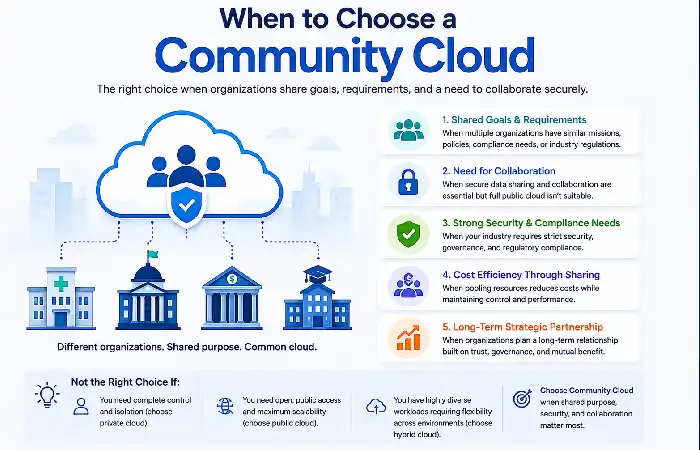
Community cloud might be used in such situation when separate organizations genuinely share certain common needs and aspired to work together.
Choose it when you need:
- Shared infrastructure
- Strong governance
- Controlled data sharing
- Industry-specific compliance
- Collaboration between organizations
- More control than a typical public-cloud arrangement
If a single organization requires the highest level of control a private cloud may be appropriate. If large scale growth is important and less operational complexity is sought then a public cloud may be more suitable. For transitioning workloads from one environment to another, a hybrid cloud is most appropriate.
Frequently Asked Questions
Public or private community cloud?
Neither. It is a distinct cloud deployment model tailored for an entire community of similar organizations with similar needs.
As an example of what a community cloud is, to what extent is it used?
This is an example where you have one set of government agencies collaborating on an infrastructure based on common security needs and compliance issues.
Is the community cloud providing greater security than the public cloud?
It can deliver more specific security and governance but security depends on architecture, configuration, identity controls, monitoring and governance. It is not automatically ‘more secure’ just because it‘s a community cloud.
Who will be running the community cloud?
May remain administered by either one or more of the player‘s participating organizations, a third party provider, or some combination thereof.
What are community cloud and hybrid cloud?
Community cloud remain about who the cloud is built for and what remain the common requirements of its users. Hybrid cloud remain a mixture of different cloud infrastructures interconnected in some way to allow portability or interoperability.
Final Takeaway
Community cloud can remain defined as shared and controlled cloud environment that is suitable for organizations that have shared concerns (such as mission, security or compliance considerations). The community cloud is the most attractive to users as it provides a unique feature of blending operating in a shared cloud that is allowing collaboration amidst a greater control compared to a generic one, public-cloud.
By 2026 the larger cloud market is heading to a place of centralized governance, measurable value and increased control, this is why community clouds are extremely pertinent to industries where companies must work together in conjunction with preserving security and compliance standards.
Kashifa Jafar is a technology writer and contributor at FutureTechExpert with 4+ years of experience in technology writing and content creation.
Read Full Bio of Author →Sameena reviews selected health, wellness, technology, and digital content for clarity, factual presentation, and reader usefulness.
Read Full Bio of Reviewer →