
 Kashifa Jafar
Technology Writer & Contributor
Kashifa Jafar is a technology writer and contributor at FutureTechExpert with 4+ years of experience in technology writing and content creation.
Read Full Bio of Author →
Kashifa Jafar
Technology Writer & Contributor
Kashifa Jafar is a technology writer and contributor at FutureTechExpert with 4+ years of experience in technology writing and content creation.
Read Full Bio of Author →
 Sameena Begum
Health, Technology & Digital Content Reviewer
Sameena reviews selected health, wellness, technology, and digital content for clarity, factual presentation, and reader usefulness.
Read Full Bio of Reviewer →
Sameena Begum
Health, Technology & Digital Content Reviewer
Sameena reviews selected health, wellness, technology, and digital content for clarity, factual presentation, and reader usefulness.
Read Full Bio of Reviewer →
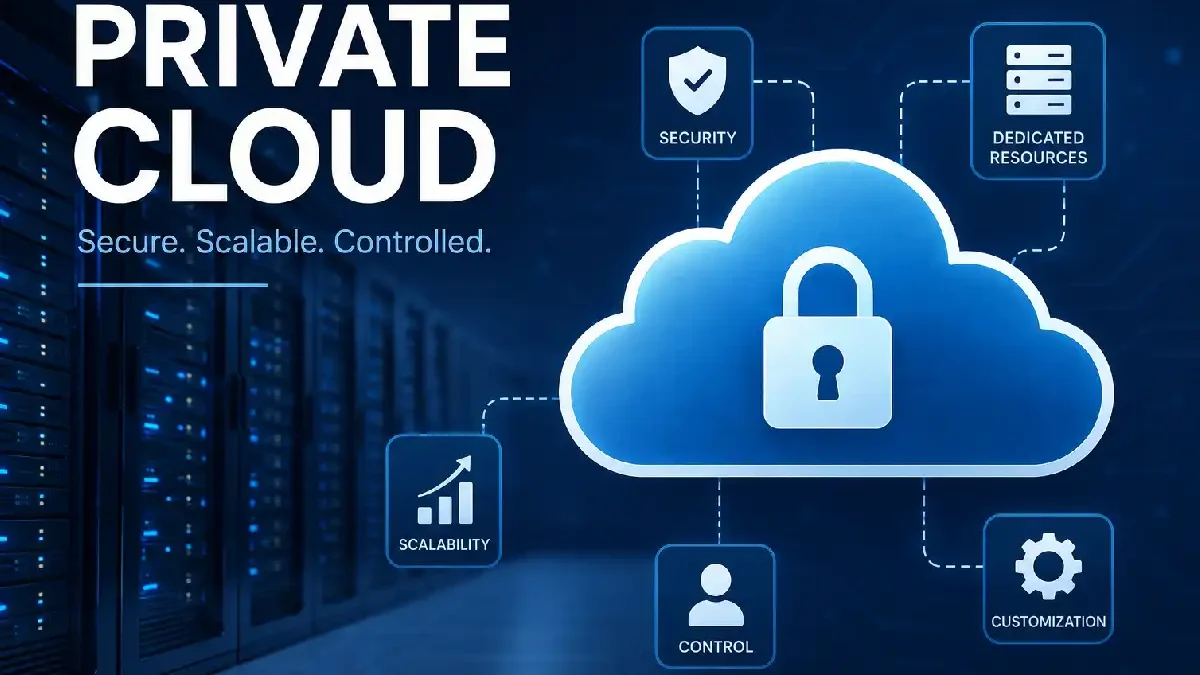
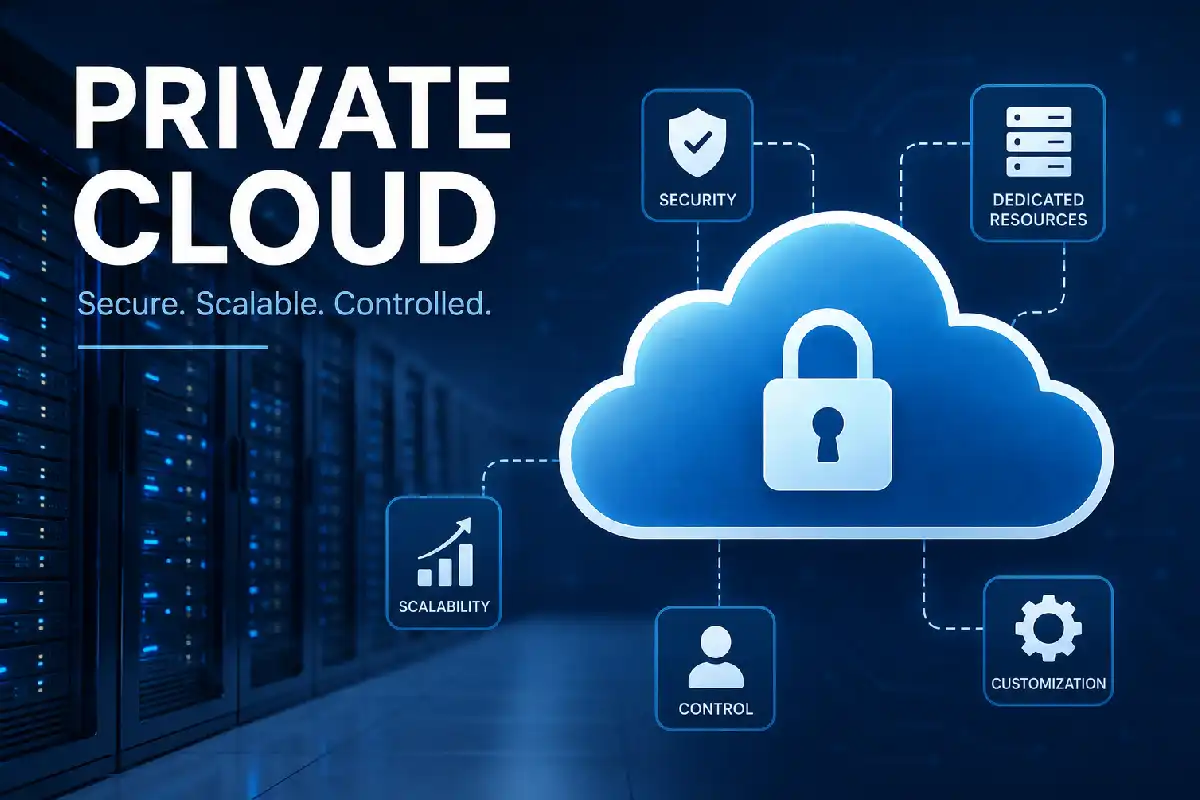
A private cloud is a proprietary cloud architecture in which the services and infrastructure are maintained on a private network. This ensures that the private cloud computing environment can be accessed solely by the enterprise maintaining it, hence gaining more control of the infrastructure and application data, security and customized applications, although still having the advantages of a cloud of on-demand, automated, scalable and self-service infrastructure.
It is different from a public cloud as it does not have multiple tenants sharing the infrastructure, but the infrastructure is utilized by one single customer. Private clouds can be hosted in an organizations data center, vendor‘s data center or a third-party data center.
Of course, for companies dealing with sensitive information, under tighter regulation or running more unique workloads, it offers a compromise between cloud agility and infrastructure control.
 This article is part of
Deployment Models Resources
Table of Contents
What Is Private Cloud?
It is a single-tenant cloud environment built for an individual organization. Resources for compute, storage, networking and management are isolated from other customers.
It can be deployed in several ways:
- Managed private cloud: A provider manages some or all of the private-cloud environment.
- Virtual private cloud: A logically isolated environment is created within public-cloud infrastructure.
The key point is that a private cloud is not the location of the servers, but that there is a dedicated and isolated environment.
A private cloud is one of several cloud deployment models organizations can choose from, with each model offering different levels of control, scalability, security, and resource sharing.
How Private Cloud Works
It is a thin layer of abstraction which uses virtualization, cloud management software, networking, storage, security and automation on top of physical infrastructure.
A simplified private-cloud workflow looks like this:
Physical servers → Virtualization/container layer → Resource pools → Cloud management → Self-service portal → Applications and users
Virtualization applies abstraction to the physical computing resources and pools them together so that CPU, Memory, Storage and Networking can remain flexibly allocated and reallocated. All this remain controlled by a management software, and automated by automation framework.
The focus is also on enabling virtual infrastructure to support on demand provisioning by IT, rather than by having to manually configure every appliance.
Unlike a public cloud, where infrastructure is shared among multiple customers, private cloud resources are dedicated to a single organization.
Key Features of Private Cloud
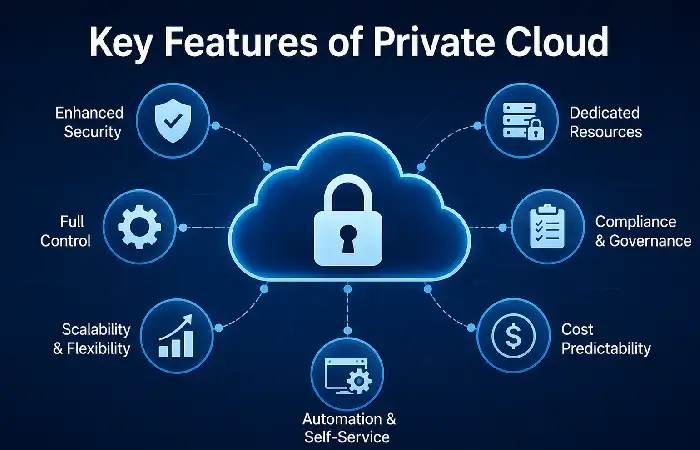
| Feature | What it means | Why it matters |
| Single tenancy | Resources are dedicated to one organization | Improves isolation and control |
| Virtualization | Physical resources become flexible resource pools | Improves utilization |
| Self-service | Users can request resources through a portal | Speeds provisioning |
| Automation | Repetitive IT tasks can be automated | Reduces manual work |
| Centralized management | Infrastructure can be monitored from management tools | Simplifies administration |
| Custom security | Policies can be tailored to organizational requirements | Supports sensitive workloads |
| Scalability | Resources can be increased when capacity is available | Helps handle changing workloads |
These features give organizations the ability to build a cloud-like operations model while retaining a lot more control of the underlying infrastructure.
Benefits of Private Cloud
The primary benefit of private cloud is control. Organizations can define the infrastructure, security policies, configuration of software and management of data.
Other benefits include:
Better control and customization
It environment can remain designed to suit the individual demands of the specific business and its applications. according to IBM, “users maintain the flexible control of hardware and software, but tailor the environment to match the type of work they will remain doing”.
Stronger isolation
Due to the individual allocation of resources a private cloud can offer more effective isolation than a common multi tenancy public-cloud environment.
However, it is not inherently secure. Lack of good identity management, unpatched systems, weak network controls or misconfiguration can just as easily result in a security risk.
Compliance support
Regulated sector organizations might also require a stronger grip on data location, access and system configuration. It can facilitate the enforcement of compliance controls tailored to organization.
Resource efficiency
Virtualization and automation provides the means to share out physical resources on demand, rather than dedicating each physical server to individual applications.
Predictable infrastructure
For more predictable workloads, the dedicated infrastructure offers better visibility into capacity, performance, and the configuration of the infrastructure.
Organizations that need dedicated infrastructure for sensitive workloads while taking advantage of public-cloud scalability can consider a hybrid cloud strategy.
Challenges of Private Cloud
It might not be the solution for every company.
| Challenge | What to consider |
| Higher upfront investment | Hardware, software, networking, and facilities can require significant capital |
| Management complexity | Skilled infrastructure and cloud engineers may be required |
| Capacity planning | Physical capacity must be planned before demand exceeds available resources |
| Maintenance | Hardware, software, security, and updates require ongoing attention |
| Scalability limits | Expansion may require purchasing additional infrastructure |
| Operational responsibility | The organization may be responsible for availability and disaster recovery |
From the cost perspective, IBM point out the importance of considering limitations that occur with the system, such as the costs and the lack of flexibility especially when the organization remain required to buy and support the extra infrastructure.
A managed private cloud has the potential for easing some of these operational responsibilities as the infrastructure remain being managed by a third-party provider.
Organizations with similar regulatory, security, or operational requirements may also consider a community cloud as an alternative deployment approach.
Private Cloud Security
Given a private cloud, this should not remain protected by isolation but rather by multi-layers.
Important controls include:
- Identity and access management
- Multi-factor authentication
- Network segmentation
- Firewalls
- Encryption
- Secure APIs
- Vulnerability management
- Patch management
- Backup and disaster recovery
- Security monitoring and logging
- Least-privilege access
In particular, IBM emphasizes technologies including firewall, virtual private network, encryption, and API key, as security controls available to private-cloud services.
A useful security model is:
Identity → Network → Workload → Data → Monitoring
Security ought to remain implemented at each layer.
Private Cloud Infrastructure and Management
A typical private-cloud infrastructure includes:
- Compute: Physical servers, virtual machines, containers, or specialized accelerators.
- Storage: Block, file, and object storage.
- Networking: Switches, routers, software-defined networks, firewalls, and load balancing.
- Virtualization: Software that abstracts physical hardware.
- Cloud management: Platforms used to provision and manage resources.
- Automation: Tools that automate deployment and operational processes.
- Monitoring: Systems that track performance, capacity, availability, and security.
OpenStack is one example of technology that can remain used to build private-cloud infrastructure. Red Hat describes private clouds as combinations of infrastructure, virtualization, management, and automation technologies.
For organizations looking beyond a single provider, multi-cloud deployment can distribute workloads across multiple cloud platforms and provide greater flexibility.
Private Cloud Scalability
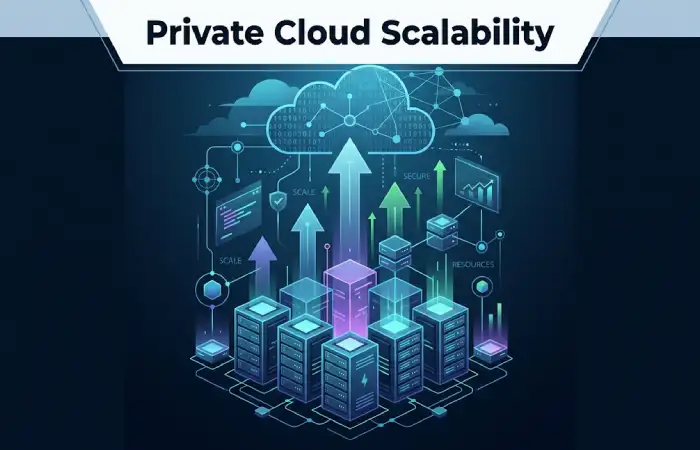
It is scalable, only the way it scales is different from the public cloud.
In public cloud, additional capacity is usually available from a provider’s large pool of infrastructure, whereas in private cloud, the available capacity is whatever infrastructure you have or whatever capacity remain included in your private-cloud service.
For example:
Initial capacity → Increased workload → Resource optimization → Additional servers/storage → Expanded capacity
Is why capacity planning is so critical.
It can handle elastic workloads by virtualization, automation, containers, and resource pooling. Besides, Kubernetesis an example that can also offer agility and adaptable resource provisioning.
Common Private Cloud Use Cases
Private cloud makes most sense when an organization requires a mix of control, security, customization and cloud-like operation.
Common use cases include:
- Financial and banking workloads
- Healthcare applications
- Government systems
- Sensitive corporate data
- Regulated workloads
- Enterprise application modernization
- AI and machine-learning workloads
- Research environments
- Data sovereignty requirements
- Hybrid-cloud architectures
- Mission-critical applications
Also, the use cases of they are specified by IBM which include application modernization, hybrid multicloud, edge computing and AI-based security.
Understanding cloud deployment for businesses can help organizations compare infrastructure options based on security, workload requirements, budget, compliance, and long-term scalability.
How to Choose a Private Cloud Deployment
The optimal deployment model remain determined by the level of control requirement from your organization and the amount of infrastructure to remain managed by you.
| Deployment | Best for | Control | Management responsibility | Resource |
| On-premises private cloud | Maximum infrastructure control | High | High | — |
| Hosted private cloud | Dedicated infrastructure without owning the facility | High | Medium | IBM Private Cloud Storage |
| Managed private cloud | Organizations wanting provider expertise | Medium–High | Lower | — |
| Virtual private cloud | Isolation with public-cloud flexibility | Medium | Lower | — |
Before choosing, evaluate:
- Data requirements: Does the workload contain sensitive or regulated information?
- Compliance: Are there data residency, retention, auditing, or access-control requirements?
- Workload profile: Is the workload stable, highly variable, AI-intensive, or latency-sensitive?
- IT skills: Does your team have the expertise to operate the environment?
- Budget: Can the organization support infrastructure and ongoing operating costs?
- Scalability: How quickly will capacity need to grow?
- Hybrid requirements: Will applications eventually need to connect with public-cloud services?
Troubleshooting: Common Problems
Slow application performance
Such as this hybrid approach mixes private infrastructure (for sensitive workloads) and public-cloud resources (for workloads that require even more elasticity).
Resources cannot be provisioned
It is important to check CPU, Memory, Storage Latencies, N/W utilization, contention for resources before scaling.
Unexpected security alerts
Analyze review identity activity; all network traffic; endpoint configuration, logs and recent config changes.
Capacity is running low
Analyze historical demand and project future need. Decommisone unused capacity prior to investing in new infrastructure.
Backups are failing
Verify storage capacity, backup policy, connectivity, permissions, retention policy, recovery point objective.
Frequently Asked Questions
Are private cloud and on-premises infrastructure one and the same?
No. An existing on-premies infrastructure remain not considered a private cloud. This remain distinguished by the fact that they embody various characteristics of the cloud paradigm.
Is private cloud more secure than public cloud?
While it offers more isolation and control, it doesn‘t guarantee security. If it isn‘t set up correctly, then its security issues will make it as vulnerable as any public cloud.
Is a private cloud costly?
It can be. When organizations run a private cloud they might need to pay for hardware, software, facilities, maintenance, security, and skilled staff. In a managed model some of these activities can remain shared.
What remains the difference between private cloud and the virtual private cloud?
It is essentially a private cloud for single organization. A virtual private cloud (or VPC) operates on the same sort of shared public-cloud platform but remain logically isolated from other virtual private clouds. For example, Amazon Cloud describes its VPC offering as a “logically isolated virtual network for your resources.”
Would private cloud still matter in 2026?
Yes. In fact, current enterprise conversations pair private cloud with AI, security, data sovereignty, workload repatriation, and hybrid-cloud in a manner that makes for a compelling it story.
Final Takeaway
Private cloud provides utility-like services with the dedicated infrastructure, higher level of control and greater flexibility for customization. It can remain useful especially for heavily regulated industry, sensitive workloads and enterprise applications, AI infrastructure, organizations with special data-sovereignty demands.
Kashifa Jafar is a technology writer and contributor at FutureTechExpert with 4+ years of experience in technology writing and content creation.
Read Full Bio of Author →Sameena reviews selected health, wellness, technology, and digital content for clarity, factual presentation, and reader usefulness.
Read Full Bio of Reviewer →