
 Kashifa Jafar
Technology Writer & Contributor
Kashifa Jafar is a technology writer and contributor at FutureTechExpert with 4+ years of experience in technology writing and content creation.
Read Full Bio of Author →
Kashifa Jafar
Technology Writer & Contributor
Kashifa Jafar is a technology writer and contributor at FutureTechExpert with 4+ years of experience in technology writing and content creation.
Read Full Bio of Author →
 Sameena Begum
Health, Technology & Digital Content Reviewer
Sameena reviews selected health, wellness, technology, and digital content for clarity, factual presentation, and reader usefulness.
Read Full Bio of Reviewer →
Sameena Begum
Health, Technology & Digital Content Reviewer
Sameena reviews selected health, wellness, technology, and digital content for clarity, factual presentation, and reader usefulness.
Read Full Bio of Reviewer →
FaaS (Function as a Service) is one of the fastest-growing cloud computing models for 2026. With the growing adoption of serverless among many organizations, FaaS provides a model to developers to deploy and run code without managing the servers, OS, scaling hardware and the environment.
Rather than having specific servers for the tasks required, developers can simply upload the required functions which run in response to an event. This system is far easier to manage, more scalable, and more cost effective in terms of infrastructure.
In current industry predictions the FaaS market worldwide continues to experience a 2-digit yearly growth due to organizations’ modernization of application suites and adoption of cloud native architectures.
 This article is part of
Service Models Resources
Table of Contents
What Is Function as a Service?
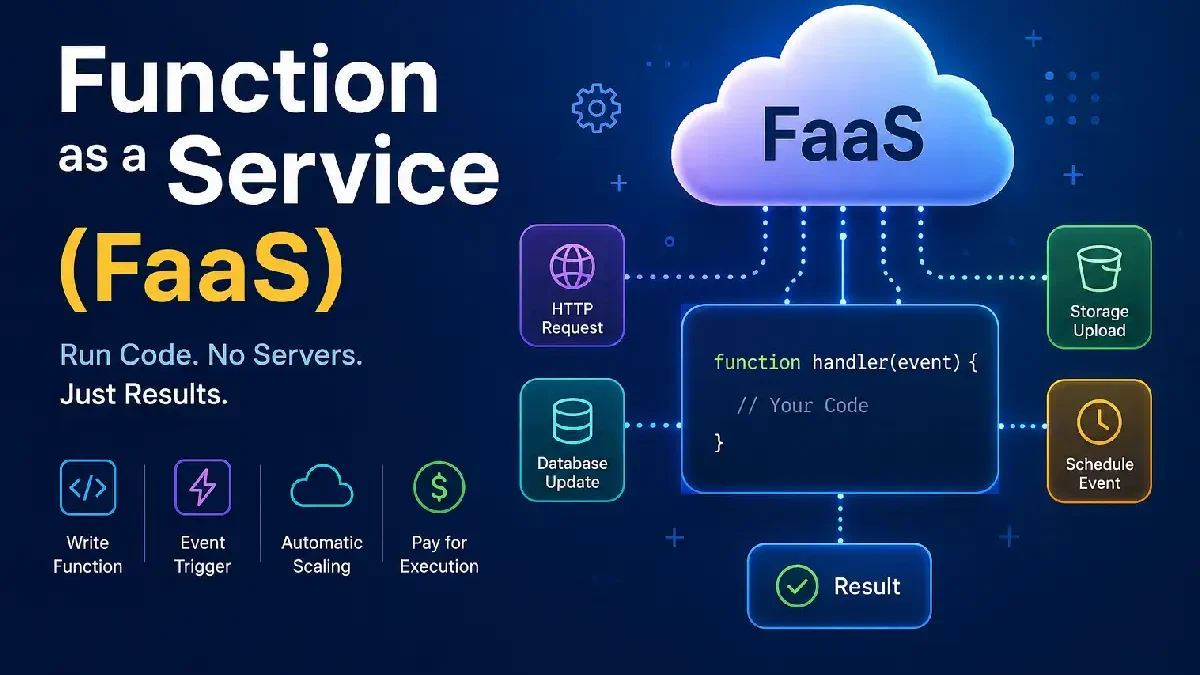
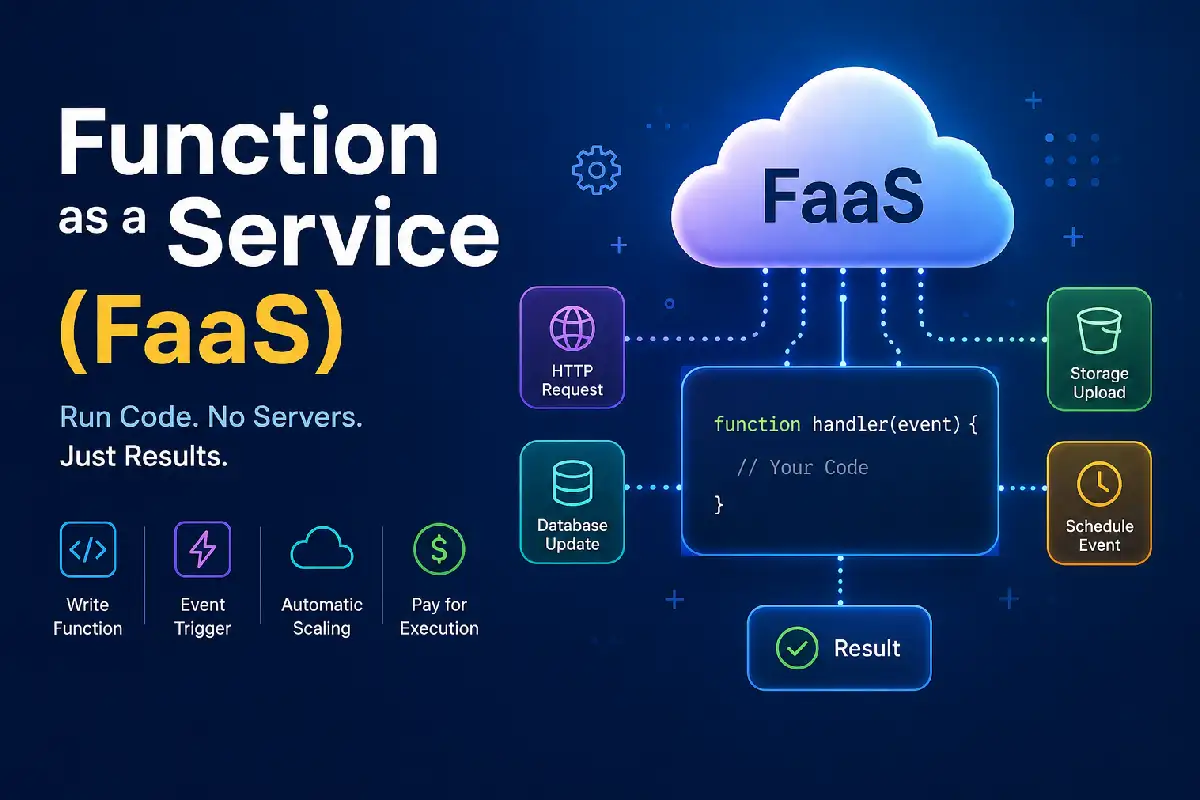
FaaS–Function as a Service is a type of cloud computing that enables developers to run individual pieces of code, or functions, without the need to rent or manage servers or the underlying application hosting infrastructure and operating system. A fundamental aspect of the serverless model that FaaS enables is the ability to run application logic only in response to events or invoke requests.
In classic hosting environments, developers would have to provision servers, configure infrastructure, scale, handle availability, etc. When using FaaS the cloud provider addresses all of these operational problems and just development teams focus on writing and deploying code.
Common triggers include:
- HTTP requests
- Database updates
- File uploads
- IoT device events
- Message queues
- Scheduled tasks
Cloud providers automatically handle:
- Server provisioning
- Scaling
- Availability
- Monitoring
- Infrastructure maintenance
It is a common practice that developers only worry about writing business logic.
Function as a Service (FaaS) is a serverless computing model that enables developers to execute code in response to events without managing servers. As one of the most innovative cloud service models, FaaS helps organizations reduce operational complexity and improve scalability.
Popular FaaS Platforms
| Platform | Provider | Resource |
| AWS Lambda | Amazon Web Services | https://aws.amazon.com/lambda |
| Azure Functions | Microsoft Azure | https://azure.microsoft.com/services/functions |
| Google Cloud Functions | Google Cloud | https://cloud.google.com/functions |
| Cloudflare Workers | Cloudflare | https://workers.cloudflare.com |
| OpenFaaS | Open Source | https://www.openfaas.com |
How FaaS Works
In the function as a service model, we are dealing with an event-driven architecture where each function is triggered and only executed when required. Thus there are no continuously running dedicated servers, instead, functions will just remain passive and get executed on being called by events.
Events can be any action which will trigger the execution of a function, like a request over an API, a data base event or a file upload, or an action on a scheduled time.
The cloud provider transparently handles management of the infrastructure, provisioning, scaling and execution environments, allowing the developer to solely concentrate on application code and not server maintenance.
Workflow
- Event occurs
- Trigger activates function
- Cloud platform allocates resources
- Function executes
- Response is returned
- Resources scale down automatically
Example
A user uploads an image:
- Upload event triggers a function
- Function compresses image
- Optimized image is stored
- Notification is sent
This whole process happens with no server administration.
Unlike Platform as a Service (PaaS), which provides a complete application development environment, FaaS focuses on running individual functions on demand.
Serverless Computing and FaaS
Serverless computing’ and FaaS’ are frequently used synonymously, however they are not synonymous:
| Feature | FaaS | Serverless Computing |
| Executes code | Yes | Yes |
| Event-driven | Yes | Often |
| Backend services | Limited | Extensive |
| Infrastructure management | Hidden | Hidden |
| Focus | Functions | Complete architecture |
As a matter of fact FaaS is a sub-category of serverless.
Key Benefits of FaaS
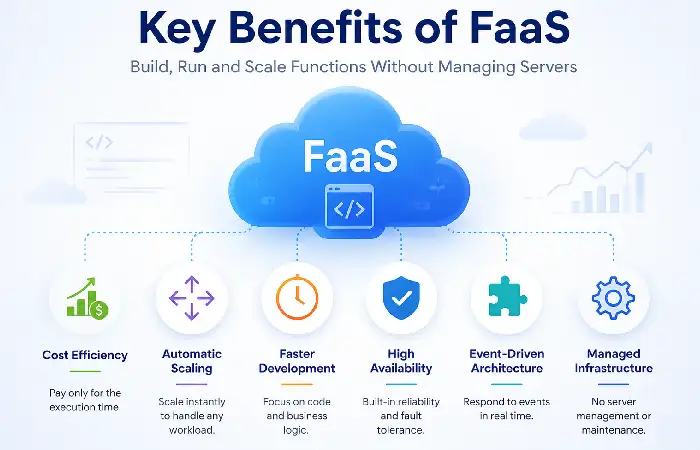
- Lower Costs
There is payment only upon the execution of functions
Benefits include:
- No idle server expenses
- Reduced operational overhead
- Predictable usage-based billing
- Automatic Scaling
Sudden spike of traffic can be automatically managed.
- Faster Development
Developers focus solely on application logic. There are no issues of infrastructure.
- Improved Agility
New features can be quickly pushed live through autonomous functions.
- High Availability
The top cloud providers include redundancy and reliability as features.
It also differs from Infrastructure as a Service (IaaS), where users remain responsible for managing virtual machines, storage, and networking resources.
Challenges of FaaS
FaaS provides the benefits of automatic scaling, fewer infrastructure worries and pay per execution; however, FaaS may not be suitable for all workloads. Businesses should be aware of the challenges involved in using a serverless architecture to verify if it is best for their needs.
| Challenge | Impact |
| Cold Starts | Initial execution delays |
| Vendor Lock-In | Difficult cloud migration |
| Execution Limits | Runtime restrictions |
| Debugging Complexity | Distributed troubleshooting |
| Stateless Design | External storage required |
These constraints should be considered by an organization before moving to a serverless model.
FaaS Scalability and Performance
One of the great features of FaaS is elastic scaling.
Performance Comparison
| Hosting Model | Scaling Speed | Maintenance | Cost Efficiency |
| Traditional Servers | Manual | High | Medium |
| Virtual Machines | Moderate | Medium | Medium |
| Containers | Fast | Medium | High |
| FaaS | Instant | Low | Very High |
FaaS platforms can scale from zero requests to thousands of parallel executions seamlessly.
This makes them ideal for:
- APIs
- Event processing
- Real-time analytics
- Automation workflows
Many businesses integrate FaaS with Software as a Service (SaaS) applications to automate workflows, process events, and enhance user experiences.
FaaS Security Considerations
Security is a key concern for any cloud computing paradigm, FaaS included. While cloud providers handle most of the security of the background infrastructure, you still need to secure your function code, configuration, data and access management. So, it is critical to ensuring secure development best practices.
Best Practices
Implement Least-Privilege Access
Functions should only use the resources it needs.
Secure Secrets Management
Use the cloud-native secret management service.
Encrypt Data
Protect:
- Data at rest
- Data in transit
- API communications
Monitor Function Activity
Enable:
- Logging
- Alerts
- Audit trails
Patch Dependencies
Keep your libraries current so that they do not present many security flaws.
In enterprise environments, FaaS can complement Desktop as a Service (DaaS) solutions by supporting backend automation, authentication, and data processing tasks.
Common FaaS Use Cases
API Backends
The REST API is scalable and does not use separate server to perform the function.
File Processing
Automatically:
- Resize images
- Convert documents
- Process uploads
IoT Applications
Real time process sensor data.
Chatbots
Dynamically handle user interaction.
Data Pipelines
Move and transform data from system to system.
Event Automation
Launch business workflows on the trigger event automatically.
FaaS vs Traditional Application Hosting
| Feature | FaaS | Traditional Hosting |
| Server Management | None | Required |
| Scaling | Automatic | Manual |
| Cost Model | Pay-per-use | Fixed resources |
| Maintenance | Minimal | Significant |
| Deployment Speed | Fast | Moderate |
| Operational Complexity | Low | High |
FaaS is thus an appealing choice for those organizations that wish to become more flexible and reduce costs.
Additionally, developers often compare FaaS with Backend as a Service (BaaS) because both approaches simplify application development and reduce the need for extensive server management.
When to Use Function as a Service
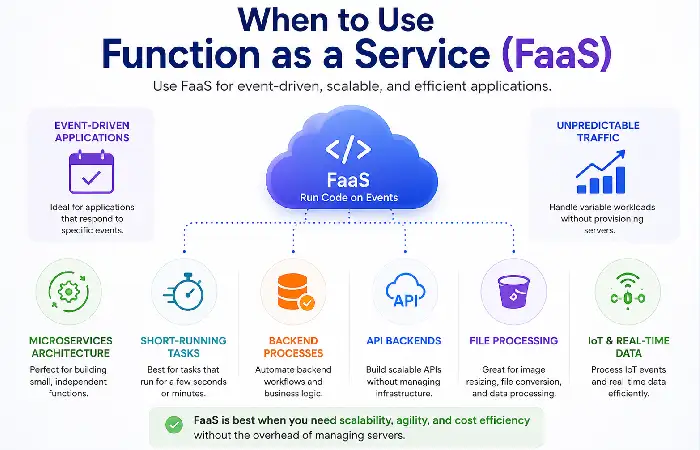
FaaS is ideal when applications:
Handle unpredictable traffic
Require event-driven workflows
Use microservices architecture
Need rapid deployment cycles
Must scale automatically
Avoid FaaS when applications:
Require long-running processes
Need persistent state
Demand extensive hardware control
Have predictable, constant workloads
FAQ
So, is FaaS the same as serverless computing?
No. The function execution component of serverless computing is called FaaS.
Which FaaS platform is the most popular?
Currently, AWS Lambda is one of the most popular FaaS platforms in the world.
Does FaaS provide savings?
Yes. They only have to pay when the servers are actually working, rather than for idle infrastructure.
What are the security risks for FaaS?
Yes if used correctly, and backed with appropriate access controls, monitoring, encryption and general security principles.
Can FaaS be used for all applications?
No. If an application is long-running or very stateful then a container or conventional hosting might be a more appropriate choice.
Conclusion
Serverless functions, or Function as a Service (FaaS) is also emergings as an essential element of cloud-native architecture. The advantages given by these serverless facilities allow organizations to develop dynamic, event driven systems basing on zero infrastructure management. Auto scaling, cost per execution systems and fast development cycles are helping businesses to evolve faster and with less IT drag.
Kashifa Jafar is a technology writer and contributor at FutureTechExpert with 4+ years of experience in technology writing and content creation.
Read Full Bio of Author →Sameena reviews selected health, wellness, technology, and digital content for clarity, factual presentation, and reader usefulness.
Read Full Bio of Reviewer →