
 Kashifa Jafar
Technology Writer & Contributor
Kashifa Jafar is a technology writer and contributor at FutureTechExpert with 4+ years of experience in technology writing and content creation.
Read Full Bio of Author →
Kashifa Jafar
Technology Writer & Contributor
Kashifa Jafar is a technology writer and contributor at FutureTechExpert with 4+ years of experience in technology writing and content creation.
Read Full Bio of Author →
 Sameena Begum
Health, Technology & Digital Content Reviewer
Sameena reviews selected health, wellness, technology, and digital content for clarity, factual presentation, and reader usefulness.
Read Full Bio of Reviewer →
Sameena Begum
Health, Technology & Digital Content Reviewer
Sameena reviews selected health, wellness, technology, and digital content for clarity, factual presentation, and reader usefulness.
Read Full Bio of Reviewer →
Internet Services form the backbone of contemporary connectivity, entertainment, commerce, cloud computing, online education, and digital transformation. Be it streaming 4K videos, attending video conferencing, powering an online store, or utilizing AI-driven software, people‘s dependence on robust internet services is undeniable.
By 2026, Internet penetration will be over 68% across the globe, corresponding to billions of connected devices on high speed broadband, fiber, wireless and mobile internet networks. Selecting the most appropriate internet service can have positive implications on productivity and end user experience as well as on overall connectivity costs.
This all-in-one handbook provides breakdown of how internet works, various types of connections, comparison of providers, speed needs for users, and upcoming new technology.
 This article is part of
Internet & Connectivity Resources
Table of Contents
What Are Internet Services?
Internet services are any of the technologies, systems, or resources that allow users to connect to the internet and use its services. It include: accessing information, watching videos, using apps, practicing communication of some sort; and it provides such access to technology.
Internet services are fundamentally based on an interconnected system of computers, servers, data centers, and communication network which are owned and operated by Internet Service Providers (ISP). Once an individual has been granted access to the internet via a broadband, fiber, wireless, mobile, or satellite connection, they now have access to a worldwide data transfer network.
Internet services have changed a lot over the last 20 years. Starting with just simple web browsing and emailing to now having high speed streaming, cloud computing, working from home services, online multiplayer gaming, IoT devices, AI and much more.
These services enable:
- Web browsing
- Email communication
- Video streaming
- Online gaming
- Cloud computing
- Video conferencing
- Remote work
- E-commerce
- Social media access
- AI-powered applications
Internet services are delivered through various technologies including fiber optic networks, cable broadband, DSL, satellite, fixed wireless, and mobile cellular networks.
Choosing the right internet service providers is essential for finding reliable connectivity, competitive pricing, and service options that match your needs.
Core Components of Internet Services
| Component | Function |
| ISP | Provides internet connectivity |
| Modem | Connects users to ISP network |
| Router | Distributes internet locally |
| Backbone Network | Transfers global internet traffic |
| Data Centers | Host websites and applications |
| DNS Servers | Convert domain names into IP addresses |
Types of Internet Services
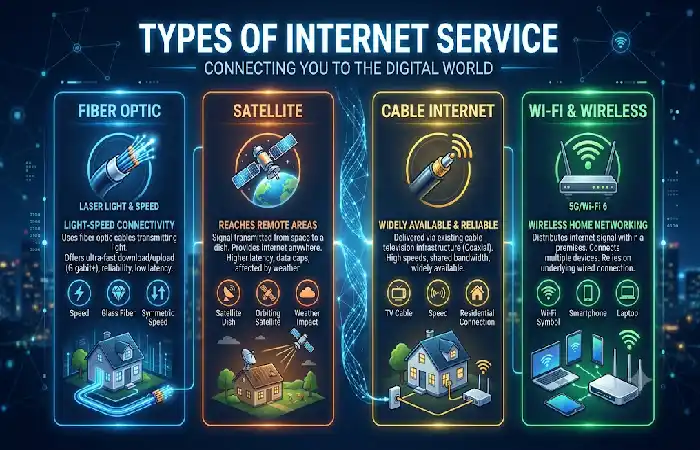
The internet services are provided in many forms to accommodate the various connectivity, cost and geographical requirements. It is very important to understand the types of Internet services available to be able to select the most cost effective and reliable solution suited to your specific use case.
The major distinctions between internet services are speed, reliability, availability, latency, installation and the overall performance. Although fiber offers the fastest speeds and lowest latencies, other solutions, such as cable, wireless, mobile and satellite, are useful options to consider based on location.
Comparison of Internet Service Types
| Service Type | Typical Speed | Reliability | Best For |
| Fiber | 300 Mbps – 10 Gbps | Excellent | Homes and businesses |
| Cable Broadband | 100 Mbps – 2 Gbps | Very Good | General households |
| DSL | 10 – 100 Mbps | Moderate | Rural areas |
| Fixed Wireless | 50 – 500 Mbps | Good | Remote locations |
| Mobile Internet | 10 – 1000 Mbps | Variable | Mobility |
| Satellite | 25 – 300 Mbps | Improving | Remote regions |
Official Resources
| Resource | Purpose |
| FCC Broadband Guide | Broadband information |
| BroadbandNow | Provider lookup |
| Ookla Speedtest | Speed testing |
| Internet Society | Internet standards |
Finding the best internet type will vary from one individual or business to the next and depends largely on your location, price range, speed needs, number of devices that will connect, and your intention for the internet use.
For most homes and small organizations in the year 2026 fiber will still be the best option, if accessible, with cable, wireless, mobile, and satellite service all being widely utilized to help increase bandwidth and access.
How Internet Services Work
It might look complicated, but the process of connecting to the Internet and using web services takes only a few seconds. The next time you use a website, watch a streamed video, send an email or conduct a conference call via video, a set of technologies are working in the background to send information to you, or from you, between your own computer or handheld device, to servers around the globe.
Simply put, Internet services work by sending data along a series of switches, routers, servers, data centers, wiring, cable and wireless routers between your computer and the many servers, switches and ISPs that make up the internet.
Internet Data Journey
- User enters website address.
- DNS translates domain into IP address.
- ISP routes request.
- Backbone network transfers data.
- Destination server responds.
- Data returns through network path.
- Browser displays content.
Simplified Network Flow
User Device → Router → Modem → ISP → Internet Backbone → Server → ISP → Device
This process happens in milliseconds.
Why Understanding How Internet Services Work Matters
Knowing how internet services work can help you:
- Select the suitable internet package
- Attempt to resolve connection problems
- Ease the home networking pain
- Make streaming and gaming as smooth as possible
- Wait states which are used to understand speed and latency measurements.
When selecting between providers, evaluate their capabilities and reputations based on the required scope and essential demands of the project.
As internet technologies are advancing, insight to the basics of connectivity are good to have at hand for making use of them both at work and home.
Broadband Internet Services
Internet services that provide high speed connectivity with constantly connected internet access. Unlike the traditional dial-up connection, broadband is faster and more reliable and can handle multiple users at the same time.
Currently, broadband is the most common way for home, business, school and government organizations to connect to the internet. It enables web surfing and video streaming, cloud computing and online gaming as well as telecommuting and connected home features.
In 2026, broadband internet has also become an essential utility to cope with the increasing demands of being Digital. Users can still work, find information, and be entertained online.
Benefits of Broadband
- Faster downloads
- HD and 4K streaming
- Video conferencing
- Smart home connectivity
- Cloud application support
- Online gaming
Modern broadband internet services deliver the speed and reliability needed for streaming, remote work, online learning, and everyday browsing.
Typical Broadband Speed Recommendations
| Activity | Recommended Speed |
| Email & Browsing | 25 Mbps |
| HD Streaming | 50 Mbps |
| 4K Streaming | 100 Mbps |
| Gaming | 100–300 Mbps |
| Remote Work | 100 Mbps |
| Large Households | 500 Mbps+ |
Fiber Internet Services
Fiber Internet Services are often regarded as the best internet connection in the world in 2026. It utilizes newer technology for internet which is known as fiber-optic. Fiber internet is a technology that uses the acceleration of light impulses through the thin strands of glass or plastic fiber allowing speeds, lag, and reliability to be much higher than other technologies.
With homes and offices requiring more bandwidth-inducing applications like 4K streaming, cloud computing, video conferencing, virtual gaming, AI applications, and smart devices, the standard of fiber internet has emerged as the top preference for users demanding the best.
Advantages of Fiber
- Symmetrical upload/download speeds
- Ultra-low latency
- High reliability
- Better scalability
- Supports AI and cloud applications
Fiber vs Cable Comparison
| Feature | Fiber | Cable |
| Download Speed | Excellent | Good |
| Upload Speed | Excellent | Moderate |
| Latency | Very Low | Low |
| Congestion | Minimal | Possible |
| Future Scalability | Excellent | Moderate |
Why Fiber Dominates in 2026
Modern applications increasingly require faster uploads for:
- Cloud backups
- Video conferencing
- Remote collaboration
- AI workflows
- Content creation
For users who demand exceptional speed and low latency, fiber internet services offer one of the most advanced internet technologies available today.
Wireless Internet Services
Wireless Internet Services allow internet access without the use of physical cables that you need to use in order to connect with your devices. It utilizes radio wave, cellular network, satellite, or fixed wireless pathways that allow connection between end users and internet providers.
Wireless internet is becoming more popular, as the need for portable and portable internet is being demanded. It is being used as an alternative to wired broadband for homes, business, commuters and travelers and for more remote locations that will not be able to be connected via fiber or cable.
In 2026 wireless internet is becoming faster, more resilient and prevalent thanks to new developments in 5G, fixed wireless access (FWA), Wi-Fi 7 and satellite internet,
Common Wireless Technologies
Fixed Wireless
Uses radio towers to provide internet.
Benefits:
- Faster deployment
- Rural connectivity
- Lower infrastructure costs
Satellite Internet
Modern low-earth orbit satellite systems provide:
- Improved speeds
- Lower latency
- Global coverage
Ideal for:
- Remote locations
- Maritime use
- Rural communities
Future of Wireless Internet Services
Wireless technology is also constantly improving and changing. Here are some of the other developments known to be underway:
Key trends include:
- Growth of 5G and 5 G Advanced networks.
- The initial stage of the 6G evolution.
- How do we accelerate that adoption of fixed wireless access
- Development of satellite broadband networks.
- Network optimization using AI
- More Wi-Fi 7 installations, as its number of “more” is doubled.
- Better coverage of internet in rural areas
With the growth of wireless infrastructure and the advancement of network technologies, the delivery of wireless internet services will remain a key differentiator in providing high speed, reliable and ubiquitous access to users worldwide.
Wireless internet complementing broadband and fiber with the flexibility and availability that consumers and business want, to do their part in getting more people online.
Mobile Internet Services
Mobile Internet Services (MIS) refer to internet access using the cellular network with a mobile device. Users can access the internet, applications, and communication mediums via MIS from many locations due to its mobility. Unlike wired internet access, mobile internet allows its users to stay connected even on the go.
The proliferation of 4G LTE and 5G has made mobile internet one of the fastest growing sub segments in telecommunication world. By 2026 billions of people worldwide are using mobile internet services for social media, videos, cloud computing, mobile banking and business collaboration.
With the proliferation of smartphones, tablets, laptops and IoT devices, mobile internet services support a connected digital lifestyle.
Mobile Network Evolution
| Generation | Speed Capability |
| 3G | Up to 14 Mbps |
| 4G LTE | Up to 300 Mbps |
| 5G | 1–10 Gbps |
| Early 6G Research | 50+ Gbps Potential |
Benefits of Mobile Internet
- Portability
- Flexible connectivity
- Wide coverage
- Mobile hotspots
- Remote workforce support
With the advancement of wireless technology, mobile internet will continue to be a vital element of connectivity everywhere. Mobile internet will allow consumers and business to connect to any information, communicate, work and have digital experiences from just about everywhere. For many users and companies, mobile internet is no longer just a luxury, it‘s a lifestyle.
Internet Service Providers
Internet Service Provider (ISPs) are operators that offer users access to the internet.They are the link that connects the end users and the worldwide administration of the internet, and allows users to make use of the internet services like web surfing, streaming videos, cloud computing, video conferencing, online gaming or digital communications.
If there were no Internet Service Providers then the user would not be able to connect their device to the internet. They provide the networks, equipment and infrastructure used to send data from the user to online services.
By 2026 with the proliferation of work from home, cloud applications, smart homes, artificial intelligence, and IOT, speeds needed will continue to demand support from 86 ISPs.
What ISPs Do
- Provide network access
- Manage infrastructure
- Offer customer support
- Deliver security services
- Allocate IP addresses
Major Global ISP Categories
| Provider Type | Examples |
| Fiber Providers | AT&T Fiber, Google Fiber |
| Cable Providers | Xfinity, Spectrum |
| Telecom Providers | Verizon, Vodafone |
| Mobile Operators | Jio, Airtel, T-Mobile |
| Satellite Providers | Starlink |
Official Provider Resources
| Provider | Website |
| AT&T Fiber | Fiber Internet |
| Google Fiber | Fiber Services |
| Starlink | Satellite Internet |
| Verizon | Home Internet |
| Reliance Jio | Mobile & Fiber |
Why Internet Service Providers Matter
Internet Service Provider is a backbone or foundation of the digital world we live in today. It is access to education, health care, entertainment, shopping, cloud computing, remote working and communication we all rely on.
With the proliferation of internet usage and advancement of technologies, including artificial intelligence, smart cities, autonomous systems, and highly intelligent cloud offerings, Internet Service Providers will still be at the core of future digital connectivity delivery, delivering the demands for speed, quality, and security.
Whether you are a normal homeowner in need for decent broadband connection or a business with an enterprise not to mention reliable connectivity, selecting the right ISP plays a vital part in your internet.
Internet Speed and Performance
Internet Speed and Performance are also very influential factors of how good an internet connection is. If you are for example watching a video, in a voice conference, playing games, running cloud applications or browsing websites, the speed of your internet connection is crucial.
The proliferation of internet in 2026, insights into internet speed and performance indicators can help consumers and enterprises to select the most appropriate internet service plan, carry out basic troubleshooting and improve internet access control.
Key Performance Metrics
| Metric | Meaning |
| Download Speed | Receiving data |
| Upload Speed | Sending data |
| Latency | Response time |
| Jitter | Connection stability |
| Packet Loss | Lost network data |
Recommended Speeds by User Type
| User Type | Recommended Speed |
| Single User | 100 Mbps |
| Family Home | 300 Mbps |
| Smart Home | 500 Mbps |
| Remote Workers | 500 Mbps |
| Small Business | 1 Gbps |
Understanding internet speed and performance factors can help users optimize their network for faster downloads, smoother streaming, and better online experiences.
Choosing the Right Internet Service
Deciding what Internet service is crucial for both consumers and businesses. There are several different options of connection type, providers, speed packages and prices that it is difficult to chose the right one. To decide what Internet service is appropriate you must first analyze your needs, where you are located and the type and frequency of your utilization of the Internet.
Your perfect internet service will deliver the correct mix of speed, stability, efficiency and value, meeting your present and future needs. Whether you‘re a home worker, an online gamer, a business owner, a streaming fan or just someone who surfs, knowing this is key to avoiding paying for what you don‘t need, or suffering from what you do.
Evaluation Checklist
- Availability
Not all technologies are available in every location.
- Speed Requirements
Assess:
- Number of users
- Streaming habits
- Gaming needs
- Remote work requirements
- Budget
Compare:
- Monthly cost
- Equipment fees
- Installation charges
- Contract requirements
- Reliability
Review:
- Uptime guarantees
- Customer reviews
- Service history
The best internet provider is not always the fastest or the most affordable but the one that meets the customer’s needs, budget, and usage that fits him/her the best. With the help of analyzing the connection type, the bandwidth needed, the reliability, the cost, the customer support and the future growth, you can find the perfect fit of the internet service for you.
Reliable internet connectivity solutions ensure consistent access to cloud services, smart devices, communication platforms, and digital applications.
Internet Services for Home and Business
Internet services are crucial and needed in both home and business, but the connectivity need is quite different in both. In homes, people mainly need internet for entertainment, communication and connecting smart devices. Businesses need another level of service, where they use internet for daily operation, cloud computing, customer servicing and remote working.
Selecting the appropriate internet service starts at considering where the majority of internet use will be; home user or business user. Various aspects of internet services including internet speed, internet reliability, security, uptime and support services may impact the most appropriate connection.
Home Internet Requirements
Typical needs:
- Streaming
- Gaming
- Video calls
- Smart devices
Home Internet Comparison
| Household Type | Recommended Service |
| Single User | 100 Mbps Broadband |
| Small Family | 300 Mbps Fiber |
| Large Family | 500 Mbps–1 Gbps Fiber |
| Smart Home | Gigabit Fiber |
Business Internet Requirements
Businesses prioritize:
- Uptime
- Security
- Scalability
- Dedicated support
Business Connectivity Options
| Business Size | Recommended Solution |
| Startup | Fiber Broadband |
| SMB | Business Fiber |
| Enterprise | Dedicated Internet Access |
| Global Organization | SD-WAN + Fiber |
Internet services aimed at domestics and business users have the identical basic requirement of fast and reliable connectivity, however, the needs of each consumer group are on varying scales. The home user most likely has a preference for low-cost connections and streaming compatibility, whilst the business user emphasizes uptime, security, headroom and productivity.
Comparing different home internet services can help households find the ideal balance between performance, affordability, and coverage.
Future of Internet Services
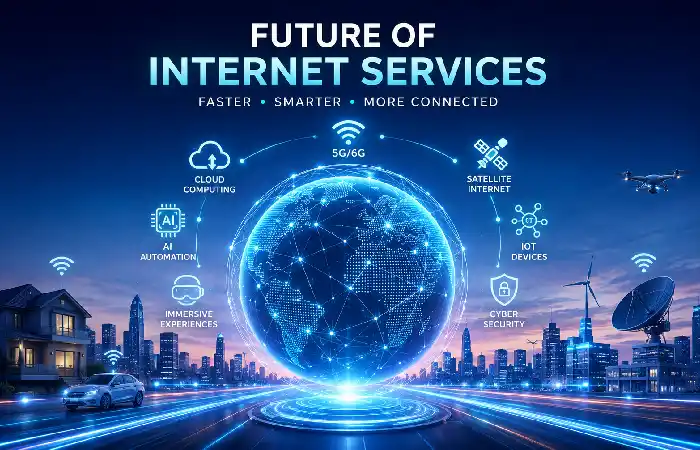
The future of Internet Services will be driven by technological advances, globalization of the internet and of digital technologies usage in our daily lives. When all industries, its organizations, governments and people rely on cloud computing, AI, working from home, smart devices and frontier interfaces, the infrastructure will need to support rapid evolution while maintaining high speed, reliability and security.
In the foreseeable future, the scope of internet services will dramatically expand 10 years from now from conventional broadband access. 5G Advanced, 6G, Satellite Broadband, edge computing, Quantum Networking and Autonomous Network Management by means of Artificial Intelligence (AI) are just some of the developments that is anticipated to redefine how individuals willlink in future years.
Emerging Trends
5G Expansion
Provides:
- Ultra-low latency
- Massive IoT support
- Faster mobile broadband
6G Research
Expected advancements:
- AI-native networks
- Terahertz communications
- Real-time holographic experiences
Satellite Constellations
Benefits:
- Global coverage
- Rural connectivity
- Disaster recovery communications
AI-Powered Networks
AI enables:
- Predictive maintenance
- Automated traffic optimization
- Enhanced cybersecurity
Quantum Networking
Long-term developments include:
- Ultra-secure communications
- Advanced encryption technologies
The next decade of internet services is defined by the pursuit of fast, smart, reliable, and ubiquitous connectivity. Carriers and vendors, together with open communities, will leverage new technologies like fiber rollouts, 5G Advanced, 6G, AI-enabled networking, edge, satellite broadband, and quantum communications, which will reshape how users and enterprises access the digital environment.
FAQs
What were internet services?
Internet services are technology and systems which enable access to websites, online resources, cloud services, digital communications and applications.
Which is the right Internet service?
Most people believe fiber internet is the best because it is faster and more reliable and scalable.
What internet speed do I require?
A home may require from 100 to 500 Mbps, while larger homes or companies may opt for gigabit speeds.
Is 5G knocking off broadband?
Not quite. 5G is designed to complement the broadband experience, but FTTP is still the go-to solution if you want a reliable high-quality connection.
What type of internet service should i be using for remote work?
Fiber internet offers the most reliable experience of Video conferencing, Cloud Applications and Collaboration tools.
Is there a way to boost my internet speed?
Upgrade equipment, proximity of the Wi-Fi, may be used an Ethernet conection, and choose a plan of internet service according to your usage.
Conclusion
The Internet, now available through a variety of services such as dial-up, broadband, fiber, wireless, satellite (globally accessible) has risen in maturity. In the year 2026, users will have the option of broadband, fiber, wireless, mobile or satellite internet services depending on the local availability, speed and cost considerations.
In this era of increasing penetration of technologies like 5G, AI based networks, satellite constellations, and upcoming 6G networks, web speeds will be faster, smarter and more accessible. Picking the right service today gets you the better performance, reliable connectivity and future-proof technology.
Kashifa Jafar is a technology writer and contributor at FutureTechExpert with 4+ years of experience in technology writing and content creation.
Read Full Bio of Author →Sameena reviews selected health, wellness, technology, and digital content for clarity, factual presentation, and reader usefulness.
Read Full Bio of Reviewer →