
 Kashifa Jafar
Technology Writer & Contributor
Kashifa Jafar is a technology writer and contributor at FutureTechExpert with 4+ years of experience in technology writing and content creation.
Read Full Bio of Author →
Kashifa Jafar
Technology Writer & Contributor
Kashifa Jafar is a technology writer and contributor at FutureTechExpert with 4+ years of experience in technology writing and content creation.
Read Full Bio of Author →
 Sameena Begum
Health, Technology & Digital Content Reviewer
Sameena reviews selected health, wellness, technology, and digital content for clarity, factual presentation, and reader usefulness.
Read Full Bio of Reviewer →
Sameena Begum
Health, Technology & Digital Content Reviewer
Sameena reviews selected health, wellness, technology, and digital content for clarity, factual presentation, and reader usefulness.
Read Full Bio of Reviewer →
Internet Connectivity Solutions: In the age of the digital world, Internet Connectivity Solutions are the only thing which forms the basis of communication, remote working, online learning and entertainment, running of business on the net, etc. So no matter if you are looking for a better streaming experience at home or a business setup for handling applications stored on the cloud, the right choices of connectivity solutions can prove to be significant for your business and end user more than ever.
As fiber networks grow quickly, 5 G becoming mainstream, and satellite internet arriving in the most remote places, the year 2026 presents more options for internet connectivity than ever before. This page describes the most common internet connectivity options, compares their speeds, and shows you which are the better options to go for.
 This article is part of
Internet & Connectivity Resources
Table of Contents
What Are Internet Connectivity Solutions?
Internet connectivity solutions. Internet connectivity solutions are the ways of connecting people, devices and organizations to the Internet.
These solutions include:
- Broadband internet
- Fiber-optic connections
- Wireless internet
- Mobile networks (4G/5G)
- Satellite internet
- Dedicated business connections
- Hybrid networking solutions
The right solution depends on:
- Location
- Bandwidth requirements
- Number of users
- Reliability expectations
- Budget
Connectivity relies on dependable internet services to connect users, devices, and applications across networks.
Broadband Connectivity
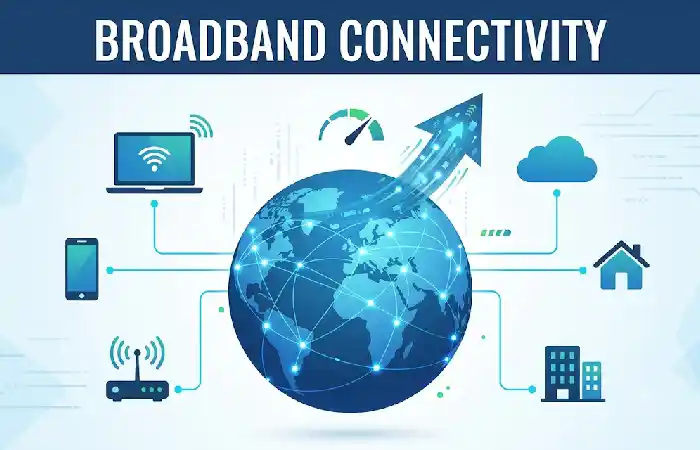
Broadband Connectivity allows high speed (example 11 mbps) always on internet connection, which provides user to access websites, watching videos, video calls, using any cloud services, connecting multiple devices at the same time. This service concept is replacing the traditional slow dial up site.
Benefits of Broadband
- Always-on connection
- Affordable pricing
- Suitable for households
- Supports streaming and gaming
- Widely available
Common Broadband Types
| Type | Typical Speed | Best For |
| DSL | 10–100 Mbps | Light usage |
| Cable | 100–1000 Mbps | Families |
| Fiber Broadband | 300 Mbps–10 Gbps | Heavy users |
| Fixed Wireless | 50–500 Mbps | Rural areas |
Resources
| Resource | Link |
| FCC Broadband Guide | https://www.fcc.gov |
| Broadband Forum | https://www.broadband-forum.org |
Many modern networks use fiber internet connections because they offer faster speeds and lower latency than traditional technologies.
Fiber Connectivity
Fiber Connectivity is a modern, high bandwidth Internet technology that involves the transmission of data using fiber-optic cables that are made of thousands of tiny glass or plastic strands. In comparison to copper-based networks, fiber provides several key advantages including higher bandwidth, higher reliability, lower latency, and increased speed. As such, it is most often found as the backbone to consumer, business, cloud, and next-generation digital communications.
Why Fiber Is Growing
Fiber uses light to send the data providing much higher speed and latency.
Advantages
- Symmetrical upload/download speeds
- Low latency
- Better reliability
- Future-proof infrastructure
- Ideal for cloud applications
Fiber vs Traditional Broadband
| Feature | Fiber | Cable |
| Download Speed | Up to 10 Gbps | Up to 1 Gbps |
| Upload Speed | Up to 10 Gbps | Often lower |
| Latency | Very Low | Moderate |
| Reliability | Excellent | Good |
| Scalability | High | Moderate |
For households with multiple connected devices, reliable home internet solutions are essential for maintaining consistent connectivity.
Wireless Connectivity
Wireless service provides internet access wirelessly.
Popular Wireless Solutions
- Fixed wireless access (FWA)
- Wi-Fi networks
- Point-to-point wireless
- Microwave links
Benefits
- Fast deployment
- Reduced infrastructure costs
- Flexible coverage
- Useful for temporary locations
Wireless solutions are more and more being treated as broadband substitutes, especially in the case of modern 5G networks.
Mobile Connectivity
Mobile Connectivity is providing internet service over the network of cellular telecom company.
Evolution of Mobile Networks
| Generation | Maximum Speed |
| 3G | 2 Mbps |
| 4G LTE | 100 Mbps |
| 5G | 10+ Gbps |
| 6G (Expected) | 100+ Gbps |
Best Uses
- Remote work
- Travel connectivity
- IoT devices
- Mobile hotspots
- Backup internet connections
The introduction of 5G has greatly enhanced the experience of using mobile internet services for both consumers and businesses.
Choosing reputable internet service providers can significantly improve network reliability and coverage.
Business Connectivity Solutions
More robust and secure connections.
Common Business Connectivity Options
| Solution | Use Case |
| Dedicated Internet Access | Enterprises |
| MPLS Networks | Multi-site organizations |
| SD-WAN | Cloud-first businesses |
| Fiber Ethernet | High-performance offices |
| 5G Business Internet | Flexible deployments |
Key Benefits
- Guaranteed uptime
- Better security
- Service-level agreements (SLAs)
- Scalable bandwidth
- Enhanced cloud performance
Comparison of Business Solutions
| Solution | Reliability | Cost | Scalability |
| Broadband | Medium | Low | Moderate |
| Dedicated Fiber | Very High | High | Excellent |
| MPLS | High | High | Good |
| SD-WAN | High | Medium | Excellent |
Rural Internet Connectivity
Many rural areas still lack access to connectivity
Available Rural Solutions
- Fixed wireless
- Satellite internet
- Rural fiber expansion
- Community broadband networks
- Mobile broadband
Rural Connectivity Comparison
| Technology | Speed | Availability |
| Satellite | 50–250 Mbps | Very High |
| Fixed Wireless | 50–500 Mbps | Medium |
| Fiber | 300 Mbps–10 Gbps | Limited |
| 5G Home Internet | 100–1000 Mbps | Growing |
Government support has since opened the door for even greater access with recent advances in satellite.
Most connectivity solutions today are powered by broadband internet, which supports streaming, gaming, and remote work.
Improving Internet Reliability
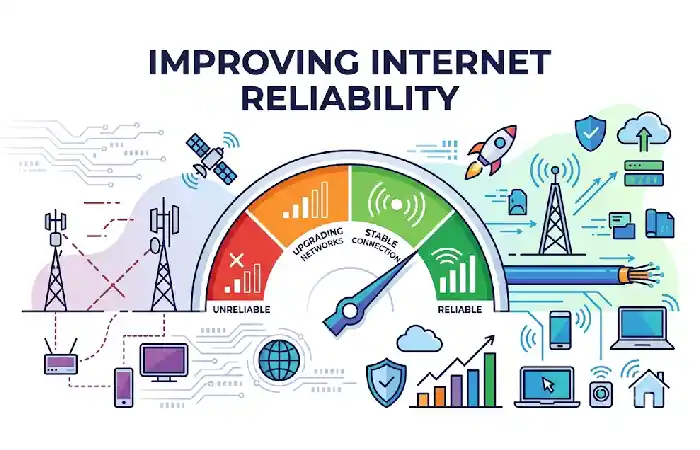
Can you get reliable internet? Seems simple, but unless you are in the city, or there is a neighbor with the same service, often this can be a problem.
Best Practices
- Upgrade outdated hardware
- Use enterprise-grade routers
- Implement network redundancy
- Optimize Wi-Fi coverage
- Monitor bandwidth usage
- Update firmware regularly
Reliability Checklist
| Action | Impact |
| Router Upgrade | High |
| Mesh Wi-Fi | High |
| Fiber Upgrade | Very High |
| Backup Connection | Very High |
| Network Monitoring | High |
Internet Connectivity and Network Performance
The quality of connectivity is more than just in terms of speed.
Key Performance Metrics
| Metric | Why It Matters |
| Download Speed | Streaming and downloads |
| Upload Speed | Video calls and backups |
| Latency | Gaming and VoIP |
| Jitter | Video conferencing |
| Packet Loss | Reliability |
Performance Benchmarks (2026)
| Activity | Recommended Speed |
| Web Browsing | 25 Mbps |
| HD Streaming | 50 Mbps |
| 4K Streaming | 100 Mbps |
| Remote Work | 100 Mbps |
| Cloud Applications | 250 Mbps+ |
| Large Enterprises | 1 Gbps+ |
Future Connectivity Technologies
The future of connectivity is already here.
Technologies to Watch
- 6G Networks
Orange promised to offer ultra-low latency and AI based network optimization.
- Low-Earth Orbit Satellites
Taking broadband to the remotest corners of the world.
- Wi-Fi 7
Provides a much higher throughput with much less congestion.
- AI-Powered Networking
Automatic maximization of traffic and performance.
- Edge Computing Connectivity
Minimize delay of real-time applications.
Future Technology Comparison
| Technology | Estimated Impact |
| 6G | Transformational |
| Wi-Fi 7 | High |
| Edge Computing | High |
| AI Networking | High |
| LEO Satellites | High |
Monitoring internet speed and performance helps users optimize their online experience and troubleshoot connectivity issues.
FAQ
What Type of Internet Service is the best Option for Internet Access in 2026?
Fiber remains the best overall choice as it provides unparalleled speed, durability and flexibility.
So is 5 G a replacement for broadband?
For some yes. Generally, fiber is more reliable.
What is the best business connectivity?
Fiber dedicated with SD-WAN redundancy is highly reliable.
What is the most effective internet solution in rural regions?
The most common currently available technologies are Satellite Internet and fixed wireless.
How do I improve my internet speed?
Upgrade the equipment, improve the Wi-Fi coverage, keep an eye on the traffic and get a plan according to the needs.
Conclusion
Today‘s Internet Connectivity Solutions offer more choice than any before. Be it fiber-optic networks, broadband services, or wireless, mobile, or satellite solutions, any organization or household can find the right solution for the required performance and budget.
Connectivity will simply keep getting faster, smarter and more reliable to better, as 5G gets bigger, Wi-Fi 7 gets adopted, and 6G gets developed. With so much on the horizon, getting to know digital connectivity today is more useful than ever.
Kashifa Jafar is a technology writer and contributor at FutureTechExpert with 4+ years of experience in technology writing and content creation.
Read Full Bio of Author →Sameena reviews selected health, wellness, technology, and digital content for clarity, factual presentation, and reader usefulness.
Read Full Bio of Reviewer →