
 Kashifa Jafar
Technology Writer & Contributor
Kashifa Jafar is a technology writer and contributor at FutureTechExpert with 4+ years of experience in technology writing and content creation.
Read Full Bio of Author →
Kashifa Jafar
Technology Writer & Contributor
Kashifa Jafar is a technology writer and contributor at FutureTechExpert with 4+ years of experience in technology writing and content creation.
Read Full Bio of Author →
 Sameena Begum
Health, Technology & Digital Content Reviewer
Sameena reviews selected health, wellness, technology, and digital content for clarity, factual presentation, and reader usefulness.
Read Full Bio of Reviewer →
Sameena Begum
Health, Technology & Digital Content Reviewer
Sameena reviews selected health, wellness, technology, and digital content for clarity, factual presentation, and reader usefulness.
Read Full Bio of Reviewer →
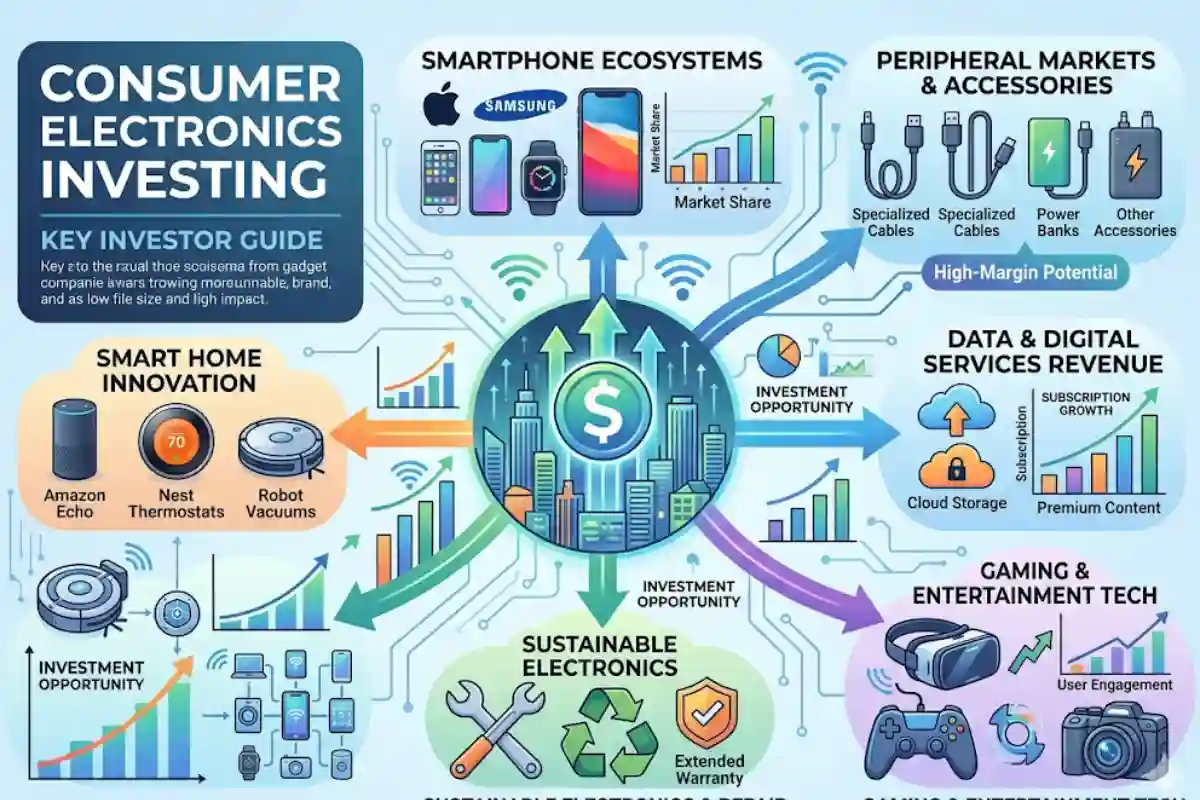
Consumer Electronics Investing is now among the fastest-growing sectors on the stock market. The wider scope of smart devices, the increasing use of AI-enabled products, the inclusion of wearables and gaming peripherals, and the penetration of connected home devices.
Consumer electronics companies are bringing the future into today‘s homes, with offerings ranging from smart watches and smartphones to laptops powered by AI, and chips made of semiconductor.
Investors are now asking for a hardware story for a change. Industry reports suggest worldwide consumer electronics spending will peak in 2026 with increasing AI adoption, smart home proliferation and the upsurge in the demand for high computing gadgets, all contributing to the flourishing of the sector.
Semiconductor companies, appliance manufacturers and electronics vendors are reaping the benefits. Through this guide, you will learn how consumer electronics investing works, which stocks rule the roost and invest for the long term.
The consumer electronics industry plays a major role in gadgets investing, as product innovation and market demand often influence investment opportunities across the technology sector.
 This article is part of
Gadgets Investing
Table of Contents
Why Consumer Electronics Investing Matters in 2026
Now the range of consumer electronics is far wider than ever before, so consumer electronics products are not just TVs, smartphones, and MP3 players.
Buyers can evaluate products more effectively through technology education and analysis resources.
Today’s market includes:
- AI laptops
- Smart home devices
- Wearable technology
- Gaming consoles
- AR and VR hardware
- Connected vehicles
- Smart health gadgets
By giving rise to artificial intelligence, which is a whole upgrade cycle in its own, consumers and businesses are all set to buy smarter devices. Consumer demand is heavily influenced by evolving technology market trends across global markets.
Key Growth Drivers
| Growth Factor | Impact on Investors |
| Artificial Intelligence | Higher demand for AI-capable devices |
| Smart Homes | Increased hardware sales |
| Wearable Technology | Expanding consumer adoption |
| Semiconductor Innovation | Strong chip demand |
| Gaming Industry Growth | More hardware revenue |
Many of today’s emerging gadget trends are being driven by
AI-powered consumer technology innovations, influencing everything from automation to smart devices.
Best Consumer Electronics Stocks to Buy
Cabinet investors seek out companies making gadgets that reach hundreds of millions of consumers around the world.
Leading Consumer Electronics Stocks in 2026
| Company | Industry Segment | Investment Strength |
| Apple | Smartphones & Ecosystem | Premium brand loyalty |
| Sony | Gaming & Electronics | Diverse revenue streams |
| Samsung Electronics | Smartphones & Semiconductors | Global manufacturing scale |
| LG Electronics | Consumer Appliances | Smart home expansion |
| Sonos | Smart Audio Devices | Niche growth market |
Apple still holds the dominant position via its revenue flows from the ecosystem. Samsung has the additional area of electronics manufacturing (plus the semiconductor business) while Sony continues to build momentum through gaming, entertainment and high end consumer hardware.
Many electronic devices are designed to enhance gaming and entertainment technology experiences.
Investor Tip
Look for companies with:
- Strong brand recognition
- Recurring ecosystem revenue
- Global supply chains
- AI integration strategies
Many of today’s most popular electronic devices are driven by emerging smart technology trends, including AI integration, automation, and connected ecosystems.
How Gadget Companies Make Money
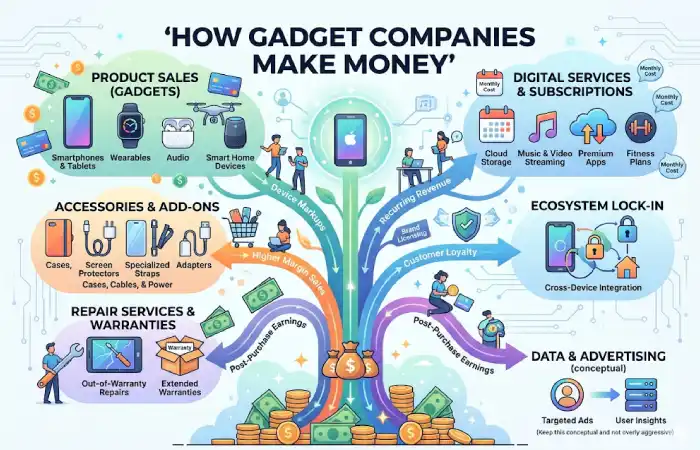
A common misconception among beginner investor is that gadget companies make money exclusively by selling gadgets. Actually, the real situation is that the huge electronic companies profit from a great many of resources.
Revenue Sources
| Revenue Stream | Example |
| Hardware Sales | Smartphones, TVs |
| Subscription Services | Cloud storage |
| Software Ecosystems | App stores |
| Advertising | Smart TV platforms |
| Accessories | Headphones, chargers |
| Licensing | Technology patents |
Apple would receive income from its services, whereas Sony receives income from its gaming subscriptions and entertainment content. This diversification as well offers large electronics companies some protection in times of recession.
Tech Hardware vs Software Investments
Selecting either hardware or software stocks ranks as one of the most difficult choices investors make.
Comparison Table
| Factor | Hardware Companies | Software Companies |
| Growth Potential | Moderate to High | High |
| Profit Margins | Lower | Higher |
| Manufacturing Costs | Significant | Minimal |
| Supply Chain Risk | High | Low |
| Competitive Advantage | Innovation | Recurring revenue |
There is generally a cyclical nature to hardware companies, whereas software companies, on the other hand, often operate on subscription bases.
Many investors opt for a mixed approach by holding investments across two groups. Some of today’s most popular gadgets began as ideas within startup and innovation trends.
Top Public Companies in Smart Gadgets
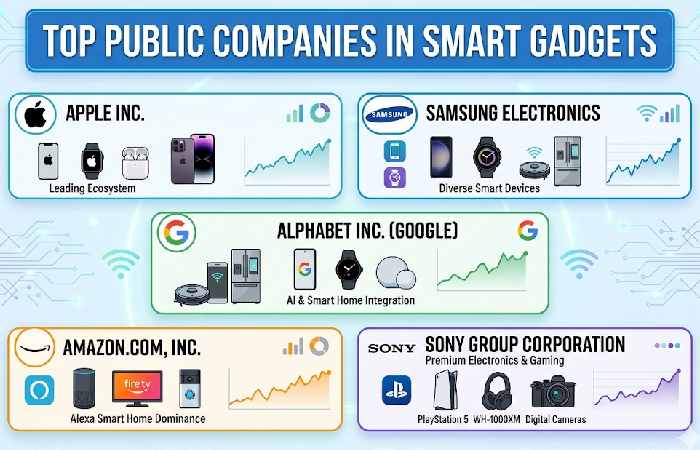
Smart household devices are slowly entering into our homes.
Major Smart Gadget Companies
| Company | Key Products |
| Apple | Apple Watch and AirPods |
| Samsung | Galaxy Watch and SmartThings |
| Sony | PlayStation and Smart Devices |
| Xiaomi | Smart Home Products |
| Garmin | Fitness Wearables |
The industry is still growing; more and more users prefer to use health trackers and AI assistants and smart home solutions. As asserted by industry analysts, Wearable technologies and smart devices with embedded AI technology will remain two of the fastest-growing segments within consumer electronics this decade.
The rapid growth of connected living has made
smart home device ecosystems an essential part of modern consumer electronics.
Semiconductor Stocks Powering Gadgets
Semiconductors are the foundation of all advanced electronic devices. From smartphones, to game consoles, to smartwatches, to those ever increasingly complex AI machines, advanced chips exist in the majority of systems.
Top Semiconductor Stocks in 2026
| Company | Ticker | Industry Role | Key Growth Driver (2026) | Investment Thesis | Resources |
| NVIDIA | NVDA | AI GPUs & Accelerators | AI infrastructure demand | Manufactures chips for NVIDIA, Apple, and Qualcomm | NVIDIA Investor Relations |
| Taiwan Semiconductor Manufacturing Company | TSM | Semiconductor Foundry | 2nm & 3nm manufacturing | Benefits from custom AI silicon and networking demand | TSMC Investor Relations |
| Broadcom | AVGO | AI Networking & Custom Chips | Hyperscaler AI spending | Increasing market share in the fields of AI accelerators and server processors | Broadcom Investors |
| Advanced Micro Devices | AMD | CPUs & AI GPUs | Data-center expansion | Important supplier of the HBM memory used in artificial intelligent systems | AMD Investor Relations |
| Micron Technology | MU | Memory & HBM Chips | AI memory demand | A Monopolist provider of EUV equipment has the necessary advanced chips | Micron Investors |
| ASML Holding | ASML | EUV Lithography | Advanced chip production | Demand for high-performance processors in smartphones and increased use of AI on device. | ASML Investor Relations |
| Qualcomm | QCOM | Mobile & Edge AI Chips | AI smartphones | Powers billions of devices through licensing model | Qualcomm Investor Relations |
| Arm Holdings | ARM | Chip Architecture Licensing | AI device growth | Manufactures chips for NVIDIA, Apple, AMD, and Qualcomm | Arm Investor Relations |
Nvidia continues to be well-positioned in the field of demand for Ai chips. TSMC manufactures many of the world‘s most advanced semiconductors. Micron gains from rising demand for AI memory chips and data-center infrastructure.
Semiconductor Market Snapshot (2026)
| Trend | Impact |
| AI Growth | Massive chip demand |
| Memory Shortages | Higher pricing power |
| Advanced Manufacturing | Increased capital spending |
| Smart Device Expansion | More chip consumption |
Industry “experts expect the semiconductor demand to remain a key driver of consumer electronics growth through 2026 and beyond.”
Risks of Consumer Electronics Investing
While the industry does seem to have a positive growth outlook investors must be cautioned of a few risks along the way.
Common Risks
- Supply chain disruptions
- Semiconductor shortages
- Economic slowdowns
- Product launch failures
- Regulatory changes
- Increased competition
Diversify over multiple segments of technology.
How Beginners Can Start Investing
If you‘re new to consumer electronics investing:
- Research leading companies.
- Understand business models.
- Compare valuation metrics.
- Follow earnings reports.
- Diversify across hardware and semiconductor stocks.
- Invest consistently over time.
Most of investors put together the consumer electronics stocks and the semi-conductor stocks to have an access on the whole technology supply chain.
Before purchasing any new device, readers should explore
consumer electronics buying guides for expert comparisons and recommendations.
Frequently Asked Questions
Is consumer electronics investing good for beginners?
Yes. Many worldwide consumer electronic manufacturers and brand names issue easily obtainable financial reports which can be researched with relative ease by beginners.
What is the biggest trend in consumer electronics investing?
One of the key drivers of growth today is the integration of artificial intelligence across devices.
Are semiconductor stocks part of consumer electronics investing?
Yes. Semiconductors are in our phones, gaming consoles and AI-enabled devices.
Which consumer electronics companies are most influential?
Apple, Samsung, Sony, and LG, among others, are still among the leaders of global consumer electronics.
Should investors choose hardware or software stocks?
Related to the previous point, a number of long-term investors will have both.
Final Thoughts
Consumer Electronics Investing remains one of the most attractive Technology investment themes in 2026. The combination of AI-enabled devices, intelligent gadgets, next-generation semiconductors and growing digital ecosystems are opening new doors for investors
Instead of emphasising a single company focus, investors might do well to look at the entire consumer electronics supply chain from device makers and wearable tech patents and brands to the semiconductor giants behind the new wave of devices.
Consumer electronics brands are increasingly investing in
next-generation wearable gadgets to improve health tracking and user connectivity.
CuDA has Established its supremacy in the AI accelerator market with Ledership in the data-center by the cuda ecosystem.
Kashifa Jafar is a technology writer and contributor at FutureTechExpert with 4+ years of experience in technology writing and content creation.
Read Full Bio of Author →Sameena reviews selected health, wellness, technology, and digital content for clarity, factual presentation, and reader usefulness.
Read Full Bio of Reviewer →