
 Kashifa Jafar
Technology Writer & Contributor
Kashifa Jafar is a technology writer and contributor at FutureTechExpert with 4+ years of experience in technology writing and content creation.
Read Full Bio of Author →
Kashifa Jafar
Technology Writer & Contributor
Kashifa Jafar is a technology writer and contributor at FutureTechExpert with 4+ years of experience in technology writing and content creation.
Read Full Bio of Author →
 Sameena Begum
Health, Technology & Digital Content Reviewer
Sameena reviews selected health, wellness, technology, and digital content for clarity, factual presentation, and reader usefulness.
Read Full Bio of Reviewer →
Sameena Begum
Health, Technology & Digital Content Reviewer
Sameena reviews selected health, wellness, technology, and digital content for clarity, factual presentation, and reader usefulness.
Read Full Bio of Reviewer →
Gaming headsets, a union of headphones and microphone into a single piece of equipment, provides players with sound for the game as well as a microphone without the need of an external microphone. The correct headset can allow you to more easily track footsteps, enhance immersion, facilitate team communication and remain comfortable.
However not all gaming headsets are aimed at the same player. Some wiring models can focus entirely on low latency while others that do not have wires do not. Some second their focus to competitive FPS gaming while others to single player games, consoles, streaming or home use.
Before you purchase, we will highlight the main features to consider in this guide.
 This article is part of
Gaming Gadgets Resources
Table of Contents
What Are Gaming Headsets?
A gaming headset is a headphone or earphone intended solely for playing games. Most gaming headsets are over-ear or on-ear types and have built in drivers, a microphone with a built in boom, a means of controlling sound level, and some sort of means of linking up to the game (i.e. gaming connectivity).
Modern headsets may also include features such as:
- 2.4GHz low-latency wireless connectivity
- Bluetooth
- Virtual surround or spatial audio
- Noise-canceling microphones
- Active noise cancellation (ANC)
- Custom EQ profiles
- Detachable or retractable microphones
- Multi-platform compatibility
The best choice is rather more playing to your gaming behavior then having the most extended specification list.
A gaming headset is an important part of any setup, but it is only one piece of the overall experience. You can build a more complete setup by choosing the right gaming accessories, including keyboards, mice, controllers, mouse pads, and gaming monitors.
Why Audio Matters in Gaming
Great in-game sound not only enhances your game, it can also help you locate where footsteps, gunfire, vehicles or ambient noises are.
This is especially true for games of skill where a few milliseconds may make all the difference.
RTINGS point out that for gaming headsets, you need to consider comfort, low latency connectivity, quality of positional sound and microphone, rather than trying to get the best sound quality in general headphone terms.
For story-driven games, on the other hand, soundstage, clarity of speech and bass may benefit thereon more immersion.
Wired vs. Wireless Gaming Headsets
The biggest buying decision is often connectivity.
| Feature | Wired | 2.4GHz Wireless | Bluetooth |
| Latency | Very low | Very low | Usually higher |
| Battery | Not required | Required | Required |
| Freedom of movement | Limited | Excellent | Excellent |
| Competitive gaming | Excellent | Excellent | Usually less ideal |
| PC compatibility | Usually excellent | Excellent | Depends on device |
| Convenience | Good | Excellent | Excellent |
| Typical use | Competitive/value | All-round gaming | Gaming + everyday use |
In competitive play wired or dedicated 2.4GHz wireless is usually better than regular Bluetooth as latency can be lower and more uniform.
Nowadays, a lot of gaming headsets support different kind of connection, so they can be used for gaming equipment but also for other things.
Surround Sound and Spatial Audio
Space audio tries to make sounds come from various directions around the player.
Depending on the platform and headset you might be using Windows Sonic, Dolby Atmos or spatial processing by the manufacturer.
But this does not mean surround sound is preferable to stereo.
In competitive FPS gaming, a true positional cue is often more relevant than the “7.1” label. Virtual surround sound can be a mouse click away from neutral on a bad headset.
E.g.. On its TUF Gaming H3 ASUS offers virtual 7.1 audio with Windows Sonic to enhance positional accuracy.
Noise-Canceling Gaming Headsets
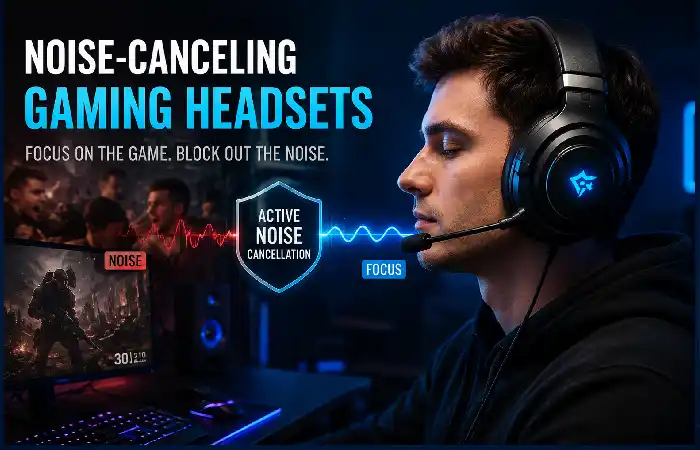
There are two types of noise cancellation buyers should be aware of:
Passive isolation results from the ear cushions blocking externally generated sound.
Active noise cancellation employs microphones and electric technology to cancel noise from the environment.
ANC could be helpful if your gaming room is a bit noisy, but it shouldn‘t be your only measurement criteria. The microphone noise reduction is a distinct feature and might be more crucial for multiplayer interactions.
Premium gaming headsets are gradually integrating inbuilt microphone noise cancellation or Ai voice processing. Among the 2026 current recommendations, it is proven that Ai noise cancelling is integrated in some top of the range headsets.
Gaming Headsets with Microphones
In terms of multiplayer gaming, the quality of the microphone is just as critical as the quality of the headphones.
Look for:
- Clear voice reproduction
- Background-noise reduction
- Easy mute controls
- A flexible boom arm
- Detachable or retractable microphone
- Good microphone positioning
An amazing-sounding microphone can be… For instance, a very nice sound in the peace and quiet of your room might not be the same next to your mechanical keyboard, fan or any other players.
Sound quality is only secundary, especially for competitive and team strategies games. In this case, focus on voice clarity while not on decoration.
Clear communication becomes even more important when your headset is paired with responsive gaming keyboards. A comfortable keyboard with fast and reliable inputs can complement your headset during competitive multiplayer gaming.
Headsets for FPS and Competitive Gaming
FPS players should prioritize:
- Positional accuracy
- Low latency
- Clear mids and highs
- Good microphone performance
- Lightweight construction
- Long-session comfort
While bass-rich tuning can be satisfying, it can also be overwhelming and push quieter FX like footsteps and reloads into the background.
In conclusion, competitive players should not pick a headset based on the amount of bass or virtual 7.1 surround it claims to have.
FPS players should also consider how their headset works alongside other peripherals. A precise gaming mouse can help with accurate aiming and quick movements, while a good headset makes it easier to hear footsteps and other positional audio cues.
Console and PC Gaming Headsets
Compatibility should be examined before you buy.
| Platform | What to Check | Recommended Connection |
| PC | USB, 3.5mm, software support | USB / 2.4GHz / 3.5mm |
| PlayStation 5 | PS5 compatibility and spatial audio | USB / 2.4GHz |
| Xbox | Xbox Wireless compatibility | Xbox-compatible wireless / 3.5mm |
| Nintendo Switch | USB-C / 3.5mm support | Wired / compatible wireless |
| Mobile | Bluetooth / USB-C | Bluetooth / USB-C |
Some headsets are multi-platform, others are designed for a specific ecosystem. Double check that your possible purchase will work with your platform.
The current 2026 buying guides more often split recommendations by PC, PS5, Xbox, Nintendo Switch and multi-platform usage, indicating that compatibility is becoming one of the factors in choosing a headset.
For console players, the headset is just one part of the setup. A responsive gaming controller can provide comfortable controls for racing, sports, action, and other controller-friendly games.
How to Choose a Gaming Headset
Use this simple checklist before buying:
| Priority | What to Look For | Why It Matters | Resource |
| Audio | Accurate sound and positioning | Helps identify game cues | RTINGS Gaming Headsets |
| Connectivity | Wired or low-latency 2.4GHz | Reduces connection delays | RTINGS PC Gaming Headsets |
| Microphone | Clear voice + noise reduction | Improves team communication | Lenovo Gaming Headsets |
| Comfort | Lightweight frame + good cushions | Important for long sessions | Lenovo Gaming Headsets |
| Compatibility | PC/console support | Prevents connection problems | Lenovo Gaming Headset Guide |
| Budget | Features that match your use | Avoids paying for unnecessary extras | Tom’s Hardware 2026 Guide |
My advice is to put more emphasis on the audio quality and microphone quality, connection and comfort before the RGB colors or appearance.
A complete gaming setup should also balance audio and visual performance. Along with choosing the right headset, selecting suitable gaming monitors can improve visual clarity, refresh rates, responsiveness, and overall immersion.
Gaming Headset Comfort and Fit
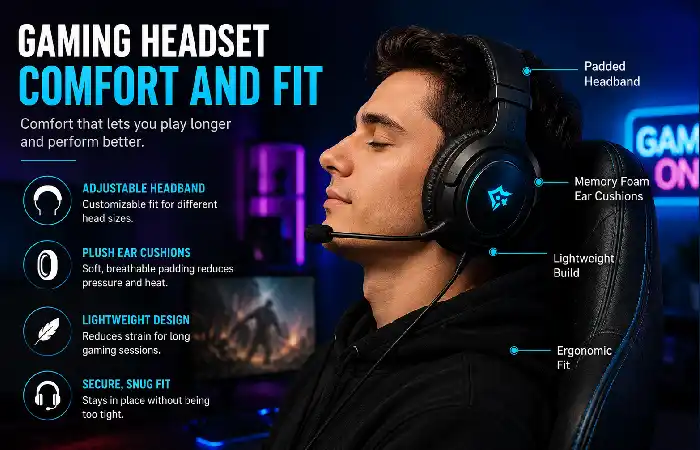
A headset can have wicked audio, but if you need to take it off after 30min then it kind of defeats the point of it‘s even good audio.
Check:
- Headband padding
- Ear-cup size
- Clamping pressure
- Overall weight
- Cushion material
- Adjustability
- Glasses compatibility if applicable
If you play for long periods of time, Air permeable cushions as well as a light weight body can benefit. As an example ASUSTEK highlights on its TUF Gaming H3, the light weight construction as well as fast-cooling memory-foam cushions.
Comfort is not limited to your headset. A suitable gaming mouse pad can provide a consistent surface for mouse movement and make longer gaming sessions more comfortable.
FAQs About Gaming Headsets
Are gaming headsets worth buying?
Yes, they deliver all of this in one package. They combine headphones and a microphone, add low latency connectivity, gaming controls, and a platform specific experience.
Should you go for a wired or wireless gaming headset?
Not necessarily. Wired systems can offer low latency and simple operation, while modern 2.4GHz wireless headsets offer the same low latency but with a much greater range of motion.
Is the presence of surround sound required for FPS games?
No. Favourable positional audio is of greater value than a label of a surround-sound system. While some players like stereo others may prefer the processing that lets them hear more spatially.
What should we look for in a good gaming headset?
A good gaming headset should also be clear with crisp, accurate sound, a good microphone, comfortable fit, an appropriate connection and compatibility with your gaming system.
Final Verdict
Not all of the best gaming headsets are the most expensive. If you know where you are going to be playing with it, then you will be able to choose the best gaming headset.
Looking ahead to 2026, the most compelling buying strategy is straightforward: select the best sound first, select the best mic second, select the best connectivity and compatibility third, select the bestComfortover the entire process second. Anything having to do withRGBlighting should follow the fundamentals.
Kashifa Jafar is a technology writer and contributor at FutureTechExpert with 4+ years of experience in technology writing and content creation.
Read Full Bio of Author →Sameena reviews selected health, wellness, technology, and digital content for clarity, factual presentation, and reader usefulness.
Read Full Bio of Reviewer →