
 Kashifa Jafar
Technology Writer & Contributor
Kashifa Jafar is a technology writer and contributor at FutureTechExpert with 4+ years of experience in technology writing and content creation.
Read Full Bio of Author →
Kashifa Jafar
Technology Writer & Contributor
Kashifa Jafar is a technology writer and contributor at FutureTechExpert with 4+ years of experience in technology writing and content creation.
Read Full Bio of Author →
 Sameena Begum
Health, Technology & Digital Content Reviewer
Sameena reviews selected health, wellness, technology, and digital content for clarity, factual presentation, and reader usefulness.
Read Full Bio of Reviewer →
Sameena Begum
Health, Technology & Digital Content Reviewer
Sameena reviews selected health, wellness, technology, and digital content for clarity, factual presentation, and reader usefulness.
Read Full Bio of Reviewer →
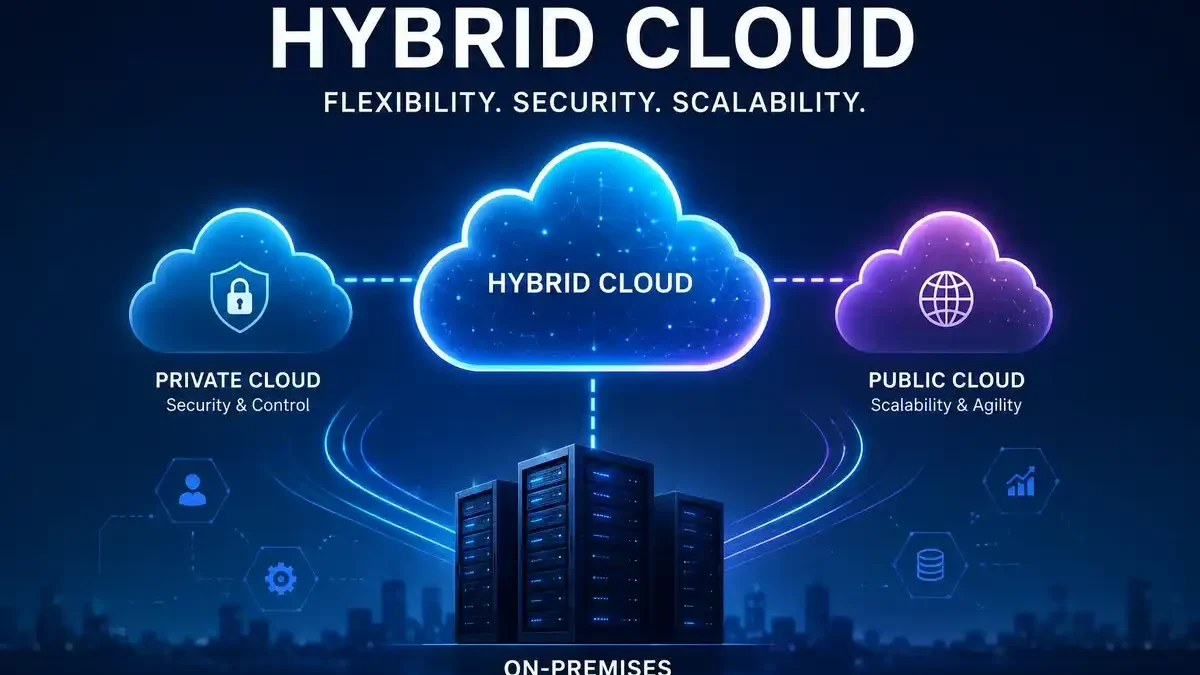
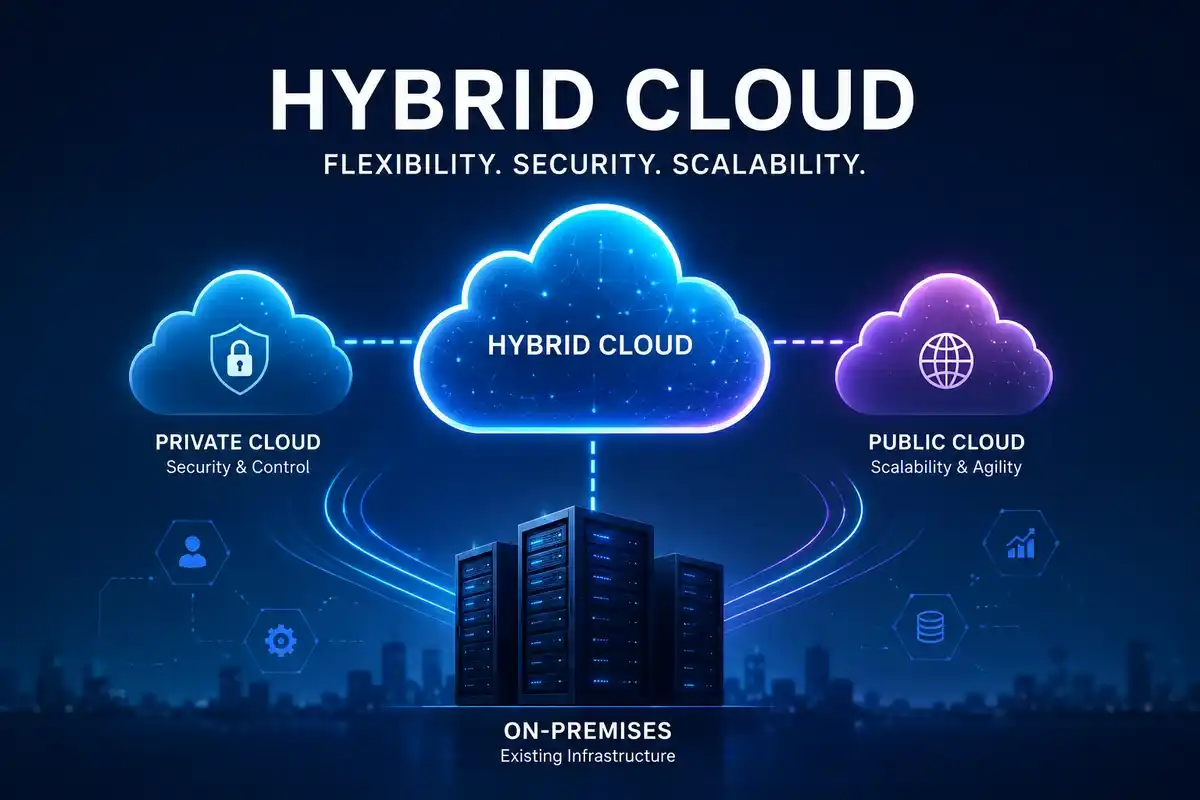
Hybrid cloud however refers to a combination of public and private cloud, or on premises infrastructure. This gives enterprises a greater level of control over sensitive workloads along with the flexibility of cloud. It remains prevalent as of 2026: 73 percent of enterprises use hybrid cloud as per State of the Cloud in 2026 by Flexera, an increase of 3 percentage points from the previous year.
Hybrid cloud can also be used as a compromise for enterprises doing a consolidation of legacy systems, managing regulated data, running AI workloads, or satisfying unpredictable demand.
 This article is part of
Deployment Models Resources
Table of Contents
What Is Hybrid Cloud?
A hybrid cloud is a composition of two or more clouds (private, public or both) that are bound together (which can be on-premises infrastructure, or an external service provider) by technology that allows data and applications to be shared amongst them.
For example, a bank could keep private customer data in a private cloud, but run analytics or customer service applications through a public cloud. Similarly, a retailer could run its core systems locally, but temporarily use cloud computing resources during times of high traffic.
The difference is integration. Just having both a private and a public cloud does not make a good hybrid cloud of the two. They have to be connected, coordinated, managed, and most importantly in a contemporary architecture have portability of workloads.
Before choosing a hybrid approach, it is important to understand the different cloud deployment models available to organizations, including public, private, community, multi-cloud, and hybrid environments.
How Hybrid Cloud Works
A typical hybrid cloud connects environments through technologies such as:
- VPNs and dedicated network connections for secure communication
- APIs for application and service integration
- Virtualization for efficient infrastructure utilization
- Containers and Kubernetes for portable workloads
- Cloud management platforms for centralized visibility
- Automation and orchestration for deploying and moving workloads
The basic workflow is straightforward:
On-premises/private infrastructure → secure connectivity → cloud platform → centralized management → workload/data orchestration
Allows the business to determine the optimized location for each workload to execute based upon business cost, perf-ormance, security, latency, compliance and availability requirements.
Organizations that need scalable infrastructure and flexible access to shared resources may consider the public cloud deployment model, which can provide on-demand computing resources without requiring businesses to maintain all infrastructure themselves.
Key Features of Hybrid Cloud
| Feature | Why It Matters | Resource |
| Workload portability | Allows applications to operate across environments | IBM Hybrid & Portable Architecture |
| Unified management | Improves visibility across infrastructure | IBM Hybrid Cloud Management |
| Secure connectivity | Connects private and public environments | Google Cloud Hybrid Cloud Guide |
| Automation | Speeds deployment and resource provisioning | Red Hat Hybrid Cloud |
| Scalability | Adds public-cloud capacity when demand increases | Microsoft Azure Hybrid Cloud |
Benefits of Hybrid Cloud
However, hybrid clouds are attractive to an enterprise because it allows an enterprise to leverage the right platform for any application or workload.
Flexible: You can suspend your workload at the point where highest efficiency/lowest cost can be achieved or merge the different loads.
Scalability: More computing resources are available from the public cloud if the web site experiences heavy traffic.
Protection & compliance: Critical workloads can be hosted in secure areas and less critical applications can be sent to public cloud.
Cost optimisation: Organisations can inlineavoid that expanding physical infrastructure for every workload and still keep investments.
Business continuity use of cloud resources can implement backup, disaster recovery and failover.
Accelerated innovation: Teams are able to use cloud native technologies such as AI, analytics, containers, and managed services, while holding on to some of the legacy estate.
Businesses with strict security, compliance, or data-control requirements may benefit from a private cloud deployment model, which provides greater control over infrastructure and workload management.
2026 Hybrid Cloud Data Snapshot
| 2026 metric | Finding | Source |
| Organizations using hybrid cloud | 73% | Flexera 2026 State of the Cloud Report |
| Hybrid cloud adoption, ≤5,000 employees | 69% | Flexera 2026 Report Data |
| Hybrid cloud adoption, >5,000 employees | 78% | Flexera 2026 Report Data |
| Estimated wasted IaaS/PaaS spend | 29% | Flexera 2026 State of the Cloud Report |
| Organizations with a Cloud Center of Excellence | 71% | Flexera 2026 Cloud Findings |
The 73% figure is significant. Hybrid cloud is not just a ‘half-way house’ architecture in 2026: it is the prevailing operating model.
Challenges of Hybrid Cloud
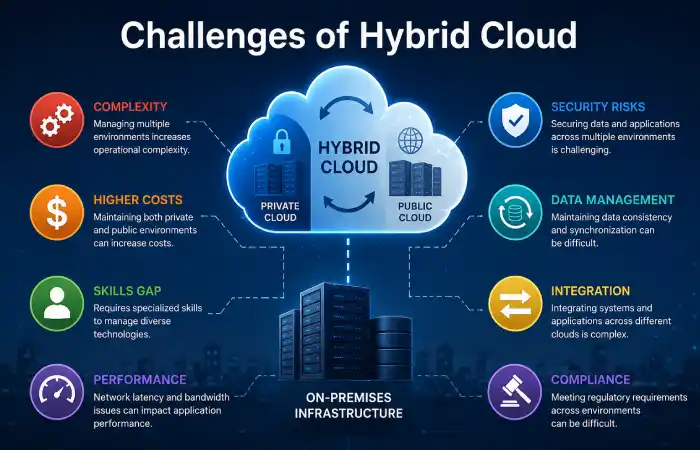
With more agility in hybrid cloud, there is also more cost.
Companies end up having to deal with a very large number of architectures, layers of networking, identity systems, security policies, monitoring, and pricing. Architectures that are not well thought out can create visibility gaps and costly surprises.
Common challenges include:
- Complex infrastructure management
- Data synchronization problems
- Network latency
- Higher operational costs
- Skills shortages
- Vendor lock-in
- Inconsistent security policies
- Difficult cloud cost forecasting
According to Flexera‘s 2026 research, 29% of IaaS and PaaS expenditure was squandered, further underlining the importance of cost governance in a cloud ecosystem so often becoming more complex.
Organizations that share similar regulatory, security, or operational requirements can explore a community cloud deployment model designed around the needs of a specific group or industry.
Hybrid Cloud Security
A holistic approach to security is preferred instead of segregating public and private infrastractures.
A strong hybrid cloud security model should include:
- Zero-trust access controls
- Multi-factor authentication
- Encryption in transit and at rest
- Identity and access management
- Network segmentation
- Continuous monitoring
- Centralized logging
- Regular vulnerability assessments
- Consistent compliance policies
Security is especially critical when sensitive data flows across environments. Data should be classified first and then deciding where to store and compute it.
According to research by Flexera in 2026,security and compliance risks constitute the highest scaling concern for all cloud-based AI initiatives. This underscores the need for governance which will prove more crucial as hybrid environments becomes more AI-intensive.
Hybrid cloud should not be confused with multi-cloud. While hybrid cloud combines private and public environments, multi-cloud deployment involves using cloud services from multiple providers to meet different business and workload requirements.
Integrating Public and Private Cloud
Successful integration is not only about a network connection. Organizations should have aligned policies for identity, security, monitoring, automation and data-management between environments.
Common integration technologies consist of VPNs, API‘s, SD-WAN, containers,Kubernetes, infrastructure as code and on a central management platform.
For instance, Kubernetes allows teams to package applications in a consistent way so that workloads can be moved across private infrastructure and between public-cloud environments with less of a difference in architecture.
The right deployment strategy depends on an organization’s workload requirements, security priorities, budget, and scalability goals. Businesses evaluating these factors can learn more about cloud deployment for businesses before selecting an architecture.
Hybrid Cloud Data Management
One of the most crucial parts of hybrid cloud architecture is data handling.
Organizations should define:
- Where sensitive data is stored
- Which workloads can access it
- How data moves between environments
- Backup and retention requirements
- Data residency requirements
- Encryption standards
- Disaster recovery procedures
One pragmatic compromise is to keep sensitive or regulated data in controlled environments, and perform elastic workloads using the public-cloud storage and processing available.
Common Hybrid Cloud Use Cases
Cloud Bursting
While the private infrastructure scales to meet the usual flow of demand, the public cloud provides ephemeral capacity during higher demand periods. This is appropriate for ecommerce, media, seasonal business, or any other workload with variable demand.
Application Modernization
Businesses are also able to gradually evolve legacy applications rather than doing a wholesale migration.
Disaster Recovery
The critical workload can be supported in the cloud infrastructure as a secondary environment for backup and recovery.
AI and Machine Learning
Thus, organizations can maintain sensitive data in secure locations and use on-demand cloud computing and AI services when needed.
Regulated Industries
In sectors such as banking, health systems, government and others in regulated circumstances hybrid architectures are well suited to the compromise between needs for regulatory compliance and the greater scale and efficiency of the cloud.
How to Build a Hybrid Cloud Strategy
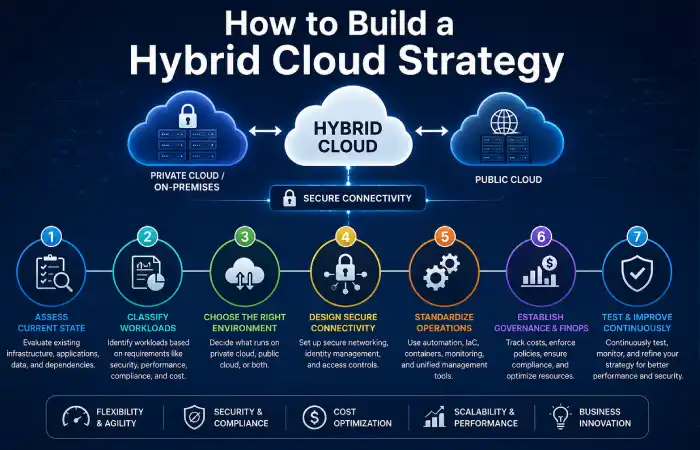
The potential of a hybrid can be exploited only if the business requirements are identified before one starts a technology choice.
Step 1: Assess existing infrastructure.
Inventory of the applications, servers, databases, dependencies, data and networking.
Step 2: Classify workloads.
Learn how to identify workload requirements based on high security, low latency, customer scalability or governance control.
Step 3: Select the right environment.
For each workload, determined if it should be on-premises, a private cloud, or a public cloud.
Step 4: Design secure connectivity.
Build a robust networking fabric between environments and shape a consistent identity governance.
Step 5: Standardize operations.
Utilize automation, containers, infrastructure as code, monitoring and a common management cluster where suitable.
Step 6: Establish FinOps and governance.
Monitor cloud consumption, ownership, performance, compliance, and business value.
Step 7: Test continuously.
Verify security, disaster recovery, failover, latency, scalability, and application performance prior to production.
2026 is becoming more relevant for this governance-first approach. According to Flexera 71% of organizations now have a Cloud Center of Excellence and 64% say they now judge their cloud migration progress based on value delivered to business units.
FAQs About Hybrid Cloud
Is hybrid cloud superior to public cloud?
Not quite. Hybrid cloud is more suitable when a firm requires a mix of public-cloud scalability and control in private or on-premise cloud. Cloud-only architecture could be less complex for firms which do not have regulatory or legacy and infrastructure restrictions.
But in the comparison of hybrid cloud and multicloud?
No. Hybrid cloud connects distinct infrastructure environments, for example private/on-premises to public cloud. Multicloud usually refers to a combination of services from different, public-cloud vendors. An organization can employ both approaches at the same time.
What advantages do hybrid clouds offer?
Flexibility, scalability, where the workload is placed, security administered, business continuity and leveraging new cloud capabilities are the key advantages.
Is hybrid cloud cost?
It can be. Companies may be forced to keep their private infrastructure while still paying for public-cloud services. Good FinOps, workload optimization and good governance are thus needed.
For whom is it appropriate?
Hybrid cloud may be compelling for existing systems,regulatory or variable workloads,variable demand, data-residency, ordrivingapplication modernization.
Bottom Line
Hybrid cloud is a dominant topical-hub keyword for 2026 because it is a word that lies across the domains of cloud infrastructure, cloud networking and security, cloud data and AI, and cloud modernization and enterprise strategy. Based on present investigations, it has been found that 73% of the interviewed organizations have hybrid cloud architecture, which makes it a prominent deployment model.
Regarding SEO, the greatest chance there is to go a level deeper than the definition and discuss how hybrid cloud operates and when, for security, data handling, providers (pricing options), actual examples, troubleshooting and rollout strategies. This wider approach can naturally serve multiple targeted keywords and also offer a more hands on guide than yet another brushstrokes cloud definition.
Kashifa Jafar is a technology writer and contributor at FutureTechExpert with 4+ years of experience in technology writing and content creation.
Read Full Bio of Author →Sameena reviews selected health, wellness, technology, and digital content for clarity, factual presentation, and reader usefulness.
Read Full Bio of Reviewer →