
 Kashifa Jafar
Technology Writer & Contributor
Kashifa Jafar is a technology writer and contributor at FutureTechExpert with 4+ years of experience in technology writing and content creation.
Read Full Bio of Author →
Kashifa Jafar
Technology Writer & Contributor
Kashifa Jafar is a technology writer and contributor at FutureTechExpert with 4+ years of experience in technology writing and content creation.
Read Full Bio of Author →
 Sameena Begum
Health, Technology & Digital Content Reviewer
Sameena reviews selected health, wellness, technology, and digital content for clarity, factual presentation, and reader usefulness.
Read Full Bio of Reviewer →
Sameena Begum
Health, Technology & Digital Content Reviewer
Sameena reviews selected health, wellness, technology, and digital content for clarity, factual presentation, and reader usefulness.
Read Full Bio of Reviewer →
Data Security Services enable organizations to keep private information secure from unauthorized access, leakage, ransomware, accidental deletion, as well as various other security risks. Data security services leverage information security solutions such as database encryption, data leakage prevention, secure storage solutions, database security, access controls, event monitoring, data backup and recovery, etc. to enable long-term security of data.
In 2026, focus on data protection is more important as for raising the use of organizations who use cloud-based architecture, SaaS applications, virtual /remote working, hyper automation, AI/ML tools and hybrid infrastructure. As per the study, the average cost of data breach in India was Rs.25.5 crore in 2026 and average data breach exposed around 39500 records.
 This article is part of
Cybersecurity Resources
Table of Contents
What Are Data Security Services?
Data security services include commercial services aimed at safeguarding business and customer data from unauthorized access, loss, theft, corruption or misuse.
Depending on the provider, services may include:
- Data discovery and classification
- Data encryption
- Data Loss Prevention (DLP)
- Database security
- Secure cloud storage
- Identity and access controls
- Backup and disaster recovery
- Data masking and tokenization
- Security monitoring and auditing
- Compliance and security assessments
More and more of the leading providers are integrating these capabilities into a broader data security strategy covering data at rest, in transit and in use.
A strong data protection strategy should be part of a broader cybersecurity services approach that protects systems, users, applications, and sensitive information.
Why Data Security Is Important
Businesses keep important data, it includes Customer information such as addresses, order details, contact number, email-id etc Business related payment details Employee details such as address, contact number, salary etc.
Intellectual property details including creative ideas and concept and many financial documents.
A successful attack can result in:
- Financial losses
- Regulatory penalties
- Business interruption
- Reputation damage
- Customer churn
- Intellectual-property theft
- Ransomware-related downtime
Ministry of Home Affairs (India) gave information about the number of cyber security incident of the India. There were 2,944,248 in 2025 against 2,041,360 in 2024.
Because sensitive data moves across internal and external networks, organizations should combine data protection with reliable network security services to reduce unauthorized access and network-based threats.
Data Encryption and Protection
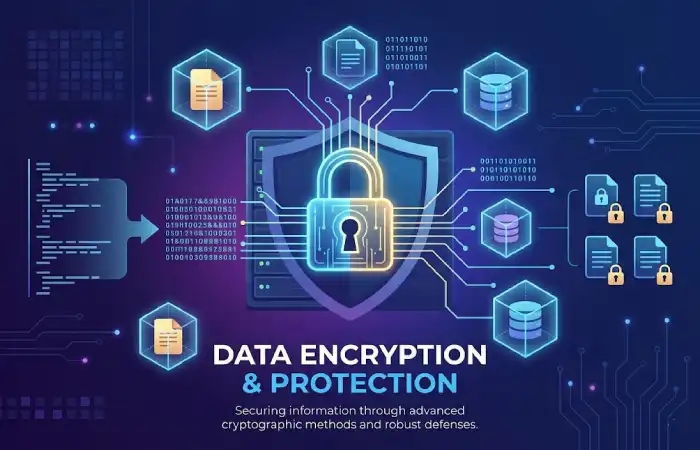
Crypto transforms intelligible data into unintelligible data, and intelligent data can only be accessed with the correct key.
Organizations commonly use encryption for:
- Data stored on servers
- Cloud storage
- Databases
- Laptops and endpoints
- Email and file transfers
- Data moving between applications
Contemporary data security applications and tools also employ techniques such as masking and tokenization to limit the leakage of unprotected information. Both TCS and HCLTech recognize the use of encryption as well as the generation and management of keys along with masking/ tokenization for protectoching enterprise data.
Implement best practices: Example; Store data securely when inactive and transmit it in a secure manner. Additionally, keep separate keys for data encryption. Use a robust security model to control access to these keys.
Businesses storing applications and information in cloud environments should also consider cloud security services to protect cloud workloads, identities, storage, and data.
Data Loss Prevention
Data Loss Prevention: A service set to curtail copying, sharing, uploading, emailing or any other form of transfer of confidential data.
For example, a DLP policy might prevent an employee from forwarding a customer database to his or her own e-mail address.
DLP can protect:
- Cloud storage
- Endpoints
- SaaS applications
- Collaboration platforms
- Databases
- Removable devices
According to Grand View Research, the world DLP market will reach an estimated value of about $4.1 billion in 2026.
Data can also be exposed through laptops, desktops, smartphones, and other connected devices, making endpoint security services an important layer of protection.
Secure Data Storage
Secure storage describes the act of protecting data that is stored anywhere, which might include the local data center, private clouds, public clouds, data records, or end point.
Important controls include:
- Encryption
- Strong authentication
- Access restrictions
- Continuous monitoring
- Secure configuration
- Backup copies
- Regular vulnerability assessments
Clouds needs special care as data can be left in several with the future perspective to lead to other clouds.
Database Security
Databases are likely to hold some of an organisations most valuable information.
Database security services can include:
- Database encryption
- Authentication
- Role-based access
- Privileged access management
- Database activity monitoring
- Vulnerability assessments
- Auditing
- Anomaly detection
Monitoring of activity in a database is now being embedded in enterprise data-security services because it can help organizations detect anomalous access and investigation of compliance issues.
Organizations without extensive in-house security teams can use managed cybersecurity services for continuous monitoring, threat detection, and security support.
Backup and Data Recovery
There is no single security control that cannnot offer assurances that the data will never be lost.
Hence, a sound data-security solution should include a solid backup and recovery plan.
A practical approach includes:
- Automated backups
- Multiple backup locations
- Offline or immutable backup copies
- Regular recovery testing
- Defined recovery objectives
- Ransomware-resistant backup policies
A backup is only advantageous if the organization has the ability to restore successfully if required.
Data Access Controls
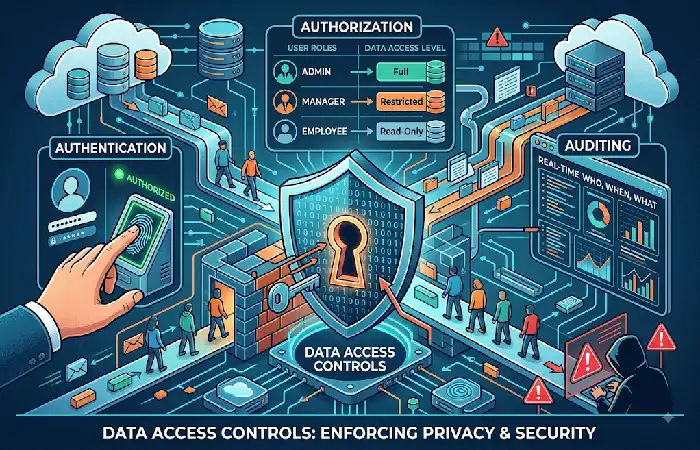
Access controls identify the users and objects that participate in a transaction, specify what data they can access, and specify what operations can be performed.
Common controls include:
- Role-Based Access Control (RBAC)
- Attribute-Based Access Control (ABAC)
- Multi-Factor Authentication (MFA)
- Privileged Access Management (PAM)
- Least-privilege policies
- Access reviews
- Identity governance
The task is very simple. It seems that the employees should have the required permissions for getting their jobs done properly, but they must not have additional ones beyond it.
Before implementing data protection controls, organizations should identify vulnerabilities and prioritize threats through cybersecurity risk assessment services.
Benefits of Data Security Services
A well-designed data security program can help organizations:
| Benefit | Business value |
| Data protection | Reduces unauthorized exposure |
| Encryption | Makes stolen data harder to use |
| DLP | Reduces accidental and intentional data leakage |
| Access controls | Limits unnecessary privileges |
| Database monitoring | Improves visibility into sensitive data access |
| Backup and recovery | Improves resilience after incidents |
| Compliance | Supports regulatory and audit requirements |
| Continuous monitoring | Helps identify suspicious activity earlier |
For enterprise environments, providers such as IBM Data and AI Security Services and HCLTech Data Security Services combine multiple controls instead of treating data security as a single product.
Data Security Best Practices
Follow these best practices to strengthen your data-security strategy:
- Classify sensitive data based on its importance and risk.
- Apply least privilege to users, applications, and administrators.
- Encrypt sensitive data at rest and in transit.
- Deploy DLP controls for email, endpoints, cloud applications, and other important data channels.
- Monitor database activity for unusual access.
- Maintain tested backups that can withstand ransomware incidents.
- Use MFA for important accounts.
- Review permissions regularly and remove unnecessary access.
- Monitor cloud environments for misconfigurations and exposed data.
- Test your incident-response and recovery plans rather than assuming they will work.
The same warning comes from IBM‘s 2026 X-Force research, which states What you do in the first round of the game will have a magnified effect. Exploits targeting public-facing applications increased 44% from the prior year.
FAQs About Data Security Services
What are data security services?
Data security services provide technology and professional services that safeguard sensitive information from being lost, stolen, damaged, viewed without authority and otherwise misused.
What do data security services actually comprise?
It could be encryption, DLP, database security, access controls, data classification, monitoring, backup and recovery, compliance and cloud data protection.
Are data security services only for large corporate organizations?
No. Small/midsize companies have customer, employee, financial, and operational data that is sensitive and of privacy. Security controls are dependent on size, risk, industry, and regulation.
So, what is the main distinction between data security and cybersecurity?
Cybersecurity (or information security) defends the systems, networks, applications, users and data from malicious computer systems. Data security (or information security) is about the protection of the data‘s confidentiality, integrity, availability and usability.
How costly are services of data security?
Prices depend significantly on the volume and type of data involved, number of users, infrastructure, complexity of compliance controls, required technologies and management or operated services. Companies should ask that a risk-based valuation be performed rather than compare the price.
Final Takeaway
Data Security Services are no longer just about encryption or “antivirus” protection. To secure data properly in 2026 a multi-layered solution will be needed: data discovery, encryption, DLP, database security, access controls, secure storage, monitoring and tested recovery.
The best approach is to first locate your top high-risk data, then determine who has access to it, secure it during the entire life of the data, keep vigilant for anomalous behavior, and keep trustworthy recovery mechanisms.
If you are a business trying to decide on a provider, don‘t be dazzled by a long list of features. Ask them about their experience with your industry, your cloud environment, your compliance needs, their monitoring, incident response, recovery, and integration of security controls with your existing infrastructure.
Kashifa Jafar is a technology writer and contributor at FutureTechExpert with 4+ years of experience in technology writing and content creation.
Read Full Bio of Author →Sameena reviews selected health, wellness, technology, and digital content for clarity, factual presentation, and reader usefulness.
Read Full Bio of Reviewer →