
 Kashifa Jafar
Technology Writer & Contributor
Kashifa Jafar is a technology writer and contributor at FutureTechExpert with 4+ years of experience in technology writing and content creation.
Read Full Bio of Author →
Kashifa Jafar
Technology Writer & Contributor
Kashifa Jafar is a technology writer and contributor at FutureTechExpert with 4+ years of experience in technology writing and content creation.
Read Full Bio of Author →
 Sameena Begum
Health, Technology & Digital Content Reviewer
Sameena reviews selected health, wellness, technology, and digital content for clarity, factual presentation, and reader usefulness.
Read Full Bio of Reviewer →
Sameena Begum
Health, Technology & Digital Content Reviewer
Sameena reviews selected health, wellness, technology, and digital content for clarity, factual presentation, and reader usefulness.
Read Full Bio of Reviewer →
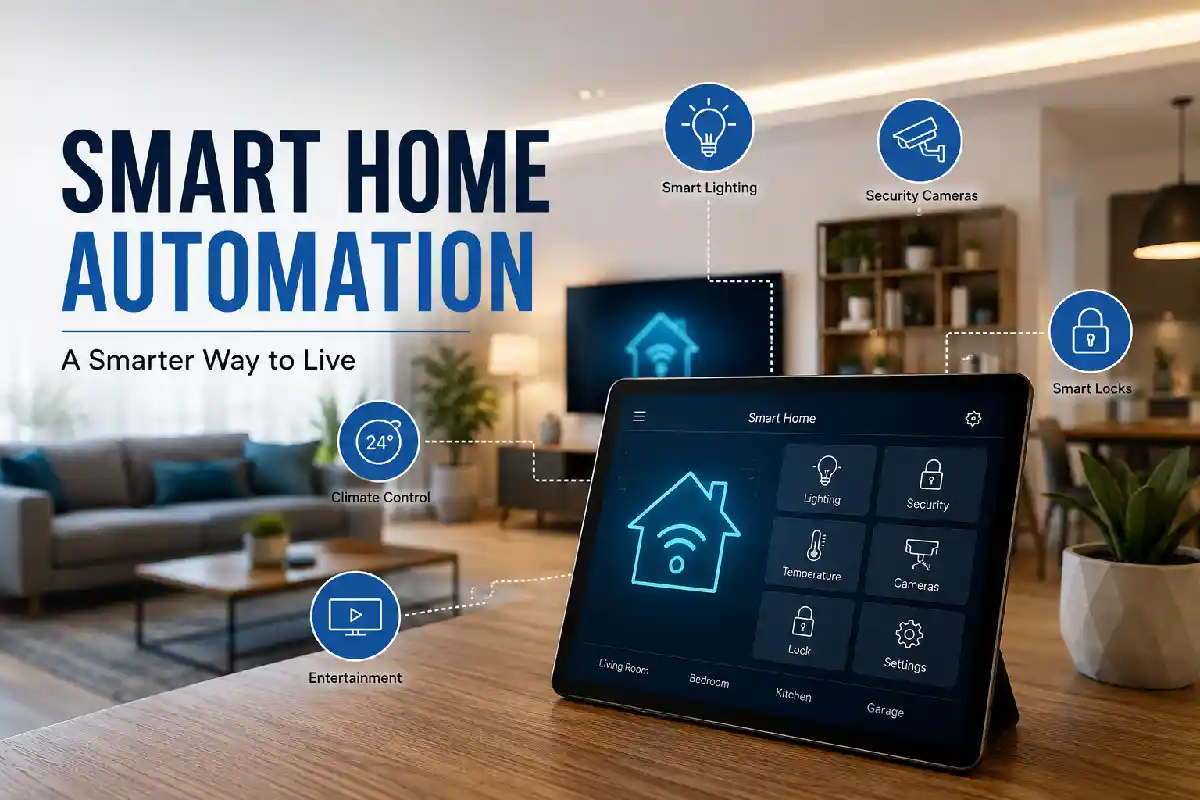
Smart Home Automation is changing the experience of controlling lights security climate entertainment and appliances! You don;t need to manually turn on or off appliances. Your home can control them automatically using scheduling sensor occupancy or by voice, etc.
With the updated Matter, Thread, AI Routines and cheap smart devicesavailable by 2026, automating your home is more achievable than ever before. If you are building your smart home from the ground up, or just want to automate components within your existing home, you need to get to grips with the principles of automation in order to select a system which is simple, secure and energy-efficient.
 This article is part of
Smart Home Gadgets Resources
Table of Contents
What Is Smart Home Automation?
Smart Home Automation is a system that control all connected device in a home and make it conduct automatically according to scheduled, trigger, sensor or demand from user. With the smart home automation system, you do not need to switch on the lamp, set the temperature, the security camera, close the door, or switch on appliance, the system will do it for you.
Fundamental to all smart home automation is the integration of devices via central management platform, smart hub or one of the mobile appli-cations. The various devices communicate and execute auto-mations by using Wi-Fi, Zigbee, Z-Wave, Bluetooth, Thread and Matter technologies.
A typical automation follows:
Trigger → Condition → Action
Examples include:
- Motion detected → Turn on hallway lights
- Sunset → Close smart blinds
- Everyone leaves home → Arm security system
- Voice command → Start movie scene
Can be implemented through the cloud, smart hubs or local controllers it‘s quite common for current systems to do all three approaches.
Smart automation delivers the best results when it is part of a properly planned smart home installation that connects devices, networks, and control systems into a unified ecosystem.
Benefits of Home Automation
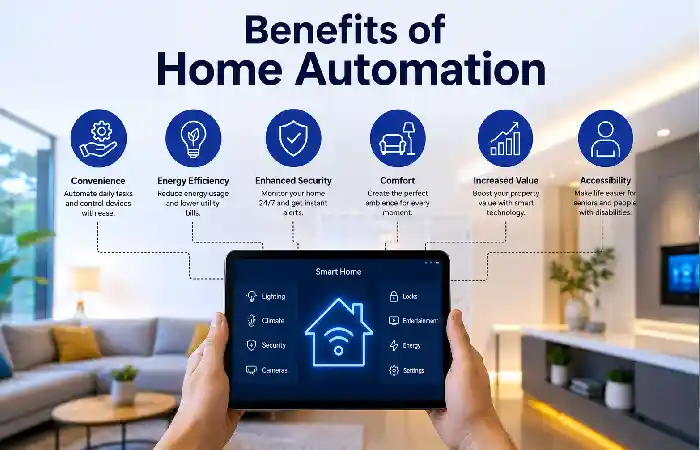
Benefit Comparison Table
| Benefit | Impact |
| Convenience | Automates repetitive tasks |
| Energy Savings | Reduces unnecessary power usage |
| Security | Continuous monitoring and alerts |
| Comfort | Personalized environments |
| Accessibility | Easier control for seniors and disabled users |
| Property Value | Modern smart homes attract buyers |
Occupancy sensors, Smart thermostats, and smart lighting can dramatically reduce energy consumption, while providing added comfort to our everyday life.
Many homeowners integrate automation with smart home security systems to automatically lock doors, trigger alarms, and send real-time security alerts.
Smart Home Hubs and Controllers
Smart home hubs and controllers serve as the brains of a smart home automation system. They connect, control and communicate with all of the smart devices in the house, in the living room, the kitchen and even outside or the backyard such as lights, thermostats, cameras, door locks and sensors, and entertainment devices.
Without a hub or controller, many devices are merely “smart,” and cannot communicate with one another, and eventually, the majority of devices cannot be automated to make a smart home a smart home.
And now in 2026, smart home hubs are more powerful than ever before thanks to support for more recent standards such as Matter and Thread making it easier than ever for devices from various makers to work together more effortlessly.
Smart Home Platform Comparison (2026)
| Platform | Best For | Strengths | Resource |
| Apple Home | Apple users | Privacy, simplicity | Apple Home |
| Google Home | Android households | AI and voice integration | Google Home |
| Amazon Alexa | Beginners | Device compatibility | Amazon Alexa |
| Home Assistant | Power users | Local control, customization | Home Assistant |
| Hubitat | Advanced automation | Offline reliability | Hubitat |
Both Home Assistant and Hubitat are gaining traction for the promise of local processing and limited cloud reliance.
Voice-Controlled Home Automation
Voice assistants are still the most common way to interact with a smart home.
Common commands include:
- Turn on living room lights
- Lock the front door
- Set thermostat to 22°C
- Start movie mode
- Activate bedtime routine
Voice assistants allow us to perform multiple actions simultaneously something that would be more challenging to do without them.
Smart Scenes and Routines
Scenes also syngergize several movement in a single command.
Example Smart Home Routines
| Routine | Actions |
| Good Morning | Open blinds, turn on lights, start coffee maker |
| Leaving Home | Turn off lights, lock doors, arm security |
| Movie Night | Dim lights, close blinds, power entertainment system |
| Bedtime | Lock doors, adjust thermostat, turn off lights |
Routines dramtically cut down on interaction has built a life of ease.
Automated Lighting and Climate Control
Lighting and HVAC automation provide one of the quickest paybacks.
Smart Lighting Features
- Motion activation
- Occupancy sensing
- Sunrise/sunset automation
- Adaptive brightness
- Energy monitoring
Smart Climate Features
- Learning thermostats
- Temperature scheduling
- Room-by-room control
- Presence detection
Contemporary systems can automatically recognize and adapt to housing needs by managing heating /cooling where such measures can be taken, therefore putting heating/cooling tariffs down.
Automated schedules and voice commands make smart home lighting solutions more convenient while helping reduce unnecessary energy consumption.
Automated Security Systems
Security is one of the most compelling factors to getting homeowners to automate.
Smart Security Components
- Smart cameras
- Video doorbells
- Smart locks
- Motion sensors
- Window sensors
- Smart alarms
Security Device Comparison
| Device | Purpose |
| Smart Lock | Keyless entry |
| Video Doorbell | Visitor monitoring |
| Security Camera | Live surveillance |
| Motion Sensor | Intrusion detection |
| Smart Alarm | Emergency response |
Nowadays, do-it-yourself security system is increasing due to not merely assistance with installation but also economic affordable.
Smart Home Scheduling
Scheduling is the automatic execution of tasks based on time instead of user interaction.
Popular schedules include:
- Lights at sunset
- AC before arrival home
- Water heater activation
- Garden irrigation
- Robot vacuum cleaning
He used time-based automation. This is probably the most fundamental way to improve efficiency.
A reliable smart home Wi-Fi network ensures that automation hubs, sensors, and connected devices communicate without interruptions.
How to Design a Smart Home Automation System
Step 1: Define Goals
Identify priorities:
- Security
- Energy savings
- Convenience
- Entertainment
- Accessibility
Step 2: Choose an Ecosystem
Select one primary platform:
- Apple Home
- Google Home
- Alexa
- Home Assistant
Step 3: Build Core Infrastructure
Start with:
- Reliable Wi-Fi 7 network
- Smart hub
- Smart speakers
A well-established network is vital as all devices will rely on reliable connection and access.
Step 4: Expand Gradually
Add:
- Lighting
- Climate control
- Security
- Entertainment
- Energy monitoring
Energy-efficient automation becomes even more effective when paired with smart thermostat installation for intelligent climate control.
Smart Home Automation Installation Best Practices
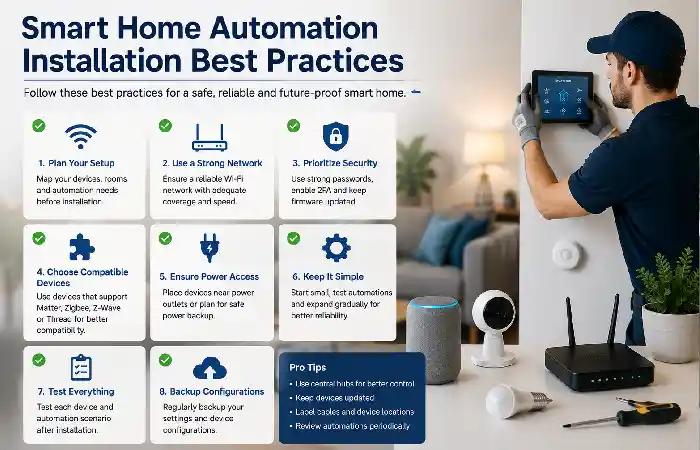
Recommended Checklist
- Plan device positions in advance.
- Use a ‘mixed bag’ of devices.
- Prefer Matter-certified products
- Use protected Wifi with strong passwords.
- Two-factor authentication14
- Create a backup automation.
Record every setting of the equipment.
Avoid These Mistakes
- Blending different ecosystems without distorting their inherent context
- Weak Wi-Fi coverage
- Overered complex routines.
- Overlooking Firmware upgrades
- Full reliance on cloud automation.
Advanced automation routines can activate smart home camera systems whenever motion is detected around your property.
FAQ
Is home automation a good investment in 2026?
Yes. Today‘s systems are more dependable, less expensive, and more compatible than the past.
Do I require a hub?
Not necessarily. Many devices work directly over Wi-Fi, but the hubs would ensure greater reliability and more advanced automation possibilities.
What constitutes a matter in smart homes?
Matter offers a common smart home standard that better supports interoperability across brands and ecosystems.
Can you cut down your electricity bills using smart house automation?
Yes. The use of automatic lighting, temperature control, and tracking the energy consumed can reduce the amount of energy wasted.
Is home automation safe?
Modern smart home platforms are relatively secure if the homeowner uses strong passwords and enabled two-factor authentication through the use of encryption.
Conclusion
Smart Home Automation has changed from an indulgence to a sensible technology that enhances comfort, security and energy savings. A well-chosen ecosystem, dependable networking and purposeful automations can set up a connected dwelling that is ready for the future and evolves with life. As the underlying technology of Matter, AI and local control continues to develop and improve in 2026, smart home automation will be better, smarter, easier.
Kashifa Jafar is a technology writer and contributor at FutureTechExpert with 4+ years of experience in technology writing and content creation.
Read Full Bio of Author →Sameena reviews selected health, wellness, technology, and digital content for clarity, factual presentation, and reader usefulness.
Read Full Bio of Reviewer →