
 Kashifa Jafar
Technology Writer & Contributor
Kashifa Jafar is a technology writer and contributor at FutureTechExpert with 4+ years of experience in technology writing and content creation.
Read Full Bio of Author →
Kashifa Jafar
Technology Writer & Contributor
Kashifa Jafar is a technology writer and contributor at FutureTechExpert with 4+ years of experience in technology writing and content creation.
Read Full Bio of Author →
 Sameena Begum
Health, Technology & Digital Content Reviewer
Sameena reviews selected health, wellness, technology, and digital content for clarity, factual presentation, and reader usefulness.
Read Full Bio of Reviewer →
Sameena Begum
Health, Technology & Digital Content Reviewer
Sameena reviews selected health, wellness, technology, and digital content for clarity, factual presentation, and reader usefulness.
Read Full Bio of Reviewer →
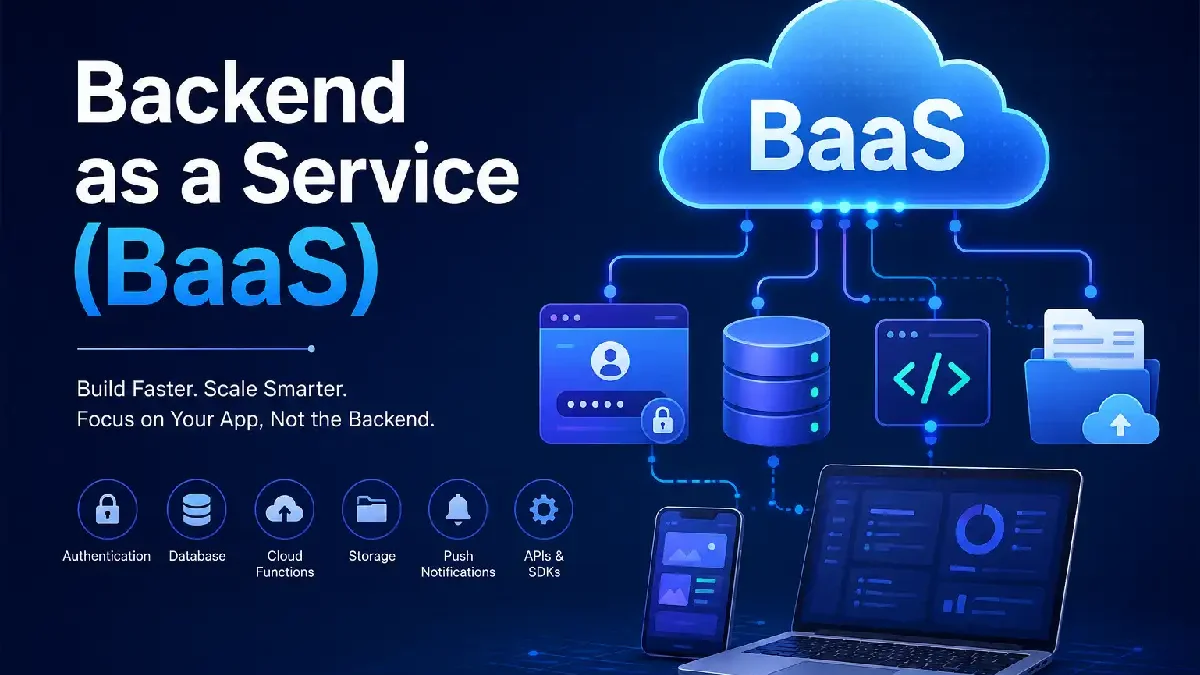
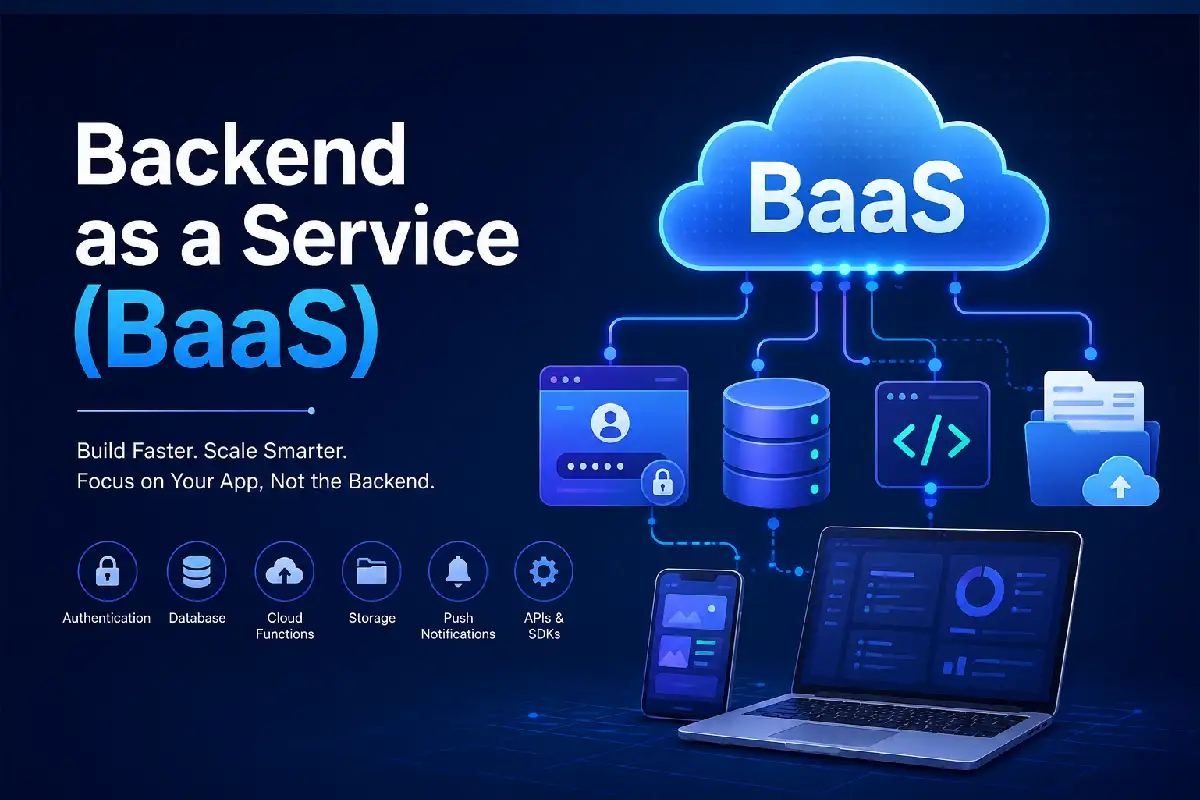
As a matter of fact, BaaS (Backend as a Service) has grown as one of the dominant cloud computing models and has taken up a key role in modern application development. Companies, in a haste to release mobile apps, web apps and digital services to the market quickly, have more and more come to rely on BaaS platforms to reduce the burden of managing complex backend infrastructure components such as server, database, user authentication, APIs, and storage to develop applications more rapidly and in an economical way.
By 2026, BaaS solutions (like Firebase, Supabase, AWS Amplify, Appwrite etc.) are the norm in companies of all sizes. Startups developing their first MVP or enterprises migrating monolithic legacy systems leverage BaaS services for rapid development of their applications, freeing developers from worrying about backend operations management through services hosted in the cloud.
Table of Contents
What Is Backend as a Service?
A cloud computing model that offers ready-made backend services. This services typically consist of the database, authentication, APIs, storage, notification service, serverless functions, etc. Developers don‘t need to construct and manage the whole backend themselves but consume the managed services from the BaaS provider.
BaaS platforms enable developers to concentrate on building applications with rich user interfaces and business logic, rather than concerning themselves with server provisioning, scaling, maintenance, and security which is taken care of by the provider.
Common BaaS platforms include:
- Firebase
- Supabase
- AWS Amplify
- Appwrite
- Backendless
- Back4App
Backend as a Service (BaaS) is part of a broader ecosystem of cloud computing solutions. To better understand where BaaS fits, explore the different cloud service models that power modern applications and IT infrastructure.
How BaaS Works
A traditional application requires developers to build:
- Authentication systems
- Database architecture
- API endpoints
- File storage
- Server infrastructure
- Security controls
In the case of BaaS these elements are pre-provided.
Typical Workflow
- Create a project in a BaaS platform.
- Configure database collections or tables.
- Enable authentication providers.
- Connect frontend applications through SDKs.
- Deploy cloud functions if needed.
- Scale automatically as usage grows.
The rapid time and expense of development are cut to the absolute minimum.
Key Features of BaaS
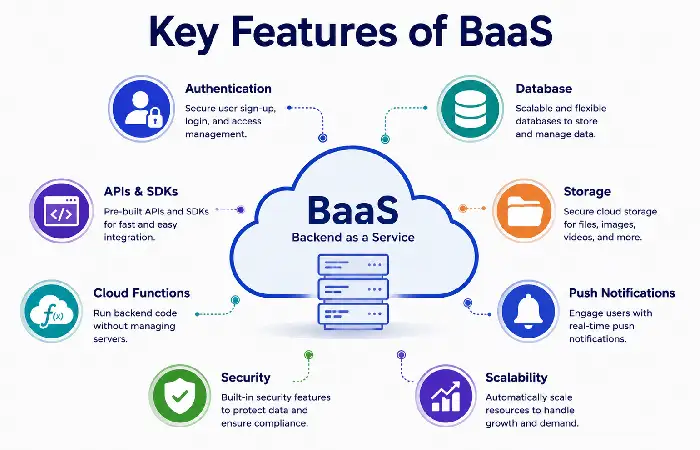
Authentication Services
Most BaaS providers offer:
- Email/password login
- Google authentication
- Apple Sign-In
- Facebook login
- Multi-factor authentication
Database Management
BaaS platforms provide managed databases:
| Platform | Database Type |
| Firebase | NoSQL Firestore |
| Supabase | PostgreSQL |
| Appwrite | MariaDB |
| AWS Amplify | DynamoDB & AWS databases |
API Generation
Automatically generated:
- REST APIs
- GraphQL APIs
- Real-time APIs
File Storage
Developers can store:
- Images
- Videos
- Documents
- Application assets
Cloud Functions
Serverless functions enable running user defined custom backend code on demand without needing to manage any servers.
Developers looking for a complete development and deployment environment often choose Platform as a Service (PaaS), which provides tools for building, testing, and managing applications without handling underlying infrastructure.
Benefits of BaaS
Faster Development
Applications could be launched in weeks, or even months, rather than months or years.
Lower Infrastructure Costs
Organizations avoid:
- Server maintenance
- Hardware expenses
- Infrastructure monitoring
Automatic Scaling
Resources are typically auto scaled by default for most platforms.
Reduced DevOps Workload
The engineering teams spend less time building infrastructure and more time developing product.
Faster MVP Creation
Many startups opt to use BaaS to test out a concept and gain validation prior to the investment of building a custom architecture.
Challenges of BaaS
BaaS has some downsides, however.
| Challenge | Impact |
| Vendor Lock-In | Difficult migrations |
| Limited Customization | Platform restrictions |
| Cost Growth | Usage-based pricing |
| Compliance Requirements | Industry-specific limitations |
| Performance Constraints | Less control over optimization |
The issue of Vendor Lock-in remains the most frequently discussed of concerns for developers deciding to adopt Firebase or similar platform services.
Organizations that need greater control over servers, storage, and networking can benefit from Infrastructure as a Service (IaaS), which offers scalable computing resources on demand.
BaaS for Mobile and Web Applications
BaaS is widely used across:
Mobile Apps
- Social media applications
- Fitness apps
- Messaging platforms
- E-commerce apps
Web Applications
- SaaS products
- Marketplaces
- Internal business tools
- Customer portals
Modern BaaS platforms offer SDKs for:
- React
- Angular
- Vue
- Flutter
- React Native
- iOS
- Android
Authentication and Database Services
Its combined with the database, constitutes the very basis of every BaaS platform.
Authentication Features
- User registration
- Password recovery
- Session management
- Social logins
- Access control
Database Features
- Data synchronization
- Real-time updates
- Backup and recovery
- Query optimization
- Data replication
Such functions lead to lesser engineering on the backend
BaaS Security Considerations
Security is one of the critical factors to consider while selecting the BaaS provider. BaaS providers look after the security aspects of the underlying infrastructure. However the applications, data and the access controls still remain the responsibility of the client organization. Implementation of the BaaS system in a secure way would prevent data leakage, unauthorized access, non compliance and service outage.
Important Security Features
- Encryption at rest
- Encryption in transit
- Role-based access control
- Audit logs
- Multi-factor authentication
- Compliance certifications
Security Best Practices
- Use least-privilege access
- Enable MFA
- Rotate API keys regularly
- Monitor suspicious activity
- Review security policies frequently
The level of security maturity varies across different providers and should be investigated while selecting vendors.
Unlike BaaS, which focuses on backend functionality for developers, Software as a Service (SaaS) delivers fully functional applications directly to end users through the cloud.
BaaS vs Traditional Backend Development
| Feature | BaaS | Traditional Backend |
| Setup Time | Fast | Slow |
| Maintenance | Managed | Self-managed |
| Scalability | Automatic | Manual |
| Infrastructure Control | Limited | Full |
| Development Speed | High | Moderate |
| Customization | Medium | High |
| DevOps Requirement | Low | High |
Choose BaaS When:
- Building MVPs
- Launching quickly
- Small development teams
- Limited infrastructure expertise
Choose Traditional Backend When:
- Complex business logic
- Regulatory requirements
- High customization needs
- Long-term infrastructure control
For serverless application architectures, Function as a Service (FaaS) works alongside BaaS by enabling developers to execute event-driven code without managing servers.
How to Choose a BaaS Platform
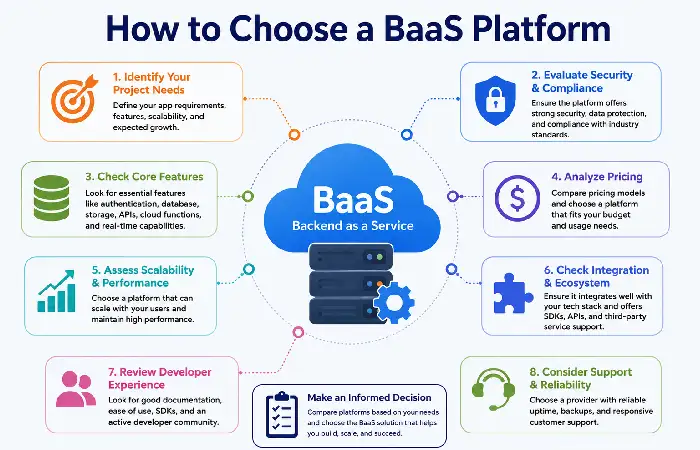
Consider Your Database Needs
- SQL-based applications → Supabase
- NoSQL applications → Firebase
Evaluate Scalability
Review:
- Expected traffic
- Data growth
- Geographic distribution
Analyze Pricing
Think beyond free tier and estimate the price for large quantities.
Check Security Requirements
Ensure compliance with:
- GDPR
- HIPAA
- SOC 2
- ISO 27001
Compare Ecosystem Fit
| Platform | Best For |
| Firebase | Mobile-first apps |
| Supabase | SQL-focused applications |
| AWS Amplify | AWS-native organizations |
| Appwrite | Open-source flexibility |
| Backendless | Low-code development |
Businesses supporting remote and hybrid work environments may also leverage Desktop as a Service (DaaS) to provide secure virtual desktop experiences across devices.
FAQ
So, what do you understand by Backend as a Service?
Backend as a Service is a model of cloud which gives developers already-built backend components such as databases, authentications, API and storage thus allows faster development of applications.
But is Firebase a BaaS?
Yes Firebase is a highly recommended BaaS platform with authentication, databases, storage, analytics and cloud functions.
Explain the distinction between BaaS and FaaS
BaaS, in full-end backend service, on the other hand is responsible for running functions independently upon events
Which BaaS platform is the most suitable in 2026?
Some of the recommended services include: Supabase, Firebase, AWS Amplify and Appwrite (the choice between these would be determined by whether you would prefer a SQL or NoSQL database, integration with other services and scalability).
BaaS appropriate for enterprises?
Yes. Enterprises are leveraging BaaS platforms to enable fast development, if their requirements in terms of security, compliance and scalability are evaluated correctly.
Conclusion
Backend as a Service (BaaS) revolutionized modern application development by offering fully managed backend services such as databases, authentication, storage, APIs and serverless functions. By taking care of a lot of backend development, BaaS empowers organizations to deploy apps faster and save money on operational costs while focusing on improving the user experience.
Kashifa Jafar is a technology writer and contributor at FutureTechExpert with 4+ years of experience in technology writing and content creation.
Read Full Bio of Author →Sameena reviews selected health, wellness, technology, and digital content for clarity, factual presentation, and reader usefulness.
Read Full Bio of Reviewer →