
 Kashifa Jafar
Technology Writer & Contributor
Kashifa Jafar is a technology writer and contributor at FutureTechExpert with 4+ years of experience in technology writing and content creation.
Read Full Bio of Author →
Kashifa Jafar
Technology Writer & Contributor
Kashifa Jafar is a technology writer and contributor at FutureTechExpert with 4+ years of experience in technology writing and content creation.
Read Full Bio of Author →
 Sameena Begum
Health, Technology & Digital Content Reviewer
Sameena reviews selected health, wellness, technology, and digital content for clarity, factual presentation, and reader usefulness.
Read Full Bio of Reviewer →
Sameena Begum
Health, Technology & Digital Content Reviewer
Sameena reviews selected health, wellness, technology, and digital content for clarity, factual presentation, and reader usefulness.
Read Full Bio of Reviewer →
Internet Service Providers are the foundation of the current internet world. They provide means to millions people and companies all over the world to help them communicate with each other, learn, work remotely, use services in the cloud and countless other things which are done on the internet.
If you see yourself using any of these methods, it means that you use Internet Service Provider. In 2026, technologies are still developing and customers have a lot more options than a few. For use internet they may use fiber, broadband, wireless, satellite or mobile internet.
Selecting the best Internet Provider for your needs is more important than ever. Understanding what an ISP does, looking at the various types of ISPs, comparing the most common internet technologies, and learning the practical considerations for selecting an internet provider are all essential topics covered in this guide. Armed with this information you will be able to evaluate various options and select the best internet provider for your home or business.
 This article is part of
Internet & Connectivity Resources
Table of Contents
What Is an Internet Service Provider?
An internet service provider (isp) connects homes, businesses and mobile devices to the internet. ISPs provide internet connection through different mediums like telephone lines, cable, wireless etc. An internet service provider may be a company offering access via, fiberoptic lines, cable broadband, digital subscriber line (DSL), wireless network, satellite service, and or mobile cellular technology.
Without an ISP, you cannot go on websites, cloud applications, streaming services, online games and video conferencing.
Some examples of who is providing the services today are fiber internet providers, broadband internet providers, cellphone network operators and wireless internet providers.
Before choosing a provider, it’s important to understand the different types of internet services available and how they impact speed, reliability, and coverage.
How Internet Service Providers Work
The domain name system (or dns) is used in order to let the users of the internet access the global net from their computer. ISPs (Internet Service Providers) connect the users to the internet via a network of routers, data centers, wires and wireless.
Basic ISP Process
- User requests a website.
- Request travels through modem/router.
- ISP network receives the request.
- ISP routes traffic to the destination server.
- Data returns through the ISP network.
- Website loads on the user’s device.
Key Components
| Component | Purpose |
| Modem | Connects home network to ISP |
| Router | Distributes internet to devices |
| Fiber/Cable Line | Physical connection |
| ISP Network | Routes internet traffic |
| Data Centers | Host internet services |
Types of Internet Service Providers
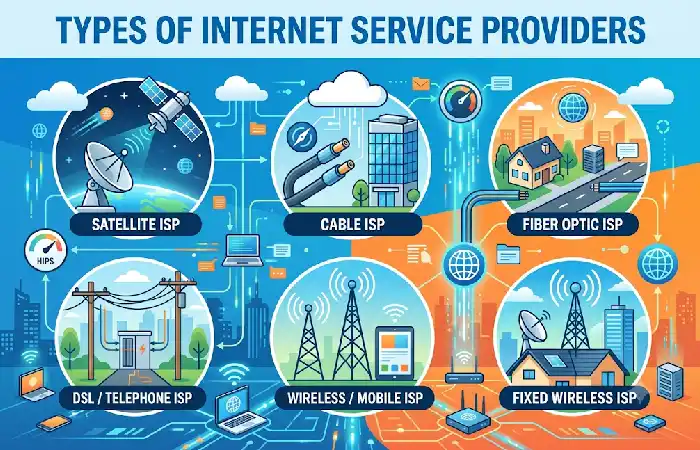
The other thing is that all ISPs have their own technology.
| ISP Type | Typical Speed | Best For |
| Fiber ISP | 300 Mbps – 10 Gbps | Gaming, streaming, businesses |
| Cable ISP | 100 Mbps – 1 Gbps | Families and households |
| DSL ISP | 10 Mbps – 100 Mbps | Basic internet use |
| Fixed Wireless ISP | 25 Mbps – 500 Mbps | Rural areas |
| Mobile ISP | 20 Mbps – 1 Gbps | Smartphones and travel |
| Satellite ISP | 25 Mbps – 250 Mbps | Remote locations |
Broadband Internet Providers
Broadband internet means fast, always-on internet connection.
Benefits of Broadband
- Faster downloads
- Stable video calls
- Multiple connected devices
- Better streaming quality
- Reliable work-from-home performance
Broadband vs Traditional Dial-Up
| Feature | Broadband | Dial-Up |
| Speed | Up to Gigabits | Very Slow |
| Always Connected | Yes | No |
| Video Streaming | Excellent | Poor |
| Gaming | Supported | Not Practical |
The global adoption of broadband still continues to grow as users are looking for a faster cloud, gaming, and streaming experience.
Many providers offer broadband internet connections that balance affordability and performance for everyday browsing, streaming, and remote work.
Fiber Internet Providers
Fiber internet is a form of high speed internet that employs light signals sent through fiber-optic technology.
Why Fiber Is Popular in 2026
- Extremely fast speeds
- Low latency
- Symmetrical upload/download speeds
- Better reliability
- Supports smart homes and AI-powered applications
Fiber vs Cable Internet
| Feature | Fiber | Cable |
| Maximum Speed | 10 Gbps+ | 1–2 Gbps |
| Upload Speed | Excellent | Moderate |
| Latency | Very Low | Low |
| Reliability | High | Good |
| Future Scalability | Excellent | Limited |
Fiber is currently the fastest growing internet technology in the world.
Users seeking ultra-fast speeds and lower latency should consider providers that utilize fiber internet technology for their network infrastructure.
Wireless Internet Providers
Wireless ISPs “carry ‘wireless’ (or radio) signals, rather than running ‘wired’ (or cable) connections to their customers.
Advantages
- Quick installation
- Useful in rural regions
- Lower infrastructure costs
- Flexible deployment
Limitations
- Signal interference
- Weather impact
- Distance sensitivity
Wireless internet has grown exponentially with the roll-out of 5G Fixed Wireless Access (FWA), where broadband subscribers cracked the one billion mark for broadband connections in India in late 2025, driven by the boom in wireless.
When comparing plans, evaluate which home internet services best match your household’s data usage and connected devices.
Mobile Internet Providers
Mobile ISPs use cellular technologies including:
- 4G LTE
- 5G
- Fixed Wireless Access
Best Uses
- Smartphone browsing
- Mobile gaming
- Remote work
- Travel connectivity
- IoT devices
Remember that price is not the only thing to look at when comparing plans from different ISPs.
Internet Provider Plans and Pricing
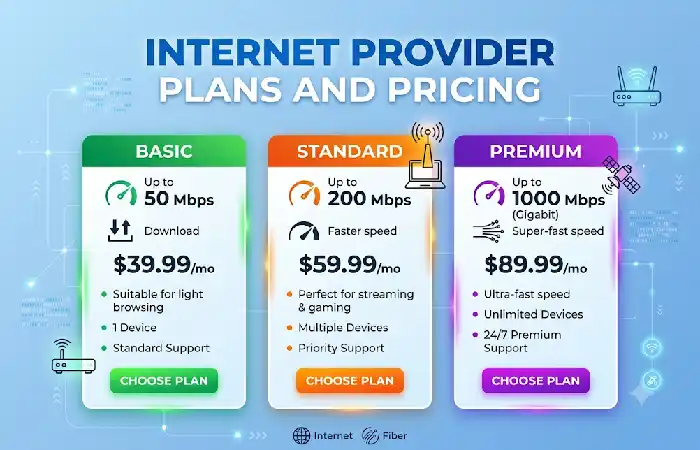
When selecting an ISP, consider the following.
What Affects Pricing?
| Factor | Impact on Cost |
| Speed Tier | Higher speed costs more |
| Technology | Fiber may cost more initially |
| Data Limits | Unlimited plans cost more |
| Equipment Rental | Additional monthly fee |
| Installation | One-time setup fee |
Typical 2026 ISP Plan Comparison
| Plan Type | Speed Range | Best For |
| Basic | 50–100 Mbps | Browsing and email |
| Standard | 100–500 Mbps | Families |
| Premium | 500 Mbps–1 Gbps | Streaming and gaming |
| Gigabit+ | 1–10 Gbps | Power users and businesses |
How to Compare Internet Providers
Selecting an ISP? Don‘t just choose the one offering the highest download speeds. In reality performance, latency, uptime and the quality of support you get may be more important.
ISP Comparison Checklist
| Criteria | Importance |
| Download Speed | High |
| Upload Speed | High |
| Reliability | High |
| Coverage Availability | High |
| Customer Support | Medium |
| Pricing | High |
| Contract Terms | Medium |
| Data Caps | Medium |
Expert Tip
It is known that performance rankings are not, run to run, location to location or maker to maker consistent.
2026 ISP Market Snapshot
Top Broadband Providers by Subscriber Base
| Provider | Subscribers (Millions) |
| Reliance Jio | 514.35 |
| Bharti Airtel | 314.26 |
| Vodafone Idea | 128.47 |
| BSNL | 33.03 |
| ACT Fibernet | 2.37 |
Performance Rankings (Example Broadband Testing)
| Rank | Provider |
| 1 | ACT Fibernet |
| 2 | BSNL |
| 3 | Airtel |
Performance rankings vary by location and testing methodology.
Reliable internet connectivity solutions are essential for video conferencing, cloud applications, online gaming, and smart home devices.
How to Choose an Internet Provider
Step 1: Check Availability
The best Internet Service Provider is pointless if it doesn‘t work at your location.
Step 2: Determine Speed Needs
| Usage | Recommended Speed |
| Email & Browsing | 25 Mbps |
| Streaming HD Video | 100 Mbps |
| Remote Work | 100–300 Mbps |
| Gaming | 300+ Mbps |
| Large Households | 500 Mbps–1 Gbps |
Step 3: Compare Plans
Evaluate:
- Monthly fees
- Data caps
- Installation charges
- Contract requirements
Step 4: Read Customer Reviews
Look for feedback regarding:
- Downtime
- Support quality
- Speed consistency
Comparing internet speed and performance metrics can help you identify providers that deliver consistent connectivity during peak hours.
FAQ
What is the role of an Internet Service Provider?
An ISP connects customers to the internet using wired or wireless infrastructure to give homes, businesses, and mobility access to the information highway.
So what category of ISP is most rapid?
Fastest speeds and lowest latency are provided by providers of fiber internet.
Is fiber better than broadband?
Fiber is one of the types of broadband technologies and is normally the best performing type of broadband.
What internet speed do I need?
In general, a hundred to five hundred megabits per second is suitable for the majority of houses, and gigabit-level subscriptions may be more appropriate for heavy-gaming households or larger families.
Is it possible for me to change my Internet Service Provider?
Yes. Chances are that if you have access to other providers in your location, most users will be able to make the switch to other providers.
Conclusion
The Internet Service Providers are responsible for linking various entities people, offices and devices to the Internet worldwide. They provide state-of-the art Internet access solutions from standard broadband to cutting-edge Fibre-optic technology and an ever-growing selection of wireless and mobile broadband access options.
Having a good grasp of how the ISPs operate, the technologies involved, and the ways in which Internet quality can be affected will aid you when shopping for an Internet Service Provider.
Kashifa Jafar is a technology writer and contributor at FutureTechExpert with 4+ years of experience in technology writing and content creation.
Read Full Bio of Author →Sameena reviews selected health, wellness, technology, and digital content for clarity, factual presentation, and reader usefulness.
Read Full Bio of Reviewer →