
 Kashifa Jafar
Technology Writer & Contributor
Kashifa Jafar is a technology writer and contributor at FutureTechExpert with 4+ years of experience in technology writing and content creation.
Read Full Bio of Author →
Kashifa Jafar
Technology Writer & Contributor
Kashifa Jafar is a technology writer and contributor at FutureTechExpert with 4+ years of experience in technology writing and content creation.
Read Full Bio of Author →
 Sameena Begum
Health, Technology & Digital Content Reviewer
Sameena reviews selected health, wellness, technology, and digital content for clarity, factual presentation, and reader usefulness.
Read Full Bio of Reviewer →
Sameena Begum
Health, Technology & Digital Content Reviewer
Sameena reviews selected health, wellness, technology, and digital content for clarity, factual presentation, and reader usefulness.
Read Full Bio of Reviewer →
Broadband Internet Services is the backbone to digital life today, allowing high speed internet for streaming, online gaming, remote work, cloud computing and almost everything we do online. If you‘re looking for internet for your home, upgrading to business or just comparing fiber, cable and wireless, here is what you need to know about broadband technology.
In this guide, you‘ll be introduced to broadband Internet, how it works, what types of connections you have access to in 2026, what broadband speeds are necessary for you, and how to go about picking the best broadband service for your requirements.
 This article is part of
Internet & Connectivity Resources
Table of Contents
What Are Broadband Internet Services?
Broadband Internet Services are a high-speedways of accessing the Internet and give users and always-on connection. It enables web users to access websites, surf the web, play computer games, make video calls and stream videos with minimal wait.
Broadband is a generalized term referring to a broadband bandwidth communication system. It has the ability to carry data in large quantities as a high speed medium. In modern times Broadband has become the norm for accessing the Internet in the homes, establishments, schools and government agencies.
Unlike older internet technologies, broadband allows users to:
- Stream HD and 4K videos
- Participate in video conferencing
- Play online games
- Download large files quickly
- Connect multiple devices simultaneously
Installing Broadband is now the predominant way to connect to the internet in a home or business.
Broadband internet remains one of the most popular internet services available today, offering reliable access for work, entertainment, and communication.
Key Characteristics
| Feature | Broadband |
| Always-On Connection | Yes |
| High-Speed Data Transfer | Yes |
| Multiple Device Support | Yes |
| Voice & Video Streaming | Yes |
| Cloud Application Support | Yes |
How Broadband Internet Works
Broadband conveys digital information over dedicated communication channels via a range of different technologies.
The process generally follows these steps:
- User device sends request
- Router forwards data to ISP
- ISP network processes request
- Data travels across internet backbone
- Requested content returns to device
Simplified Broadband Architecture
Device
↓
Wi-Fi Router
↓
Modem/ONT
↓
Internet Service Provider
↓
Global Internet Network
The infrastructure varies as per fiber, cable, DSL or wireless connection.
Types of Broadband Connections
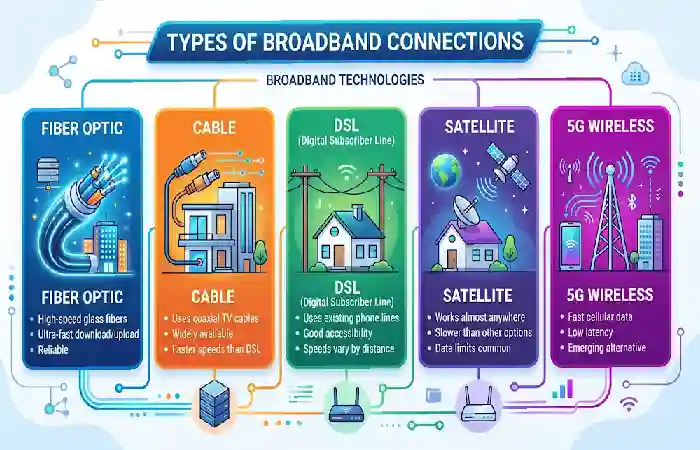
There are various broadband technologies in 2026.
| Broadband Type | Speed Range | Reliability | Best For |
| Fiber | 300 Mbps – 10 Gbps | Excellent | Homes & Businesses |
| Cable | 100 Mbps – 2 Gbps | Very Good | Residential Users |
| DSL | 10 Mbps – 100 Mbps | Moderate | Rural Areas |
| Fixed Wireless | 50 Mbps – 1 Gbps | Good | Remote Locations |
| Satellite | 50 Mbps – 250 Mbps | Moderate | Rural Regions |
Fiber Broadband
The preferred internet connectivity in 2026.
It uses fiber-optic cables to send messages over the network. These cables use light to send the data.
Advantages
- Ultra-fast speeds
- Symmetrical upload/download performance
- Low latency
- Excellent reliability
- Future-proof infrastructure
Many users are switching to fiber internet connections because they deliver faster speeds and lower latency than traditional broadband technologies.
Typical Fiber Performance
| Fiber Tier | Download Speed | Upload Speed |
| Entry-Level | 300 Mbps | 300 Mbps |
| Mid-Tier | 1 Gbps | 1 Gbps |
| Premium | 5 Gbps | 5 Gbps |
| Enterprise | 10 Gbps | 10 Gbps |
Official Resource
| Resource |
| Fiber Broadband Association |
Cable Broadband
Cable broadband utilizes the same coaxial cable network that was first built for televising.
Benefits
- Widely available
- High download speeds
- Affordable pricing
- Suitable for streaming and gaming
Limitations
- Shared neighborhood bandwidth
- Upload speeds usually lower than downloads
- Performance may decline during peak hours
Typical Cable Speeds
| Tier | Download Speed |
| Basic | 100 Mbps |
| Standard | 300 Mbps |
| Advanced | 500 Mbps |
| Gigabit | 1–2 Gbps |
DSL Broadband
DSL (Digital Subscriber Line) makes use of the existing telephone lines to access the Internet.
Pros
- Broad availability
- Lower installation costs
- Stable performance for light usage
Cons
- Slower speeds
- Distance-sensitive
- Limited scalability
Typical DSL Speed Comparison
| DSL Type | Speed |
| ADSL | 10–24 Mbps |
| VDSL | 50–100 Mbps |
Despite the widespread availability of DSL, it is still a viable solution for some rural and underserved areas where the deployment of fiber has not yet occurred.
When selecting a broadband plan, it’s important to compare different internet service providers based on speed, pricing, coverage, and customer support.
Fixed Wireless Broadband
The fixed wireless broadband has also gained popularity along with the proliferation of 5 G networks.
Rather than delivering via directly through cables, the internet is transmitted via radio signals from the local cell towers.
Advantages
- Quick deployment
- No extensive cabling required
- Competitive speeds
- Effective for rural communities
Common Use Cases
- Rural broadband
- Small businesses
- Temporary installations
- Construction sites
Performance Overview
| Technology | Typical Speed |
| 4G Fixed Wireless | 25–100 Mbps |
| 5G Fixed Wireless | 100 Mbps – 1 Gbps |
Broadband Speed and Performance
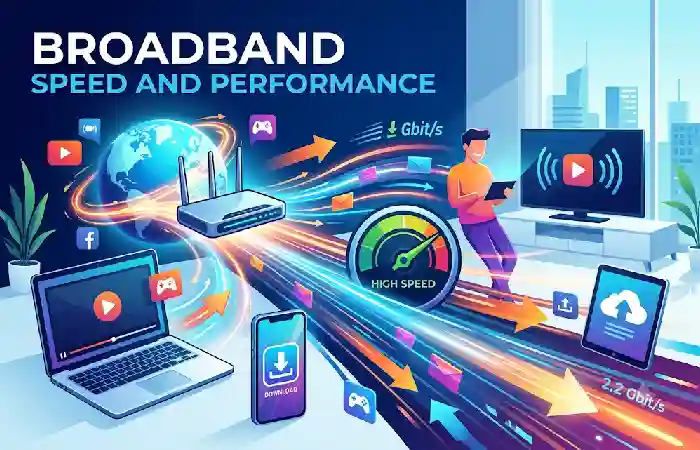
Performance of a broadband connection is a more involved issue than the advertised download speed.
Important factors include:
Speed
Transfer rate. The rate at which data is transmitted.
Latency
Estimates the response time of various devices and servers.
Jitter
Represents the variance of the network performance.
Packet Loss
Detects lost or dropped data packets.
Broadband Requirements by Activity
| Activity | Recommended Speed |
| Email & Browsing | 25 Mbps |
| HD Streaming | 50 Mbps |
| 4K Streaming | 100 Mbps |
| Online Gaming | 100+ Mbps |
| Remote Work | 100+ Mbps |
| Smart Home | 200+ Mbps |
| Large Families | 500 Mbps – 1 Gbps |
To get the best experience, users should understand how internet speed and performance affect everyday online activities such as video conferencing and online gaming.
Broadband for Home and Business
Different broadband solutions are needed for different users.
Home Broadband
Best for:
- Streaming
- Gaming
- Smart homes
- Video conferencing
Business Broadband
Requires:
- Service Level Agreements (SLAs)
- Higher reliability
- Static IP addresses
- Enhanced security
- Symmetrical speeds
Comparison Table
| Feature | Home Broadband | Business Broadband |
| Cost | Lower | Higher |
| SLA | Limited | Included |
| Static IP | Optional | Common |
| Support | Standard | Priority |
| Uptime Guarantee | Rare | Common |
A dependable broadband connection also plays a key role in creating an effective home internet setup for streaming, gaming, remote work, and smart home devices.
How to Choose Broadband Service
Your selection of broadband service will be determined by the way in which you intend to use it.
Step 1: Evaluate Availability
Some technologies just do not exist yet somewhere else.
Step 2: Assess Speed Needs
Choose based on:
- Number of users
- Streaming requirements
- Gaming activity
- Remote work demands
Step 3: Compare Technology
| Priority | Recommended Type |
| Maximum Speed | Fiber |
| Best Value | Cable |
| Rural Access | Fixed Wireless |
| Legacy Coverage | DSL |
Step 4: Review Provider Reputation
Evaluate:
- Customer support
- Network uptime
- Installation quality
- Service guarantees
Additionally, modern broadband technologies enhance overall internet connectivity, ensuring stable access across multiple devices and applications.
FAQ
What does broadband internet mean?
Broadband internet is a fast, on-all-the-time internet connection with the ability to support many modern online applications and multiple connected devices.
What is the fastest broadband technology?
Currently, fiber broadband offers the highest speeds and lowest latency.
Is cable better than DSL internet?
For most cases cable broadband is generally much faster and performs better than DSL.
Can 5g save broadband?
5G FWA can be used as a broadband substitute in some areas, but fiber is in general the most efficient solution for high performance.
What broadband speed do I require?
Most households can get 100–500 Mbps. Bigger households and businesses may need gigabit connectivity.
Conclusion
The future of Broadband Internet Services is ever changing with the expansion of fiber networks, 5G fixed wireless (FFW) and newer infrastructure around the world. Although fiber broadband is the fastest and most reliable type and considered the gold standard, other options, such as cable, DSL, and fixed wireless, continue to be viable and cost-effective depending on the user’s circumstances. Taking the time to learn about how broadband works, contrast between types of connections, and performance requirements can help users find the best fit at the best price for their long-term broadband connectivity.
Kashifa Jafar is a technology writer and contributor at FutureTechExpert with 4+ years of experience in technology writing and content creation.
Read Full Bio of Author →Sameena reviews selected health, wellness, technology, and digital content for clarity, factual presentation, and reader usefulness.
Read Full Bio of Reviewer →