

Last Updated: July 13, 2026
Cloud Security Best Practices have become increasingly important for organizations of all sizes. With organizations of all sizes migrating workloads, applications and data to the Cloud, the Cloud provides tremendous scalability, flexibility and cost savings but it also presents a new set of security issues that need to be addressed and managed proactively.
In 2026, for cloud security, we are looking at where organizations are moving toward identity first security, Zero Trust architecture, ongoing monitoring, and automated threat detection due to the need to defend against AI powered cyber-attacks and advanced cloud threats.
What cloud platform do you use? No matter if you‘re on AWS, Microsoft Azure, Google Cloud or perhaps on a multi-cloud environment, taking the most effective security practices for cloud will safeguard your data, keep you compliant and minimize the chance to your security.
Table of Contents
Why Cloud Security Is Important
While more organizations are adopting cloud, many are also discovering that the rise in adoption coincides with a rise in cyber threats to their cloud. Today, many attacks seek to steal identity, or take advantage of misconfigured resources or exposed APIs to obtain compromised credentials.
Key Benefits of Strong Cloud Security
- Protects sensitive customer and business data
- Reduces the risk of data breaches
- Supports regulatory compliance
- Improves business continuity
- Enhances customer trust
- Minimizes financial losses from cyber incidents
2026 Cloud Security Statistics
| Metric | Data |
| Organizations using hybrid or multi-cloud environments | 88% |
| Companies concerned about identity security risks | 77% |
| Organizations lacking confidence in cloud threat detection | 66% |
| Cloud security posture rated low maturity | 59% |
Source Resources
| Report | Link |
| Fortinet Cloud Security Trends 2026 | https://www.fortinet.com |
| Google Cloud Threat Horizons Report | https://cloud.google.com |
| Sysdig Cloud Security Report | https://www.sysdig.com |
This means that the cloud‘s complexity still exceeds many organization security maturity levels, as the following data shows.
Essential Security Measures for Cloud Environments
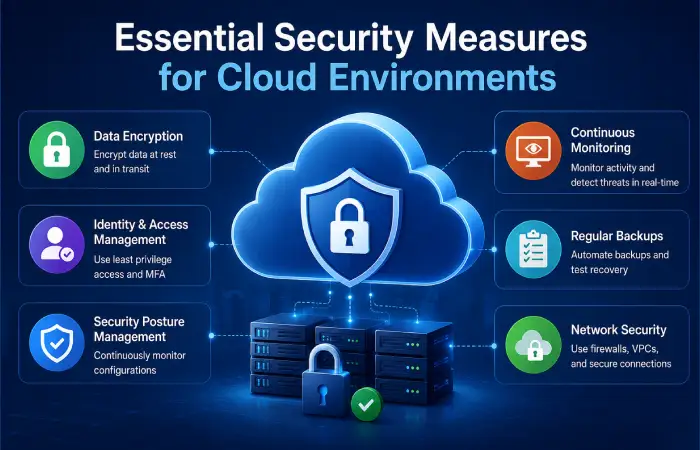
Deploying basic security controls greatly mitigates cloud security risks.
- Encrypt All Data
Organizations should encrypt:
- Data at rest
- Data in transit
- Backup data
- Sensitive databases
Encryption: makes data hard to be read or used by attackers who get access to this data.
- Enable Multi-Factor Authentication (MFA)
MFA is still “hands down” the single best mitigating control against credential theft.
Best practices include:
- Mandatory MFA for administrators
- Hardware security keys where possible
- Adaptive authentication policies
- Use Cloud Security Posture Management (CSPM)
CSPM tools continuously monitor cloud environments for:
- Misconfigurations
- Compliance violations
- Publicly exposed resources
- Security policy violations
- Maintain Continuous Monitoring
Security teams should monitor:
- User activity
- API access
- Network traffic
- Configuration changes
- Privileged actions
Ongoing Monitoring allows the quicker response to threats.
Identity and Access Management Best Practices
Now, in cloud environment identity has become the new security perimeter. Most of the recent attacks against cloud end in compromise of access rights and over-privileged accounts.
IAM Best Practices Checklist
| Best Practice | Security Impact |
| Principle of Least Privilege | High |
| Multi-Factor Authentication | High |
| Role-Based Access Control | High |
| Single Sign-On (SSO) | Medium |
| Privileged Access Management | High |
| Just-in-Time Access | High |
Implement Zero Trust Security
Zero Trust follows the principle:
“Never Trust, Always Verify.”
Key Zero Trust components include:
- Continuous authentication
- Device verification
- Micro-segmentation
- Risk-based access control
- Real-time monitoring
As organizations continue to deploy newer architectures like Cloud, organizations are more and more leaning towards Zero Trust architectures to safeguard their cloud workloads and identities.
Common Cloud Security Threats
By understanding the threats organizations can better defend themselves.
Top Cloud Security Risks in 2026
| Threat | Description |
| Identity Exploitation | Stolen credentials and privilege abuse |
| Cloud Misconfigurations | Public storage and open access controls |
| API Attacks | Exploitation of insecure APIs |
| AI-Powered Attacks | Automated reconnaissance and attacks |
| Supply Chain Risks | Third-party software vulnerabilities |
| Insider Threats | Malicious or accidental misuse |
Threat Landscape Comparison
| Risk Category | Severity |
| Identity Compromise | Critical |
| Misconfiguration | Critical |
| Data Exposure | High |
| SaaS Integration Risks | High |
| Vulnerability Exploitation | High |
A trend noted in many recent security reports is that in the absence of direct infrastructure attacks, attackers are now focusing on vulnerabilities in third-party software and trusted integration.
Building a Strong Cloud Security Strategy
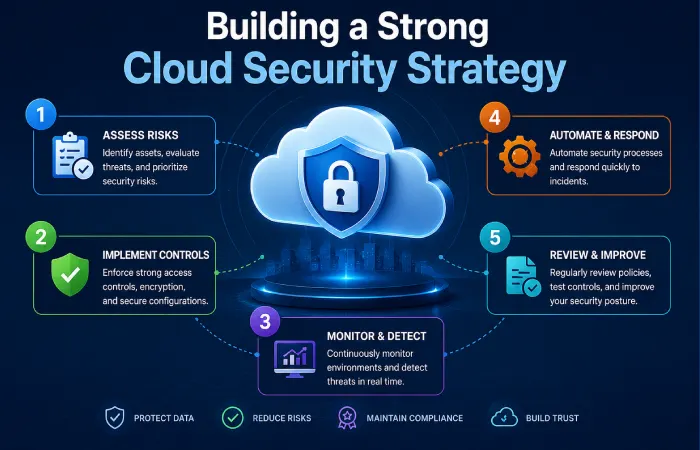
A mature cloud security program blends the people, processes, and technology in a coherent whole.
Step 1: Conduct Risk Assessments
Regular assessments identify:
- Security gaps
- Compliance issues
- High-risk assets
- Access control weaknesses
Step 2: Automate Security Operations
Automation helps:
- Detect threats faster
- Reduce human error
- Accelerate incident response
- Improve scalability
Detection at machine-speed is the next step of course and should be very relevant as load increases and we see more and more “AI-MI”.
Step 3: Implement Security by Design
Integrate security into:
- DevOps workflows
- CI/CD pipelines
- Infrastructure provisioning
- Application development
Step 4: Develop Incident Response Plans
Prepare for:
- Data breaches
- Ransomware incidents
- Service outages
- Account compromise
Cloud outages and cyber events are costly; however, operational and financial costs.
Cloud Security Tool Comparison (2026)
| Platform | Best For | Key Features |
| Microsoft Defender for Cloud | Azure Environments | Threat detection, posture management |
| Wiz | Multi-Cloud Security | Risk prioritization, visibility |
| Prisma Cloud | Enterprise Security | CNAPP, workload protection |
| Orca Security | Agentless Security | Cloud asset visibility |
| Google Security Command Center | Google Cloud | Threat intelligence |
Official Resources
| Platform | Website |
| Microsoft Defender | https://www.microsoft.com/security |
| Wiz | https://www.wiz.io |
| Prisma Cloud | https://www.paloaltonetworks.com |
| Orca Security | https://orca.security |
| Google Security Command Center | https://cloud.google.com |
FAQ
What best practices for cloud security are most significant?
Most important practices are Zero Trust security, enabling MFA, encrypting data, least privileges usage, monitoring constantly and automating detection of threat.
What is the importance of security of Identity in Cloud?
More often than not, the target is an identity once attackers have stolen your credentials, all it takes is a few keystrokes to get into your cloud. Contemporary cloud security strategy is built around an identity-first security model.
Zero Trust cloud security?
Zero Trust refers to an ongoing security posture which always authenticates the end-user, device and application prior to providing access regardless of the user, device, or location.
How frequently do we need to do our cloud security audits?
For most of the organizations, quarterly security checks and continuous automated monitoring should be performed on critical assets.
Conclusion
Cloud Security Best Practices are no longer a luxury in today‘s digital world, but essential to protect the growing cloud footprints. As organizations extend their cloud environments and attackers use AI-driven methods, organizations are required to implement a combination of identity-centric security, Zero Trust principles, real-time monitoring, and automated defense.
Organizations must establish sound IAM policies and protocols, protect sensitive information, create alternative ways to save, store, and recover data, and always be evaluating risk. By preparing their cloud environments in this way, strong cloud security can be achieved that will minimize the impact of today‘s cyber-attacks while enabling business proliferation.