

Last Updated: September 13, 2026
All modern systems depend upon network cabling. If you are setting up a small domestic network, upgrading an office system or planning a widescale enterprise network, the kind of network cabling you select will determine the performance, upgradability and reliability of the system.
With more and more organizations outsourcing their cloud services, smart devices, AI implements, and super-fast connectivity in 2026, correctly designed network cabling has never been more crucial. This guide will reveal the types of network cables, industry standards, structured cabling systems and the best practices of businesses.
Table of Contents
What Is Network Cabling?
It refers specifically to the cabling that characterizes a computer network and the lengths needed to connect pieces of equipment together.
The network cabling is the physical cable used to connect between the computers, servers, switches, router and connect between other network devices such as the wireless access points.
A network cabling system is the fundamental communication infrastructure of an IT system, providing devices with the capability to transmit data across the network.
Key Components of Network Cabling
| Component | Purpose |
| Network Cables | Data transmission |
| Patch Panels | Cable organization |
| Switches | Network connectivity |
| Connectors | Device connections |
| Racks & Cabinets | Equipment housing |
| Cable Management Systems | Organization and Protection. |
Benefits of Network Cabling
- Reliable connectivity
- High speed data transfer
- Network availability should be maximized.
- Improved scalability
- Better security
- Simplified troubleshooting
Types of Network Cables
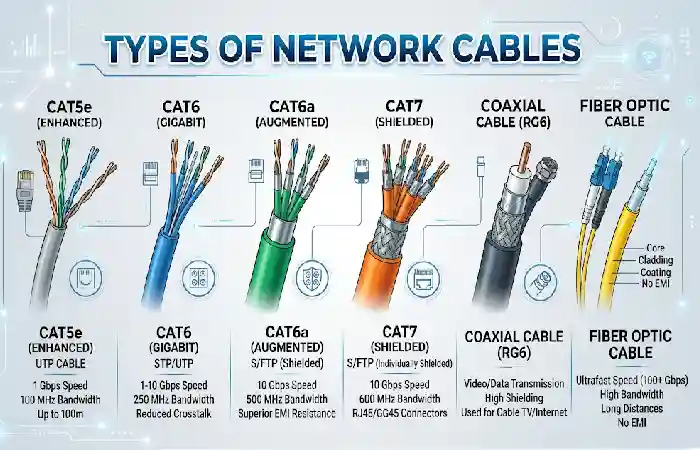
The types of cable vary according to the speed needed, distance, and environment:
| Cable Type | Maximum Distance | Typical Use |
| Ethernet (Twisted Pair) | 100 meters | Offices, homes |
| Fiber Optic | Several kilometers | Data centers, ISPs |
| Coaxial | 500+ meters | Legacy networks, CCTV |
| Direct Attach Cable (DAC) | 7 meters | Data centers |
| Twinax Cable | 10 meters | High-speed networking |
Choosing the Right Cable
Consider:
- Required bandwidth
- Installation environment
- Distance limitations
- Budget
- Future scalability
Ethernet Cables
The network cabling solution in most widespread way in the world is Ethernet cable. They utilize pairs of twisted copper wire to minimizes the effect of electromagnetic interference ( EMI ).
Ethernet Categories Comparison (2026)
| Category | Speed | Bandwidth | Recommended Use |
| Cat5e | 1 Gbps | 100 MHz | Small networks |
| Cat6 | 10 Gbps (55m) | 250 MHz | Business networks |
| Cat6a | 10 Gbps | 500 MHz | Enterprise environments |
| Cat7 | 10 Gbps | 600 MHz | Data centers |
| Cat8 | 40 Gbps | 2000 MHz | High-performance infrastructure |
Advantages
- Cost-effective
- Easy installation
- Widely available
- Reliable performance
Disadvantages
- Distance limitations
- Prone to EM-interference
Fiber Optic Cables
Fiber optic cable transmits data using light signals. Today many enterprises prefer them because they are becoming better, faster and wider.
Types of Fiber Optic Cables
| Type | Distance | Common Use |
| Single-Mode Fiber (SMF) | Between 100+ km to 50+ km on representative market. | Telecommunications |
| Multi-Mode Fiber (MMF) | Or 550 m If, for any reason, the machine is lowered beyond the point of 550 m (the lowest suggested depth), the over-orifice titrator will shut off. | Enterprise LANs |
Benefits of Fiber Optics
- Very high bandwidth
- Longer distances of transmission (area covered by the network).
- Immune to EMI
- Enhanced security
- Future-proof infrastructure
Coaxial Cables
Coaxial cables are made of a central strand, or conductor, which is then shielded and insulated.
While less common in modern LAN environments, they remain important for:
- Broadband internet
- CCTV systems
- Cable television
- Existing networking systems (legacy).
Pros
- Good signal integrity.
- Durable construction
- Affordable for particular needs
Cons
- Lower flexibility
- Too slow compared to fiber
- Limited scalability
Structured Network Cabling
Structured network cabling (SNC) is a standard way of architecting and installing communications cabling.
Rather than linking each equipment on their own, it provides a common path to all the devices.
Structured Cabling Components
| Component | Function |
| Entrance Facility | External network access |
| Equipment Room | Core network devices. |
| Backbone Cabling | Building-wide connectivity |
| Telecommunications Room | Distribution point |
| Horizontal Cabling | Workstation connectivity |
| Work Area Components | End-user connections |
Benefits
- Easier management
- Simplified maintenance
- Improved scalability
- Reduced downtime
- More efficient network performance
To get a better idea of a physical networking architecture, check out our Network Infrastructure Components guide.
Copper vs Fiber Cabling
In addition to the choice of technology, the form of infrastructure is equally important. The choice of copper or fiber, for example, is one of the most fundamental infrastructure decisions.
Comparison Table
| Feature | Copper Cabling | Fiber Cabling |
| Speed | Of up to 40 Gbps | 100+ Gbps |
| Distance | 100m | Several kilometers |
| Cost | Lower initial price | Greater early investment |
| Security | Moderate | High |
| EMI Resistance | Limited | Excellent |
| Maintenance | Easy | Specialized |
Recommendation
| Scenario | Best Choice |
| Small Office | Cat6/Cat6a |
| Enterprise LAN | Cat6a + Fiber Backbone |
| Data Center | Fiber Optic |
| Campus Network | Single-Mode Fiber |
Network Cabling Standards
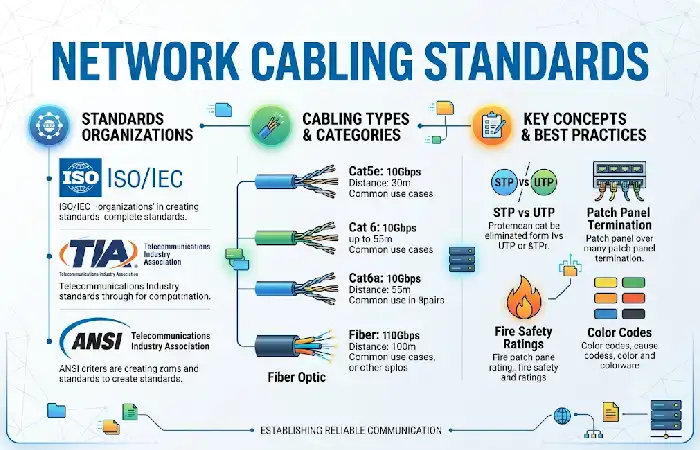
Standards set by the industry to understand how things fit and function.
Important Standards
| Standard | Organization | Purpose |
| ANSI/TIA-568 | TIA | Commercial Building Cabling. |
| ISO/IEC 11801 | ISO | Global Structured cabling |
| IEEE 802.3 | IEEE | Ethernet standards |
| TIA-942 | TIA | Data center infrastructure |
| BICSI Standards | BICSI | Architectural best practices for cabling |
Useful Resources
| Resource | Purpose |
| TIA | Telecommunications standards |
| IEEE | Ethernet specifications |
| ISO | International standards for cabling |
| BICSI | Design principles for cabling. |
Network Cabling for Businesses
Modern businesses depend on network cabling for:
- Cloud applications
- VoIP systems
- Video conferencing
- AI workloads
- Security systems
- IoT deployments
Business Benefits
- Higher productivity
- Reduced downtime
- Data sharing. Increased frequency of data sharing makes data transfer faster.
- Improved collaboration
- Improved customer experience.
Preparing cabling for a large deployment? If your organization has a network infrastructure roadmap, it probably has plans for designing internal cabling that should be consistent with it.
Best Practices for Network Cabling
Adobe recommends you follow these best practices in order to achieve the best performance and long-term stability.
Installation Best Practices
- Only use certified cables.
- Label all the cables.
- Complete cable documentation.
- No over bending of cable.
- Separate power and data cable.
- 1. Use cable trays and management systems.
- [Test each installation.].
- Adhere to TIA standards and ISO standards.
Maintenance Best Practices
- Carry out maintenance assessment.
- In the event that the cable has become damaged during use, replace the wire straight away.
- To do. Keep all documentation up to date.
- Monitor the performance of the network.
- Schedule for maintenance to be carried out preventively.
Frequently Asked Questions
What is Network cabling?
Network cabling is the physical medium used to connect the devices and transmission of data.
What is the most suitable cable for network installation?
Cat6a is the currently most preferred Ethernet cable for business use. In enterprises the fiber optic cable is best suited for high-speed installations.
What is structured network cabling?
Structured cabling is a decipline much similar to standard wiring. It is a one unified cabling solution that is designed to meet the needs of a large user community.
Is fiber the best? Especially when weighed against copper?
The fiber has the advantage of performance because it provides a higher speed, a longer distance and a more secure connection. But the copper has, in terms of cost, the advantage of a cheaper component and has a simple installation.
Duration of network cable availability
Good network cabling installation can have a life of 10–20 years or even more if properly maintained.
Conclusion
In 2026, network cabling will still be the backbone of the ever-evolving digital world. Whether it is Ethernet, fiber-optic cables, structured cabling or international standards; choosing a suitable network cabling system will influence the scalability, efficiency and dependability of a network. In the long run, organizations that choose to pay for top notch cabling will benefit from the new technologies of tomorrow, like AI, IoT, Cloud computing, and next-gen networking — thus network cabling will continue to be one of the most worthwhile investments of 2026.