



Last Updated: September 13, 2026
Network Infrastructure Design is the activity of designing, creating, deploying and managing the network infrastructure (both physical and logical) that enables applications, devices and users to communicate effectively. Network Infrastructure Design is a critical part of any business, as a well planned network reduces downtime, improves performance, secures the system and supports future business expansion.
Digital transformation is the new norm as organizations leverage cloud computing, AI workloads, hybrid workspaces and IoT devices in 2026. Network infrastructure architect became the pivotal part of the efforts.
Table of Contents
What means Network Infrastructure Design?
Network Infrastructure Design is the planning, implementation and architecture of hardware, software, connectivity and security used to build a computer network. It is the overall rule to establish the configuration of hardware, software, applications and users to monitor, distribute, maintain and operate the system.
Adequately designed network infrastructure allows the business to operate daily, run cloud applications and support remote work and data sharing without performance bottlenecks or outages.
Network Infrastructure Design refers to the planning and implementation of:
- Network hardware
- Communication pathways
- Security controls
- Connectivity services
- Management systems
The goal is to create a network that delivers:
- Reliability
- Scalability
- Security
- Performance
- Cost efficiency
Core Components
| Component | Purpose |
| Routers | Connect networks |
| Switches | Connect devices |
| Firewalls | Protect traffic |
| Wireless Access Points | Provide Wi-Fi |
| Servers | Host applications |
| Cabling/Fiber | Enable connectivity |
Network Architecture Basics
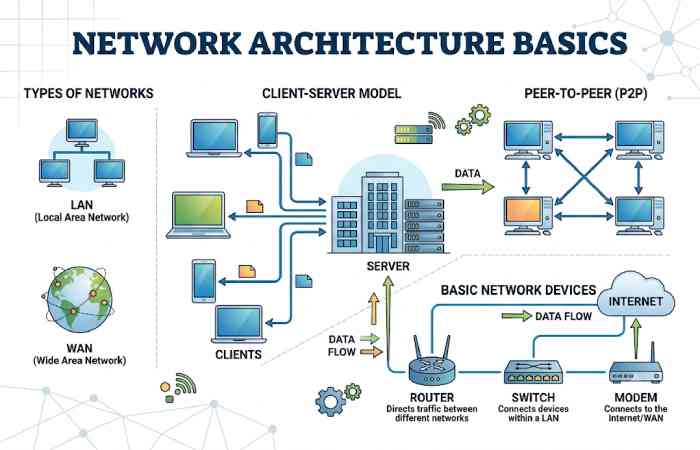
The network architecture is the way a network is constructively designed, it specifies how devices, applications, servers and the communication system are linked and related to each other. It is the main component of the network infrastructure design process. It defines how data flows on the network and whether it perform securely and reliably.
A well-structured network architecture enables organizations to efficiently host business applications and cloud services, accommodate remote users, and provide for future growth.
Common Architecture Layers
| Layer | Function |
| Core Layer | High-speed backbone |
| Distribution Layer | Policy enforcement |
| Access Layer | User connectivity |
Modern Architecture Models
| Architecture | Best For |
| Traditional Three-Tier | Enterprises |
| Spine-Leaf | Data Centers |
| SD-WAN | Multi-Branch Organizations |
| Cloud-Native | Hybrid Environments |
Network Design Requirements
Seting network design requirements – prior to establishing a network, the organizations should determine its network designing requirements to ensure that the network meets the demands of existing system and is capable of scaling.
The foundation of a good network design lies in eliciting requirements, such as business objectives, user requirements, application requirements, and security requirements. Failure to identifying requirements can result in an expensive, inflexible, and unfriendly network implementation.
Key Considerations
- Number of users, Instructional factors 1. Also, consider the number of users. Don‘t use too many complex tools at one time, practice should be your Master.
- Application requirements
- Bandwidth demands
- Security needs
- Compliance regulations
- Predicted growth in the coming years
Requirement Assessment Checklist
| Requirement | Example |
| User Count | 500 Employees |
| Sites | 10 Branches |
| Cloud Usage | Microsoft 365 |
| Remote Workforce | 40% Staff |
| Compliance | GDPR, HIPAA |
LAN and WAN Design
Local Area Network (LAN)
A Local Area Network (LAN) links devices together in a single building or campus.
Best practices:
- Managed switches
- VLAN segmentation
- Gigabit or Multi-Gig connectivity.
- Implementation of Wi-Fi 6E
Wide Area Network (WAN)
WANs interconnect sites.
Modern WAN solutions include:
| Technology | Benefits |
| MPLS | Reliable connectivity |
| SD-WAN | Cost-effective management |
| VPN | Puede integrar las conexiones remotas. Advanced Encryption Standard (AES). |
| Dedicated Fiber | Maximum performance |
LAN vs WAN Comparison
| Feature | LAN | WAN |
| Coverage | Local | Global |
| Speed | Higher | Variable |
| Cost | Lower | Higher |
| Management | Simpler | Complex |
Network Topology
Topology sets up the way in which the devices are connected.
Popular Network Topologies
| Topology | Advantages | Drawbacks |
| Star | Easy management | Central dependency |
| Mesh | High redundancy | Expensive |
| Ring | Predictable traffic | We define the probability of failure, pf, as a single failure risk. |
| Bus | Low cost | Limited scalability |
| Hybrid | Flexible | Complex design |
Suggested topology for 2026.
Most enterprises deploy:
- Star topology for offices. This architectural form is used for the network in the office and is recommended in the standards EN 50173, EN 50290-3 and ISO/IEC 11801.
- Spine-leaf architecture for data centers
- SD-WAN has blended network and application traffic to data center applications providing various benefits for branch connectivity.
Scalability and Performance
The existing network should have the capacity to future expansion.
Scalability Strategies
- Modular hardware
- Cloud integration
- SDN implementation
- Virtual networking
- High bandwidth Fiber Backbones (extending from thousands to millions of fibers).
Performance Optimization
| Optimization Method | Impact |
| QoS Policies | Significantly improved application performance |
| Traffic Monitoring | Faster troubleshooting |
| Load Balancing | Improved reliability |
| Network Segmentation | Reduced congestion |
Network Redundancy
Presence of redundant systems; reduces downtime by removing single points of failure.
Common Redundancy Measures
- Two ISP
- Backup routers
- Redundant switches
- Several power sources.
- Failover firewalls
Availability Levels
| Design Level | Expected Uptime |
| Basic | 99.0% |
| Standard Enterprise | 99.9% |
| High Availability | 99.99% |
| Mission Critical | 99.999% |
Network Security Design
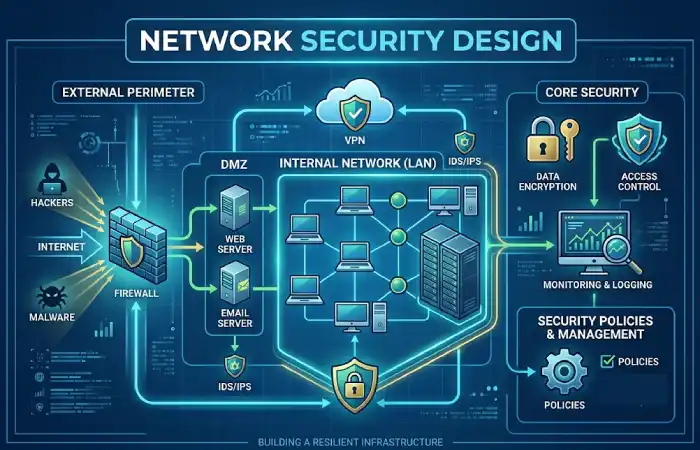
Security has to be built in on the design from the outset and not as an afterthought.
Essential Security Components
- Next-Generation Firewalls
- Network Access Control (NAC)
- Intrusion Detection Systems
- Zero Trust Architecture
- Multi-Factor Authentication
Security Layer Comparison
| Security Control | Purpose |
| Firewall | Traffic filtering |
| IDS/IPS | Threat detection |
| VPN | Secure connectivity |
| MFA | Identity protection |
| Encryption | Data protection |
Designing Business Networks
Business networks demand an equilibrium betwe… Performance Security Cost
Small Business Design
- Cloud-managed networking
- Single firewall
- Managed switches
- Access points supporting Wi-Fi 6 (802.11ax).
Medium Business Design
- VLAN segmentation
- Multiple internet links.
- Centralized monitoring
Enterprise Design
- SD-WAN
- Zero Trust Security
- Multi-cloud connectivity
- Network automation
Infrastructure Comparison
| Business Size | Recommended Design |
| Small | Cloud-managed |
| Medium | Hybrid Network |
| Enterprise | SD-WAN + Zero Trust |
Network Infrastructure Design Best Practices
Follow these proven best practices:
- Designing in scalability.
- – Ensure security by design.
- Inventorise all network assets.
- Employ branches.
- Packet sniffer programs that can filter and divide network traffic into different protocols.
- Keep an eye on the performance all the time.
- Make simple.
- Common specification of hardware and configuration.
- Ensure regular checking and auditing.
- Prepare for disaster recovery.
Recommended Resource Platforms
| Resource | Purpose |
| Cisco Design Zone | Design of the enterprise network |
| Juniper Networks | Architecture guides |
| Fortinet Resources | Secure networks such as: |
| IBM Networking Solutions | Infrastructure planning |
| TechTarget Networking | Abandonments and Buyback Inspections |
FAQ
What does network infrastructure design include?
Design of the network infrastructure relates to the planning and developing of network architecture, devices and security controls, cellular and backbone connectivity systems to meet the needs of business operations.
What is the significance of designing network infrastructure?
It enhances performance, security, reliability and scalability, user experience and reduces downtime and maintenance costs.
What topology of network should one use?
Star topology is the most widely used topology for business environments. For more modern data centers, spine-leaf architecture would be the best choice.
What is the effect of network redundancy on the reliability?
Fail safes / fail overs built in Redundant parts prevent a system collapse due to a single point of failure. This ensures operations during power or individual component failure.
What about security in this networkdesign?
Security safeguards the systems, applications and data from cyber attack, it is now considered as a key element in next generation architecture.
Conclusion
The design of Network Infrastructure provides the backbone of contemporary digital services. From designing small business networks to deploying large enterprise infrastructures or cloud first approaches, organizations need to consider scalability, security, availability and performance.
Through applying tried and tested design methodologies, leveraging modern architectures of technologies like SD-WAN or ZT and proactively monitoring network performance, businesses can establish resilient infrastructures that facilitate future growth and new technological advancements.