
 Kashifa Jafar
Technology Writer & Contributor
Kashifa Jafar is a technology writer and contributor at FutureTechExpert with 4+ years of experience in technology writing and content creation.
Read Full Bio of Author →
Kashifa Jafar
Technology Writer & Contributor
Kashifa Jafar is a technology writer and contributor at FutureTechExpert with 4+ years of experience in technology writing and content creation.
Read Full Bio of Author →
 Sameena Begum
Health, Technology & Digital Content Reviewer
Sameena reviews selected health, wellness, technology, and digital content for clarity, factual presentation, and reader usefulness.
Read Full Bio of Reviewer →
Sameena Begum
Health, Technology & Digital Content Reviewer
Sameena reviews selected health, wellness, technology, and digital content for clarity, factual presentation, and reader usefulness.
Read Full Bio of Reviewer →
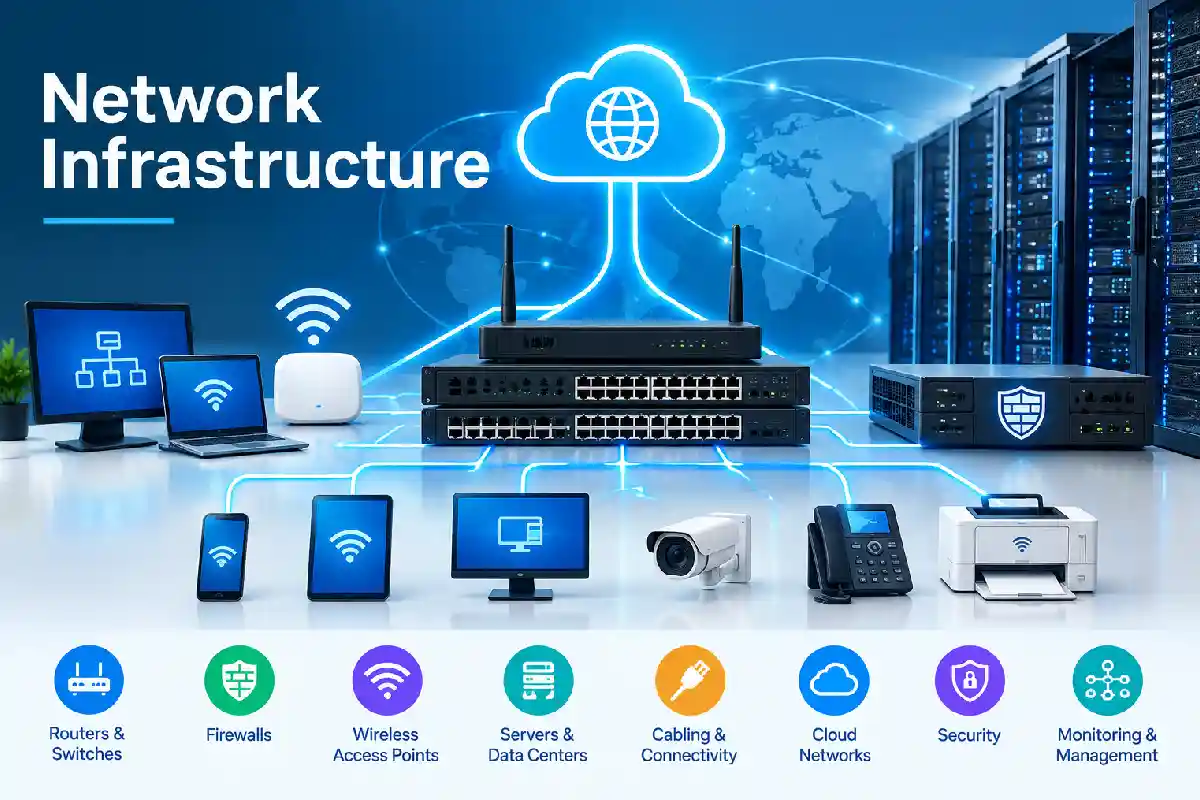
Network Infrastructure provides the solid base for devices, applications, servers and users to be able to connect either across local and world wide network. It is the ‘platform’ that makes possible browsing the net, playing a video, attend to a conference-call or run enterprise applications.
Organizations are now moving towards cloud computing, applications using artificial intelligence (AI), work from home etc. and all the internet of things (IoT) devices which require a robust and secure network platform. High bandwidth, resilient network architecture and smart network management systems are all essential components.
A complete reference to network infrastructure, detailing everything you need to understand about the foundation of the network, the building blocks involved, architecture, security considerations, management issues, and where it is heading in 2026 and beyond.
 This article is part of
Telecom Infrastructure Resources
Table of Contents
What Is Network Infrastructure?
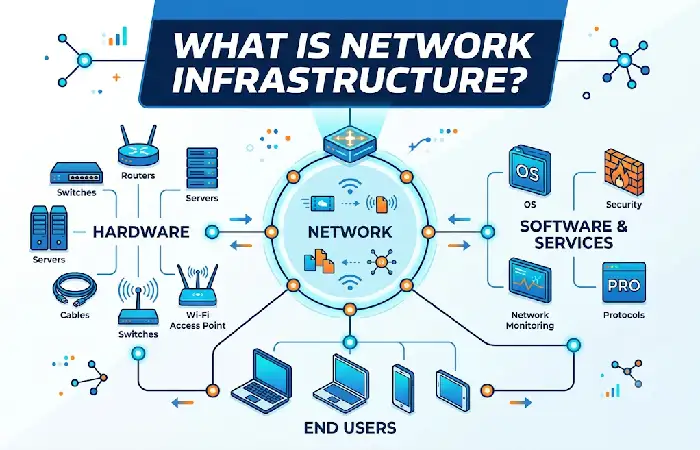
The network infrastructure consists of the hardware, software and connectivity technologies, protocols and services that enable communication between computers, mobile phones, servers, applications and other devices. The backbone of our digital lives and institutional processes, network infrastructure underpins communication for applications such as Internet and business applications, cloud computing, video conferencing and connecting devices to the internet.
A network can also be a home network network consisting of a router, Wi-Fi access point and number of interconnected devices or it can be a large enterprise which contains hundreds of switches, routers, firewalls, servers, wireless access points and numerous cloud connections.
Key Functions of Network Infrastructure
- Device connectivity
- Data transmission
- Internet access
- Resource sharing
- Security enforcement
- Traffic management
- Application delivery
- Cloud integration
With no strong network infrastructure, companies would not be able to keep in touch, to operate effectively and provide digital services.
Network Infrastructure at a Glance
| Infrastructure Element | Purpose |
| Routers | Connect networks |
| Switches | Connect devices within networks |
| Firewalls | Protect against threats |
| Access Points | Provide wireless connectivity |
| Servers | Deliver applications and services |
| Cabling | Physical data transmission |
| Cloud Platforms | Virtual networking services |
A Simple Example of Network Infrastructure
Its network environment might be a business internet line, A router, Managed network switch, Firewall, Many Wi-Fi access points, Ethernet wiring, Printers, Computers, Cloud services.
Every time an employee uploads a file to a cloud service, the network infrastructure transmits data from the employee‘s workstation over the local network and through security to the internet; and from there to the cloud.
This is why network infrastructure is more than just an internet connection. It‘s the infrastructure that allows devices, humans, applications and services to communicate, safely and consistently.
Network cabling is a critical part of any network infrastructure, providing the physical connections that allow devices, applications, and services to communicate efficiently across an organization.
How Does Network Infrastructure Work?
The network infrastructure allows the hardware, services, network and applications to interconnect and sharing the data safelyand efficiently. A set of hardware components, such as routers, switches, firewalls, access points and servers, together with a set of software resources, like cabling (physical or wireless), protocols and network management resources is enough for the data to be transferred from a source to a destination.
Every time someone logs into a website, send an email, fire up a cloud app, or just drag a file across the network, infrastructure components work together to find the right destination, determine the best path, make the call, and serve the reply.
How Data Moves Through Network Infrastructure
Most network communication gets divided into small chunks known as data packets. These include details which allow networking equipment to identify where to send the data.
A simplified process looks like this:
Device → Switch/Access Point → Router → Firewall → Internet/WAN → Destination Server
For example, when an employee accesses a cloud application:
- The employee’s computer or smartphone sends a request.
- A wireless access point or network switch receives the traffic.
- The switch forwards the traffic toward the appropriate router.
- The router determines where the traffic needs to go.
- A firewall checks the traffic against security rules.
- The data travels across the organization’s WAN or internet connection.
- The cloud service receives and processes the request.
- The response travels back through the network to the user’s device.
All of this takes place in a flash.
Basic Workflow
- User sends a request.
- Data is converted into packets.
- Switches direct packets locally.
- Routers forward traffic externally.
- Firewalls inspect traffic.
- Servers process requests.
- Response returns to the user.
Simplified Example
When someone opens a website:
| Step | Process |
| 1 | Browser sends request |
| 2 | Switch forwards data |
| 3 | Router connects to internet |
| 4 | DNS identifies website location |
| 5 | Web server responds |
| 6 | Content loads on screen |
This process occurs within milliseconds.
Ethernet cables, fiber optic links, switches, and routers are among the essential network infrastructure components that ensure reliable connectivity and data transmission.
Components of Network Infrastructure
These elements include all the hardware and software, connectivity technologies, protocols and other services which are used to communicate between the different devices and connect them to a network. These include everything from routers, switches, firewalls, servers, cables, wireless access points and network management systems to carrying out the individual tasks of a network to make it reliable, secure and fast.
The amount of components and the kind of components will be determined by the size and purpose of the network. For instance a residential network would most likely require a modem, an ADSL router, an access point to Wireless network, and some Ethernet connections. A company enterprise network could have thousands of switches, routers, firewalls, access points, servers, fiber links, load balancing equipment, monitoring and cloud-based networking services.
Core Components
Hardware
- Routers
- Switches
- Firewalls
- Servers
- Access points
- Load balancers
Software
- Network operating systems
- Monitoring platforms
- Security applications
- Configuration tools
Services
- DNS
- DHCP
- VPN
- Cloud networking
Transmission Media
- Ethernet cables
- Fiber optic cables
- Wireless signals
Network Infrastructure Components Comparison
| Component | Role | Importance |
| Router | Connects networks | Critical |
| Switch | Connects devices | Critical |
| Firewall | Security control | Critical |
| Access Point | Wi-Fi access | High |
| Load Balancer | Traffic distribution | High |
| Server | Resource delivery | Critical |
| Monitoring Tool | Performance visibility | High |
Structured cabling systems are designed to support modern network infrastructure requirements, including cloud computing, virtualization, and high-speed networking.
Types of Network Infrastructure
The types of infrastructure are vary depending on the interconnection type, location (where the network resides), and even business needs. For example a small home network can have a simple interconnection between the devices, through a broadband link provided from a Wi-Fi router, on the other hand a large enterprise can support several different infrastructures, a wired Ethernet, a fiber optics infrastructure, a Wi-Fi Infrastructure, Data center Networking, Cloud Networking, Wide areas.
Depending on the differences we have between categories, it is relatively simple to choose the best infrastructure in order to have performance, scalability, security, reliability and costs.
Major Types of Network Infrastructure
| Type | Primary Connectivity | Best For | Key Advantage |
| Wired Network Infrastructure | Ethernet and fiber | Offices, campuses, data centers | High reliability |
| Wireless Network Infrastructure | Wi-Fi and radio | Mobile users and IoT | Mobility |
| LAN Infrastructure | Ethernet/Wi-Fi | Homes and offices | Local connectivity |
| WAN Infrastructure | Internet, leased lines, SD-WAN | Multiple locations | Long-distance connectivity |
| Data Center Infrastructure | High-speed Ethernet/fiber | Servers and applications | High performance |
| Cloud Network Infrastructure | Virtual networks | Cloud applications | Scalability |
| Hybrid Infrastructure | On-premises + cloud | Modern enterprises | Flexibility |
| Edge Network Infrastructure | Local/edge connectivity | IoT and real-time applications | Low latency |
| 5G/Private Cellular Infrastructure | Cellular networks | Industrial and enterprise use | Wireless coverage and mobility |
Network Hardware and Equipment
Network hardware is a term used to describe the various bits of hardware and equipment that are used to connect computers, servers, users and other end points as well as facilitate the transfer of data across a network. It is essentially the hardware components that make up the physical network infrastructure.
The type of equipment required will vary depending on the scale of the network and the function of the network. A home network can be as simple as a modem or ont, a router and a wireless access point. An enterprise network could require switches with managed ports, enterprise level routers, firewalls, wireless controllers, access points, load balancers, transceivers and data centre specific equipment.
Selecting the appropriate network equipment is a crucial part of providing an efficient, low cost, secure, reliable and scalable network.
Essential Network Devices
Routers
Manage traffic between networks and internet connections.
Switches
Connect devices within LAN environments.
Firewalls
Inspect and filter incoming and outgoing traffic.
Wireless Access Points
Enable Wi-Fi connectivity.
Load Balancers
Distribute traffic across servers.
Network Storage
Supports centralized data management.
Enterprise Networking Equipment Comparison (2026)
| Equipment | Typical Use Case | Recommended Environment |
| Managed Switch | Business LAN | Medium to large organizations |
| Router | WAN connectivity | All businesses |
| Firewall Appliance | Security | All environments |
| Access Point | Wi-Fi | Offices and campuses |
| Load Balancer | High availability | Enterprise environments |
Resource Links
| Resource | URL |
| Cisco Networking | https://www.cisco.com |
| Aruba Networking | https://www.arubanetworks.com |
| Juniper Networks | https://www.juniper.net |
| Fortinet | https://www.fortinet.com |
| Ubiquiti | https://www.ui.com |
Selecting the right cable type is essential for building a scalable enterprise network infrastructure that can support growing bandwidth demands.
Network Cabling and Connectivity
Network cabling and connectivity includes all the physical wired and wireless connections that transmit data between the various network devices such as computers, switches, routers, access points, servers etc. While wireless networking has gained widespread popularity in recent years, physical cabling continues to be an essential part of many high-end network infrastructure deployments in most business offices, data centers, campuses and telephone networks.
For Network Connectivity use Copper Ethernet, Fiber-Optic Cables, Wi-Fi and Cell Networks, and any other transmission media. The adequate selection for a required action should be made in terms of Transmission media availability according to particular needs, for example: bandwidth, range, fidelity, installation location, security, cost and so on.
A cabling system which is designed effectively will reduce down time on the network, simplify troubleshooting, increase bandwidth, and provide adequate capacity to meet future demands.
Common Cabling Types
Cat6
Supports up to 10 Gbps.
Cat6A
Enhanced performance and reduced interference.
Cat7
Improved shielding for enterprise deployments.
Fiber Optic
High-speed backbone connectivity.
Cabling Comparison
| Cable Type | Speed | Distance |
| Cat5e | 1 Gbps | 100m |
| Cat6 | 10 Gbps | 55m |
| Cat6A | 10 Gbps | 100m |
| Cat7 | 10 Gbps+ | 100m |
| Fiber Optic | 100 Gbps+ | Several km |
Wireless Network Infrastructure
Wireless network infrastructure is the hardware that enables the use of wireless devices for network connections. This includes hardware like wireless access points, wireless controllers, antennas, cellular networks, radio-frequency communication, and of course Wi-Fi. It is the hardware that provides home, office, campus, warehouse, urban, and other network coverage.
Wireless networks provide more mobility and flexibility over wired infrastructure. Employees can walk around the office while still maintaining network connection, customers in airports or cafés can get Wi-Fi, and IoT equipment can communicate between each other without needing a wire for each equipment.
A robust wireless network architecture incorporates a blend of wireless access points, switches, security appliances, routers, authentication platforms, and a top-tier centralized management platform to establish a dependable and secure network.
Key Wireless Components
- Wireless controllers
- Access points
- Antennas
- Authentication servers
Benefits
- Mobility
- Flexibility
- Reduced cabling costs
- Faster deployment
Wi-Fi Standards Comparison
| Standard | Maximum Speed |
| Wi-Fi 5 | 3.5 Gbps |
| Wi-Fi 6 | 9.6 Gbps |
| Wi-Fi 6E | 9.6 Gbps |
| Wi-Fi 7 | 40+ Gbps |
Data Center Network Infrastructure
A data center network infrastructure is the collection of networking hardware, connectivity technologies, security systems and management tools that interconnect servers, storage, applications, users inside and outside the data center. It is the underlying mechanism that enables websites, cloud applications, databases, enterprise applications, AI workloads and all other digital services to operate.
A data center network, as distinct from a simple office network, must support an enormous amount of traffic with low latency, high availability, scalability and secure and predictable performance. A network component failure, such as a switch failure, may have a global impact on thousands of applications or users. Datacenter infrastructure is therefore typically designed with redundancy and automation for failover.
How Data Center Network Infrastructure Works
A data center network links us physical and virtual computing resources through various tiers of network infrastructure.
A simplified traffic path is:
Server → Top-of-Rack Switch → Spine/Leaf Network → Firewall/Router → WAN/Internet → External User
Within the data center, servers talking between each other within the high speed switches. The network traffic can be transferred between application servers, database, store, security appliances and outside networks.
Data Center Components
- Core switches
- Spine-leaf architecture
- Storage networks
- Virtualization platforms
- Redundant power systems
Benefits
- High availability
- Scalability
- Disaster recovery support
Modern Data Center Trends
- AI networking
- Software-defined networking
- Automation
- Zero-trust architecture
Proper cable management should be included in every network infrastructure planning strategy to improve performance, maintenance, and future expansion.
Cloud Network Infrastructure
Cloud network infrastructure refers to virtual networking services, infrastructure, safeguards, connectivity methods and management tools used to connect cloud applications, servers, datacentres, storage, users, and outside networks.
In a traditional network environment, where physical routers, switches, network adapters, cabling, firewalls are owned and managed by the organization, cloud networking is based on the utilization of software-driven and virtualized devices. This enables organizations to provision network and subnets, route rules, firewalls, load balancers and private connections using cloud management portals and APIs.
Cloud network infrastructure is critical for cloud computing, SaaS applications, remote work, enterprise information systems, websites, data analytics, AI workloads and hybrid IT.
Popular Cloud Infrastructure Providers
| Provider | Strength |
| AWS | Global reach |
| Microsoft Azure | Enterprise integration |
| Google Cloud | Data analytics |
| Oracle Cloud | Database optimization |
Cloud Networking Services
- Virtual private clouds (VPCs)
- Cloud firewalls
- VPN gateways
- Load balancing
- CDN integration
Cloud Infrastructure Comparison
| Feature | AWS | Azure | Google Cloud |
| Global Regions | Extensive | Extensive | Growing |
| Enterprise Support | Excellent | Excellent | Strong |
| Hybrid Networking | Strong | Excellent | Strong |
| AI Integration | Strong | Strong | Excellent |
Network Infrastructure Security

Network infrastructure security involves safeguards for network components, including hardware, links, equipment, information and services, against theft, unauthorized access, cybercrime, abuses and sabotage. It encompasses routers and switches, wireless access points and firewalls and servers, cloud networks, remote connections and network management systems.
A secure network infrastructure enables organizations to safeguard sensitive data while at the same time maintaining confidentiality, integrity and availability of network resources. With increasing numbers of businesses connecting more devices, cloud applications, remote workers, IoT systems, and third-party providers to their networks, security is more crucial than ever.
Security of network infrastructure is not one single product or setup. It is a multiple layer system consisting of network security hardware, access controls, encryption, segmentation, and monitoring, authentication, patching and security policy.
Major Security Threats
- Malware
- Ransomware
- DDoS attacks
- Phishing
- Insider threats
- Unauthorized access
Security Best Practices
Zero Trust Architecture
Verify every user and device.
Multi-Factor Authentication
Reduce account compromise risks.
Network Segmentation
Limit lateral movement.
Continuous Monitoring
Detect anomalies quickly.
Patch Management
Prevent known vulnerabilities.
Security Technologies Comparison
| Technology | Purpose |
| Firewall | Traffic filtering |
| IDS/IPS | Threat detection |
| VPN | Secure remote access |
| MFA | Identity verification |
| SIEM | Security monitoring |
Network Infrastructure Management
Network infra-structure management is the activity that involves monitoring, configuring, maintaining, securing, optimizing and troubleshooting the components, software, connections and services that constitute a network of an organization. It assists the organizations to have a reliable, secured, efficient and available network infrastructures, as the users, devices, applications and locations increase.
Coverage of the network infrastructure management should include all routers, switches, firewalls, wireless access points, servers, cables,cloud networks, VPNs, network services and connected endpoints. Network infrastructure management can be both manual or managed by automation platforms.
My ideal network would offer high availability, predictable performance, robust security, optimized resource consumption and scalability.
Why Network Infrastructure Management Is Important
Networks are not static environments any longer. Enterprises may run over multiple offices, data centers, clouds, remote locations or mobile environment. Likewise, IoT devices, cloud applications, video conferencing, AI/ML workloads and other services may alter network traffic pattern constantly.
Network infrastructure management helps administrators:
- Monitor network health
- Identify performance problems
- Detect security events
- Configure network devices
- Manage IP addresses
- Track network assets
- Maintain software and firmware
- Control user and device access
- Optimize bandwidth
- Troubleshoot connectivity issues
- Plan network upgrades
- Reduce downtime
Without the right handling even the best network equipment may get hard to use and handle efficiently.
Key Management Areas
Monitoring
Track uptime and performance.
Configuration Management
Maintain standardized settings.
Capacity Planning
Prepare for growth.
Automation
Reduce manual tasks.
Popular Network Management Tools
| Tool | Primary Function |
| SolarWinds | Monitoring |
| PRTG | Infrastructure monitoring |
| ManageEngine | Network management |
| Zabbix | Open-source monitoring |
| Datadog | Cloud monitoring |
Future of Network Infrastructure
The network will also evolve to become faster, smarter, more automated, more secure and more flexible. Indeed, the evolution of cloud computing, AI, Edge computing, IoT, 5 G, fiber optic and distributed applications are all redefining the architecture of future networks.
Conventional networks were typically designed around static geographic placement, physical hardware, hand-managed devices, etc. Current infrastructure merges physical networking, software-defined networking, cloud computing, automation, autonomous computing with AI assistance, and programmable infrastructure.
What we end up with is a move toward network environments that are flexible to changing traffic, applications, users, and security policies.
Major Trends Shaping the Future of Network Infrastructure
It is anticipated that several technologies will impact on the network infrastructure.
| Technology | Impact on Network Infrastructure |
| Artificial Intelligence | Enables predictive monitoring and automated optimization |
| Cloud Networking | Provides flexible virtual infrastructure |
| Edge Computing | Moves processing closer to users and devices |
| 5G and Private 5G | Enables high-speed wireless connectivity |
| Wi-Fi Advancements | Improves wireless capacity and efficiency |
| Software-Defined Networking | Makes networks more programmable |
| Network Automation | Reduces repetitive manual administration |
| IoT | Increases the number of connected endpoints |
| High-Speed Fiber | Supports growing bandwidth requirements |
| Zero Trust | Strengthens identity-based network security |
| Network Observability | Provides deeper visibility into network behavior |
These technologies are not evolving separately: they are working together more and more to support distributed network environments.
Businesses deploying new networks can benefit from a comprehensive network infrastructure guide that covers design, cabling, security, and management best practices.
Emerging Trends
AI-Powered Networking
Automated troubleshooting and optimization.
Network Automation
Self-healing networks reduce downtime.
Wi-Fi 7 Adoption
Higher throughput and lower latency.
Edge Computing
Processing data closer to users.
5G and Private Networks
Enterprise-grade wireless connectivity.
Software-Defined Networking (SDN)
Centralized network control.
Quantum-Safe Security
Preparing for future encryption challenges.
Network Infrastructure Trends Comparison (2026–2030)
| Trend | Business Impact |
| AI Networking | High |
| SD-WAN | High |
| Edge Computing | High |
| Private 5G | Medium-High |
| Wi-Fi 7 | High |
| Zero Trust Security | Critical |
| Network Automation | Critical |
Future Network Infrastructure Challenges
Amidst this rapid technological development, organizations will still experience many challenges such as:
| Challenge | Why It Matters |
| Increasing Complexity | More technologies and locations must be managed |
| Cybersecurity | Larger attack surfaces create additional risks |
| Skills | Advanced networks require specialized expertise |
| Legacy Infrastructure | Older systems may not integrate easily with modern platforms |
| Cost | Upgrades and high-performance infrastructure can be expensive |
| Interoperability | Multiple vendors and technologies must work together |
| Data Growth | More traffic requires additional network capacity |
| Automation Risks | Incorrect automated changes can have widespread effects |
| Compliance | Organizations must meet applicable security and data requirements |
Any good design will be dependent on the balance between technology, innovation, low cost and high available reliability, security and easy to use.
Frequently Asked Questions About Network Infrastructure
What is network infrastructure?
Network infrastructure: Is the combination of hardware, software, services and connectivity technologies that allows devices and systems to communicate.
The reasons for the importance of network infrastructure?
It contributes to organizations running their business on infrastructure, connectivity, cloud computing, security and performance of applications.
What makes up the network infrastructure?
Routers, switches, firewalls, access points, servers, cabling, management software.
What is the distinction between network infrastructure and network architecture?
The term infrastructure is used to describe physical and virtual resources whereas the term architecture is used for the design and structure of the resources.
What is cloud network infrastructure?
Cloud network infrastructure consists of virtualization of networking services hosted on provider premises as opposed to on-site physical equipment.
In what ways can a business enhance its network infrastructure?
Introducing new hardware, automation, enhancing security, transitioning to the cloud and ongoing performance assessment.
Conclusion
The network infrastructure is the backbone of any modern digital environment whether it be local networks, data centers, cloud or digital business transformed by AI automation. Infrastructure enables fast and safe communications, fast data delivery and mass expansion of the business without limitations.
With the continuing of cloud adoption, edge networking and Wi-Fi 7 also the efficient intelligent infrastructure management solutions based on AI organizations need to plan Infrastructure for a solid Scalability, anticipate the future growth of data, multiple workloads and demands from the customers. A solid infrastructure today means business agility and competitiveness of tomorrow.
Kashifa Jafar is a technology writer and contributor at FutureTechExpert with 4+ years of experience in technology writing and content creation.
Read Full Bio of Author →Sameena reviews selected health, wellness, technology, and digital content for clarity, factual presentation, and reader usefulness.
Read Full Bio of Reviewer →