



Last Updated: September 13, 2026
Wireless network infrastructure is the backbone of modern communications and business networks. It allows users to utilize services, access the internet and run their business without the need of cabled network. Wireless networks are the back-bone for home Wi-Fi networks as well as huge enterprise implementations. Thanks to this infrastructure we have cloud based applications, connected appliances and everything else that makes a business work.
Table of Contents
What is Wireless Network Architecture?
Wireless Network Infrastructure Hardware, software and communication technologies that provide connection and communication of other devices without physical network cables. It is the backbone of Wi-Fi network as it provides the necessary communication between laptop, smart phone, tablet computer, Internet of Things devices and the business application system across the building, office, campus, cities and towns.
Wireless network infrastructure fundamentally is based on use of Radio Frequency (RF) signals to transfer data from associated devices to wired network. Wireless network infrastructure generally comes along with internal and external APs, a variety of switch, router, controller, antenna, security system etc. for wireless network.
Core components include:
- Wireless Access Points (APs)
- Wireless Controllers
- Routers and Gateways
- Antennas
- Network Management Software
- Authentication Servers
- Wireless Security Systems
Key Benefits
| Benefit | Description |
| Mobility | Connect from any point within coverage area, 20 to 3000 Feet |
| Scalability | Simply increase network capacity. |
| Flexibility | Enables remote and hybrid work |
| Cost Savings | Cuts down the need for wiring |
| IoT Support | Seamlessly connects to various smart devices. |
Resource Links
| Resource | Link |
| Wi-Fi Alliance | https://www.wi-fi.org |
| IEEE Standards | https://www.ieee.org |
| Cisco Wireless Solutions | https://www.cisco.com |
How Wireless Networks Work
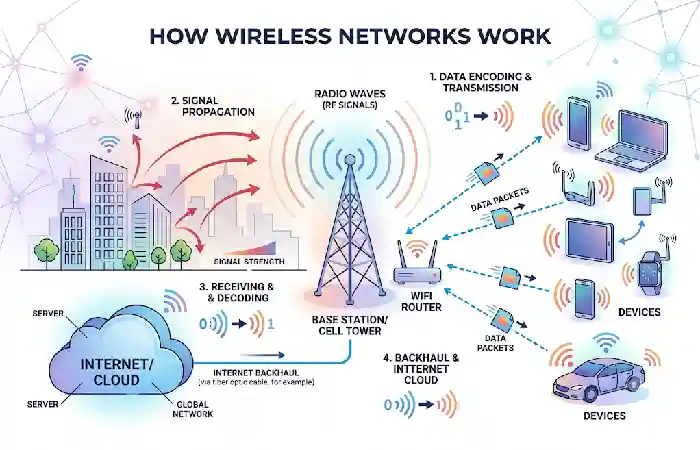
Wireless networks enable Internet and data connectivity between various wireless devices by means of radio frequency (RF) signals rather than Ethernet cables. The Wi-Fi enabled device (laptop, Smartphone, etc.) connects to the wireless network and transmits data through the wireless access points (APs).
First device scans for wireless networks and establishes a connection with the wireless access point. Once connected, data is passed wirelessly to the access point which then routes it through switches, routers and internet gateways to its destination and the reply is sent back to the device.
Basic Process
- Wireless Request is sent by the device.
- The Access Point Start up receives.
- AP sends traffic to network switch/router
- Router routing traffic to destination.
- The response is sent back to AP.
Wireless Communication Standards
| Standard | Maximum Speed | Frequency |
| Wi-Fi 5 (802.11ac) | 3.5 Gbps | 5 GHz |
| The Wi-Fi 6 (802.11ax) | 9.6 Gbps | 2.4/5 GHz |
| Wi-Fi 6E | 9.6 Gbps | 6 GHz |
| Wi-Fi 7 | 46 Gbps | 2.4/5/6 GHz |
Wireless Access Points
It Provide Wi-Fi service to users and devices.
Types of Access Points
| AP Type | Best Use Case |
| Standalone AP | Small offices |
| Controller-Based AP | Enterprises |
| Cloud-Managed AP | Multi-site businesses |
| Mesh AP | Expanses coverage area. |
Features to Consider
- I support Wi-Fi 6/6E/7.
- Multi-user MIMO
- Beamforming technology
- PoE support
- Enhanced security features
Wi-Fi Network Infrastructure
An underpinning for wireless local area networks (WLANs) is the Wi-Fi infrastructure.
Essential Components
| Component | Function |
| Access Point | Enables access to wireless. |
| Switch | Links APs to network |
| Router | Internet connectivity |
| Firewall | Network protection |
| Controller | Centralized management |
2026 Wi-Fi Technology Comparison
| Technology | Coverage | Speed | Enterprise Ready |
| Wi-Fi 5 | Medium | Good | Yes |
| Wi-Fi 6 | High | Excellent | Yes |
| Wi-Fi 6E | High | Excellent | Yes |
| Wi-Fi 7 | Very High | Outstanding | Best Choice |
Enterprise Wireless Networks
It can support thousands of users, applications and devices.
Enterprise Requirements
- High availability
- Centralized management
- Secure authentication
- Guest networking
- Network segmentation
- Scalability
Typical Enterprise Architecture
Internet
│
Firewall
│
Core Switch
│
Wireless Controller
│
Access Points
│
Users & Devices
Wireless infrastructures are a part of many major organizations in conjunction with unified communications, cloud service, and network monitoring systems.
Wireless Network Controllers
It offer centralized management of multiple access points.
Controller Benefits
| Benefit | Impact |
| Centralized Configuration | Easier management |
| Security Enforcement | Consistent policies |
| Roaming Optimization | Interfaces offer a better user experience. |
| Performance Monitoring | Faster troubleshooting |
Controller Types
- Hardware Controllers
- Virtual Controllers
- Cloud Controllers
Cloud-managed controllers are gaining importance as a result of lower infrastructure cost and easier implementation.
Wireless Network Coverage
Coverage relates to the user‘s ability to connect through a facility.
Factors Affecting Coverage
- Building materials
- Place of access points
- User density
- RF interference
- Antenna type
Coverage Best Practices
- Camping site surveys of wireless
- Optimize AP placement
- Minimize interference
- Usemesh networkingwhen necessary.
- Check the signal strength of your monitor periodically
Wireless Network Performance
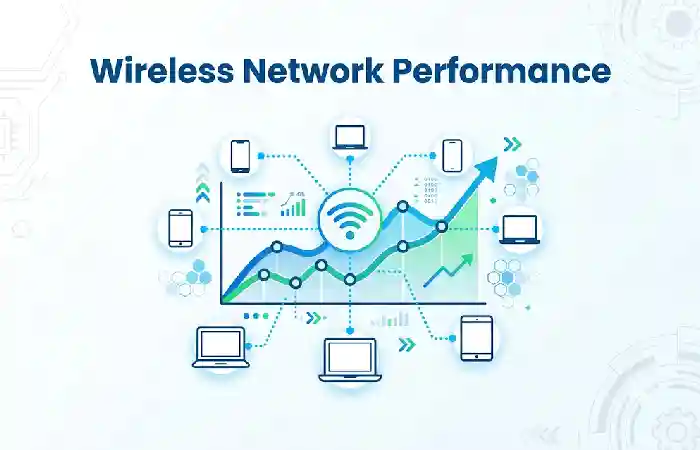
The network‘s effectiveness has a crucial effect on user productivity and application‘s dependability.
Key Performance Metrics
| Metric | Recommended Target |
| Signal Strength | -67 dBm or better Gain 9) |
| Latency | “For less than 50 ms”. |
| Packet Loss | Less than 1% |
| Availability | 99.9%+ |
Performance Optimization Tips
- Upgrade to Wi-Fi 6 or even Wi-Fi 7.
- Balance client loads
- Use Quality of Service (QoS)
- Monitor Bandwidth Usage
- Update hardware/software levels frequently
Wireless Network Security
In conclusion, security continues to be among the most important features of wireless infrastructure.
Common Threats
- Access points (rogue)
- Unauthorized users
- Data interception
- Denial-of-service attacks
- Weak passwords
Security Best Practices
| Security Measure | Purpose |
| WPA3 Encryption | Strong data protection. |
| Multi-Factor Authentication | User verification |
| Network Segmentation | Limits attack spread |
| IDS/IPS Systems | Threat detection |
| Regular Audits | Authorities and security. |
For more advanced methods of protection, see our guide to Telecommunications Security.
Future of Wireless Infrastructure
Wireless networking is a rapidly evolving field with new standards and higher levels of performance.
2019 Trends are Emerging to Shape 2026 and further..
- Adoption rate of the Wi-Fi 7
- Optimization of Network through Artificial Intelligence Utilizing artificial intelligence to optimize networks
- 5 G private integration. Such a private 5 G network design performs light workload tasks such as storing and offering data to end users. It could also be easily controlled in the light of integrating this network architecture.
- By means of cloud native wireless management
- Zero Trust networking
- IoT expansion
- Edge computing connectivity.
Those organizations that invest in state-of-the-art wireless infrastructure today are better equipped for the digital transformations of tomorrow.
Frequently Asked Questions
What is Wireless network infrastructure?
Wireless network infrastructure is all the hardware, software, and technology that makes a wireless conversation possible between users, devices, and networks.
What is the reason?
Must have‘s the main components 4 are:- access-points, routers, switches, controllers, antennas and security.
What makes Wi-Fi 6 and Wi-Fi 7?
Provides several orders of magnitude faster speeds, far lower latency, and outperform Wi-Fi 6 in crowded scenarios.
Product benefits1.Why do we need wireless controllers?
Controllers make management easier, enhance security and optimize wireless performance for all access points.
What can I do in order to improve wireless network?
Upgrade to 802.11b/g/n Wi-Fi standards, strategic AP placement, traffic monitoring and Quality of Service policies.
Conclusion
Wireless Network Infrastructure is an essential element of contemporary information technology frameworks. It provides ubiquitous, scalable, and secure access to network resources for enterprise systems, telecommuting employees, and networked intelligent products.
Supported by state-of-the-art technologies including Wi-Fi 6, Wi-Fi 7, cloud-based management and access, and sophisticated security features, the next-generation wireless infrastructure enables organizations to meet increased bandwidth and device requirements quickly and efficiently.