
 Kashifa Jafar
Technology Writer & Contributor
Kashifa Jafar is a technology writer and contributor at FutureTechExpert with 4+ years of experience in technology writing and content creation.
Read Full Bio of Author →
Kashifa Jafar
Technology Writer & Contributor
Kashifa Jafar is a technology writer and contributor at FutureTechExpert with 4+ years of experience in technology writing and content creation.
Read Full Bio of Author →
 Sameena Begum
Health, Technology & Digital Content Reviewer
Sameena reviews selected health, wellness, technology, and digital content for clarity, factual presentation, and reader usefulness.
Read Full Bio of Reviewer →
Sameena Begum
Health, Technology & Digital Content Reviewer
Sameena reviews selected health, wellness, technology, and digital content for clarity, factual presentation, and reader usefulness.
Read Full Bio of Reviewer →
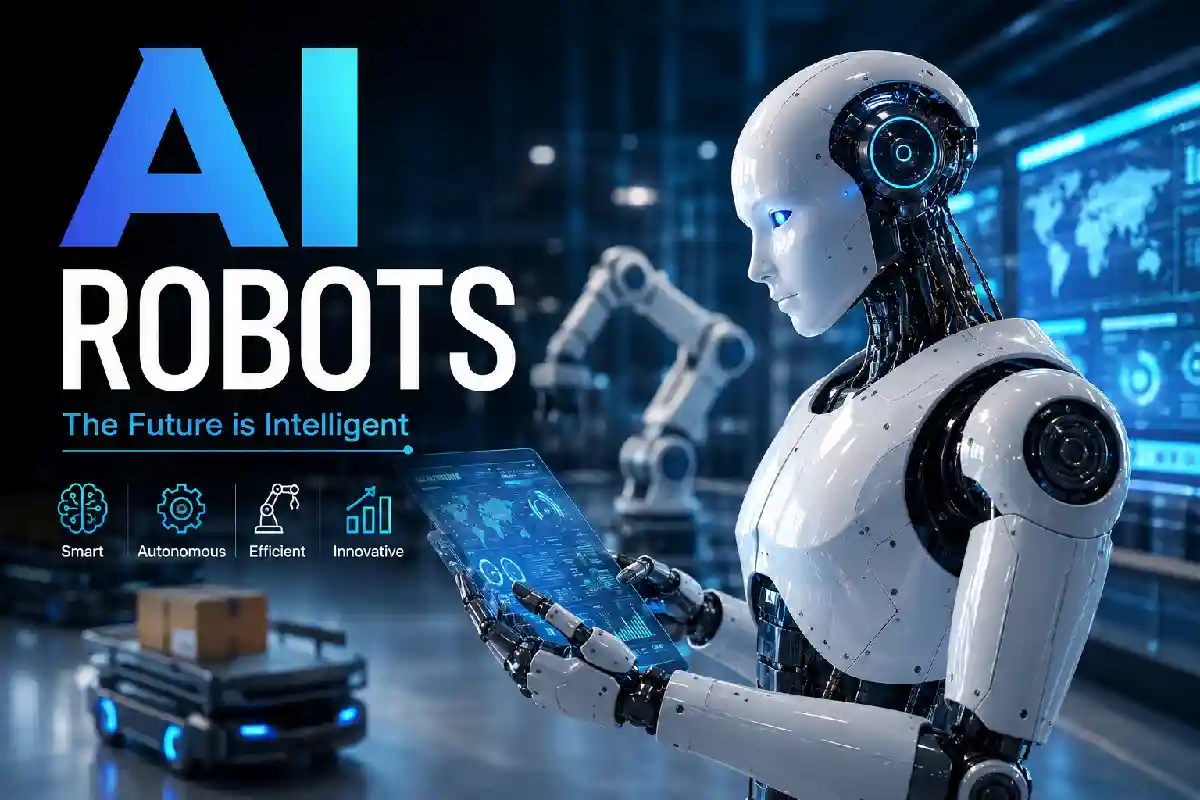
AI Robots are a game changer around the world where robotics is combined with artificial intelligence to produce a robot that learns, reasons, adapts and makes decisions on its own without human intervention in the background. In fact, robots that came out as autonomous warehouse robots, surgeon searching bots, customer service bots and humanoids are gradually translating into every business world.
Industry reports reveal that the worldwide robotics market has topped $65 billion in 2016, due to increased development of a new generation of intelligent systems including advancements in AI, machine vision, machine learning and autonomous decision making. In fact, AI robots are now being installed in industrial applications from hospitals to logistics, agriculture, retail, education, defines and homes.
All that you ever wanted to know about AI robots; how they function, their uses, advantages and disadvantages, their future trend and the technology that will power their successor robots.
 This article is part of
Artificial Intelligence Resources
Table of Contents
What Is an AI Robot?
An AI robot is a robot that incorporates the artificial intelligence (AI) along with its mechanical systems; AI robots are autonomous and can be self-governing, operational, decisive, can learn from experience, grow and adapt to the environment. Most common robots operate based on an exploitable set of rules given for a predetermined program, AI robots on the other hand can efficiently process information obtained from the sensors. They learn to identify objects or to know what it is looking at.
The basis of an AI robot is a body equipped with sensors, cameras, processor and actuators while artificial intelligence is considered as its “brain”. The artificial intelligence collects data from the surroundings, interprets it and make a decision on what to do and this makes the robot to be able to deal with complex situations that cannot be foreseen.
For instance, a factory robot, on the line, would be continuously welding repeatedly, where as an AI robot can find abnormalities, change its operations accordingly, continually learn from the environment, and refine itself.
Among the different types of AI robots, humanoid AI robots are designed to resemble human appearance and behavior, making them ideal for customer service, healthcare, and research.
Key Characteristics of AI Robots
| Feature | Description |
| Learning Ability | Enhances performance with machine learning and experience |
| Decision-Making | Makes his own decision and act according to his/her own analysis of data. |
| Environmental Awareness | Employs sensors and cameras to Capture the environment |
| Adaptability | Acclimates easily to new environs and changes in routines. |
| Automation | Completes a range of tasks with little assistance from people. |
| Interaction | Has the ability to interact with humans in the past by using sound, text, or visual gestures |
How AI Robots Work
AI robots typically follow a four-step process:
- Perceive – Collect data using sensors, cameras, microphones, and other devices.
- Analyze – Process information using AI algorithms and machine learning models.
- Decide – Determine the best action based on available data.
- Act – Execute tasks using motors, robotic arms, wheels, or other mechanical components.
Furthermore, the more experience we provide the robot with, the more efficient the AI that trains can become.
Understanding how AI robots work helps explain the role of sensors, machine learning, computer vision, and intelligent decision-making in robotic systems.
Examples of AI Robots
- Robotics: autonomous warehouse robots that transport stock and process orders.
- Surgical robot-a robot to help doctors with precision operation.
- Robots for customer service such as those in hotels, airports, retail outlets.
- Agricultural robotic used to monitoring crop and static harvesting.
- Robots that have a human-like appearance and interact with people in a natural way.
Why AI Robots Matter?
The application of AI robots is revolutionising industry by improving efficiency, accuracy, and lowering costs and human limitations by performing tasks that are either dangerous or repetitive for humans.
As the development of artificial intelligence is progressing, AI robots are becoming more sophisticated, intelligent and commonplace in industries such as healthcare, manufacturing, logistics, agriculture, education and customer service.
What is an AI robot? It is an intelligent machine that is capable of perception, reasoning, learning, and acting integrating AI with robotics to give machines smarter capabilities than usual automated approaches.
How Artificial Intelligence Works in Robotics
Artificial Intelligence (Abbreviation: AI) is a kind of technology to endow the robots with think ability, learning ability, decision ability and adapt to the environment. Where the robot without the use of AI is a simple machine with fixed program, AI robot can infer, learn, discover the pattern, solve the problem and know how to improve it. So it can be said that AI is the combination of artificial intelligence and robot.
Robotics: Implementing AI in high level In robotics, AI perform as a system that is an endless repetition of perceiving, thinking, acting and learning of the robot. Which in turn enables it to function in a sensible manner
The AI Robotics Process
| Stage | Function | Example |
| Perception | Collects environmental data | Camera identifies an object |
| Processing | Analyzes information | AI recognizes the object as a package |
| Decision-Making | Chooses the best action | Robot decides to pick up the package |
| Action | Executes the task | Robotic arm grabs and moves the package |
| Learning | Improves future performance | Robot becomes faster and more accurate over time |
Perception: Understanding the Environment
The initial process in robotic intelligence is perception. AI robots will use a wide range of sensors to develop knowledge about the environment.
Common sensors include:
- Cameras for visual recognition
- LiDAR for mapping and navigation
- Ultrasonic sensors for obstacle detection
- Microphones for voice recognition
- Temperature and pressure sensors for environmental monitoring
These devices enable robots to simulate the outside world digitally. For instance, a robot used in a warehouse can “sense” the shelves, parcels and personnel situated close to him.
Data Processing and Analysis
After the data is gathered, Robot‘s AI system analyzes the data with an advanced process. In this step, the information is filtered, objects are identified and the context is understood.
For example:
- A camera captures an image.
- Computer vision software analyzes the image.
- The AI identifies boxes, equipment, and people.
- The robot determines their positions and movement patterns.
This has to be done in a matter of milliseconds, which means that this process must be very quick.
Computer Vision: Giving Robots Sight
One of the most important methods of AI in robotics is therefore computer vision. Where a robot can interpret visual data.
Computer vision allows robots to:
- Recognize objects
- Detect faces
- Read text and labels
- Track movement
- Inspect products for defects
Automated artificial intelligence equipped vision systems are also used in manufacturing as more efficient applications for quality checking of damaged components than manual inspections.
Machine Learning: Teaching Robots to Learn
A machine learning processes can be used to help robots learn how to become better through experience, rather than programming.
Instead of being told every possible scenario, robots learn from data by:
- Recognizing patterns
- Making predictions
- Adjusting actions based on outcomes
For example, a delivery robot might discover the optimal method for circling a warehouse after thousands of deliveries.
Benefits of machine learning in robotics include:
- Increased accuracy
- Better adaptability
- Continuous improvement
- Reduced human intervention
Decision-Making and Planning
The robot must then determine the appropriate course of action upon reviewing the data.
AI algorithms evaluate multiple options and select the most effective solution based on:
- Current conditions
- Task requirements
- Safety considerations
- Efficiency goals
Sometimes we are concerned with the choices between alternatives to remain. For example, an autonomous robot that traverses a cluttered warehouse might choose an alternative path if it encounters an obstacle.
Natural Language Processing (NLP)
Robotics could have the advantage of applying Natural Language Processing. This could enable the robots to use the same language as humans.
With NLP, robots can:
- Understand spoken commands
- Answer questions
- Engage in conversations
- Translate languages
- Provide customer support
Examples are robots working in hotel Service and healthcare assistants that are interacting with patients.
Motion Control and Actuation
Once a decision has been reached, the robot needs to physically act out the task.
Convert decisions made by AI into movement for actuators, motors, and control systems.
Examples include:
- Moving robotic arms
- Walking or rolling
- Picking up objects
- Operating machinery
- Opening doors
AI creates movements that are accurate, energy-efficient and safe.
Reinforcement Learning: Learning Through Experience
Many advanced robots rely heavily on the use of reinforcement learning, where robots learn by trying a task over and over.
The robot:
- Takes an action.
- Receives feedback or a reward.
- Learns whether the action was successful.
- Adjusts future behavior accordingly.
This methodology makes robots learn life difficult tasks like all balancing, walking, navigation, grasping and so on,
Types of AI Robots
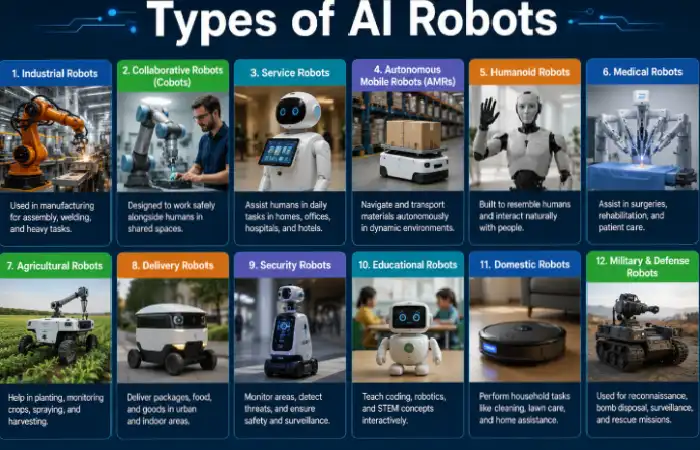
There are numerous types of AI robots, each dedicated to service a particular function with artificial intelligence, machine learning, computer vision, and automation. Whether it‘s a factory, healthcare setting, home, or warehouse, the range of AI robots offers a variety of methods in which business and individuals work with AI to improve their systems. Knowing the different types of AI robots available can allow the selection of the most optimal type for your needs.
Industrial AI Robots
Industrial AI robots are frequently seen in a number of factories and production plants. Such robots are used in monotonous and accurate tasks like assembling and packaging of parts, painting, welding, inspection of products for quality etc.
Compared with “standard” industrial robots, the AI-enabled ones are able to adapt to new production needs, detect flaws and improve workflow dynamically.
Common Applications
- Automotive manufacturing
- Electronics assembly
- Product inspection
- Packaging and palletizing
- Material handling
Benefits
- Increased productivity
- Reduced production errors
- Lower operational costs
- Improved workplace safety
Collaborative Robots (Cobots)
Collaborative robots (or cobots), have been designed to work safely along side human workers. Using AI, sensors and vision systems they are able to detect the position of the human worker and adapt their movements accordingly.
However, Cobots also have a lot of attraction for small and medium size Enterprise. This is because they are easier to implement and occupy less space compared to the usual industrial robots.
Common Applications
- Assembly assistance
- Machine tending
- Quality control
- Packaging operations
- Warehouse support
Benefits
- Human-robot collaboration
- Faster deployment
- Enhanced flexibility
- Improved worker productivity
Service Robots
Service robots help people with non-industrial roles in commercial and public settings. AI has allowed service robots to engage with customers, interpret, and follow commands, and move by themselves.
Common Applications
- Hotels and hospitality
- Airports
- Shopping centers
- Restaurants
- Customer support desks
Examples
- Reception robots
- Delivery robots
- Cleaning robots
- Information assistants
Benefits
- Better customer experiences
- Reduced labor costs
- 24/7 service availability
Autonomous Mobile Robots (AMRs)
Robots (AMR) who are equipped with sensors, cameras, navigation and ai, to find their way independently.
while AMRs can move in a changing environment with avoiding obstacles.
Common Applications
- Warehousing
- Logistics
- Inventory transportation
- Manufacturing facilities
- Distribution centers
Benefits
- Flexible navigation
- Reduced transportation costs
- Improved warehouse efficiency
Humanoid Robots
Humanoid robot. They are built to look and behave in a human manner. Sophisticated AI systems, computer vision, speech recognition, and machine learning are all employed in order to understand and to be understood.
Features
- Human-like appearance
- Facial recognition
- Voice interaction
- Object manipulation
- Autonomous movement
Common Applications
- Customer service
- Healthcare assistance
- Education
- Research and development
Examples
Walk-ability, grasps, simple conversations as well as supporting works in industry has been shown as capabilities of some popular humanoid robots.
Key Technologies Behind AI Robots
The technology of the AI robots emerging technologies enables them to sense, reason, decide and operate on their own without the need for human assistance, which are significantly upgrade over previous machine offering to change a machines function from being uninformed and motivated to be intelligent and self-learning machines, functioning in different environments and situations.
From a various perspective on the primary technologies employed in the AI robot development; we are able to explore how today’ robotic industry evolutes and joins different segments such as manufacturing, medicine, transportations, retail, agriculture, etc.
Artificial Intelligence (AI)
In essence, AI is the underlying technology which allows robot to emulate our intelligence. It enables robots analyze information, discover patterns, make decisions and resolve issues on their own and not in a brain of enduring humans.
Key Functions of AI in Robotics
- Decision-making
- Problem-solving
- Task planning
- Autonomous operation
- Adaptive behavior
Robots would only be able to perform actions already given to them without AI and would also be quite hard for them to adapt themselves into an ever-changing environment.
Machine Learning (ML)
Machine Learning is a subfield of the artificial intelligence which allows robots to learn by data and improve performance over time. Instead of explicitly coding capabilities, the machine learning algorithms search for patterns and predictions.
Applications in Robotics
- Predictive maintenance
- Object recognition
- Route optimization
- Quality inspection
- Behavioral adaptation
Benefits
- Continuous learning
- Improved accuracy
- Better operational efficiency
- Reduced need for manual reprogramming
Deep Learning
Deep learning is the newest form of machine learning using neural networks simulated after the brain. It performs well in huge datasets like visual or spoken data.
Common Uses
- Facial recognition
- Speech recognition
- Autonomous navigation
- Defect detection
- Image classification
Deep learning can greatly enhance a robot‘s perception and decision making of complex environments.
Computer Vision
The special case of computer vision is a way in which robots interpret all the visual data obtained from the various cameras and imaging devices that it utilizes. This technology enables robots to recognize objects, faces and read labels, aiding navigation.
Key Capabilities
- Object detection
- Image recognition
- Motion tracking
- Quality control inspection
- Spatial awareness
Example
This computer vision installed in one of the warehouse robots will able to give information about the location where the package is, location of the shelve and how many obstacle is that in front of the robot.
Natural Language Processing (NLP)
Natural Language Processing are the robots use NLP to understand and talk to humans more naturally and conveniently.
Applications
- Voice assistants
- Customer service robots
- Healthcare assistants
- Smart home devices
- Educational robots
Features
- Speech recognition
- Language translation
- Sentiment analysis
- Conversational AI
With the evolution of large language models, robots are also getting smarter at comprehending complex commands and conversing meaningfully.
AI Robots vs Traditional Robots
| Feature | AI Robots | Traditional Robots |
| Definition | Robots with an artificial intelligence that can learn, adapt and make decisions. | Are designed to do a standard task that is programmed in the robot to perform. |
| Learning Capability | Can be trained on data and improve its performance over time by machine learning. | Are unable to learn, need to be reprogrammed manually in order to be altered. |
| Decision-Making | Makes smart choices considering live data and present situation. | Number part of computer. Follows explicit rules and programmed commands. |
| Adaptability | Very flexible and able to adapt quickly. | Lack of flexibility, only effective under certain conditions. |
| Autonomy | May work with human assistance. | Needs a lot of human programming and supervision. |
| Environmental Awareness | Uses AI, sensors, and computer vision to perceive the environment. | Has limited awareness based on defined sensor input. |
| Object Recognition | Can recognize and categorize objects, people and obstacles. | Is able to identify only predetermined objects or conditions. |
| Navigation | “Lightly” plans routes. “Lightly” plans routes, and avoid obstacles. | Usually follows set routs. |
| Problem-Solving | Can assess situations and select best options. | Unable to resolve unexpected problems on her own. |
| Human Interaction | Supports voice commands, conversations and natural language understanding. | Reliance on little interaction through buttons, control panel or commands. |
| Flexibility | Switch between you can do many jobs. | Usually aimed at one particular task. |
| Accuracy | Continuous learning and optimization can be used to increase the accuracy. | Consistent accurate only within programmed parameters. |
| Deployment Complexity | More complex because of the training due to AI, the data needed and the maintenance for integration. | More convenient to deploy for simple, constant tasks. |
| Maintenance | Demands software updates, training the model, and monitoring. | Mainly hardware repairs, occasional reprogramming. |
| Initial Cost | Large initial capital required. | Reduce the upfront investment. |
Real-World Applications of AI Robots
Manufacturing
Applications:
- Assembly
- Quality inspection
- Material handling
Benefits:
- Reduced defects
- Increased throughput
Healthcare
Applications:
- Surgery assistance
- Medication delivery
- Rehabilitation
Benefits:
- Improved precision
- Better patient outcomes
Logistics and Warehousing
Applications:
- Inventory management
- Order fulfillment
- Autonomous transportation
Warehouse robots enabled by AI are an area of significant growth owing to the growth of e-commerce and the concerns about labor shortages.
Retail
Applications:
- Inventory scanning
- Customer assistance
- Automated checkout
Agriculture
Applications:
- Crop monitoring
- Precision farming
- Harvest automation
Security and Surveillance
Applications:
- Patrol robots
- Threat detection
- Facility monitoring
Hospitality
Applications:
- Room service
- Concierge assistance
- Cleaning
AI Robot Platform Comparison (2026)
| Platform | Best For | AI Features | Resource Link |
| NVIDIA Isaac | Robotics Development | Simulation + AI Training | https://developer.nvidia.com/isaac |
| ROS 2 | Open Source Robotics | Modular Architecture | https://www.ros.org |
| OpenCV AI | Computer Vision | Image Processing | https://opencv.org |
| TensorFlow Robotics | ML Development | Deep Learning | https://tensorflow.org |
| Azure AI Robotics | Enterprise Deployment | Cloud AI Integration | https://azure.microsoft.com |
The growing range of AI robot applications across industries demonstrates how automation is transforming manufacturing, healthcare, logistics, agriculture, and education.
Benefits of AI-Powered Robotics
Increased Productivity
Robots are not easy to become exhausted.
Improved Accuracy
AI help in minimizing the human errors.
Cost Savings
Long-term benefits include:
- Lower labor costs
- Reduced waste
- Higher efficiency
Workplace Safety
Robots are very useful for performing dangerous tasks.
Examples:
- Mining
- Chemical processing
- Disaster response
Scalability
Businesses are capable of expanding business operations more readily.
Better Decision-Making
AI robots excel at processing huge volumes of data in a short time.
AI Robotics Market Growth (2024–2026)
| Year | Market Value |
| 2024 | ~$50 Billion |
| 2025 | ~$55 Billion |
| 2026 | ~$65 Billion |
Source: Robotics Market Outlook 2026
Businesses increasingly adopt AI-powered machines because of the many benefits of AI robots, including higher efficiency, improved accuracy, and reduced operational costs.
Challenges and Limitations
High Initial Costs
Advanced robotics systems consume lot of money.
Complex Integration
Many organizations struggle with:
- Legacy systems
- Data compatibility
- Infrastructure upgrades
Data Quality Issues
AI models require:
- Large datasets
- Accurate labeling
- Continuous updates
Limited General Intelligence
Most robots are still better at performing particular tasks.
Cybersecurity Risks
Connected robots can become targets for:
- Data breaches
- Malware
- Operational disruptions
Despite rapid innovation, organizations must overcome several challenges of AI robots, such as implementation costs, cybersecurity concerns, and workforce adaptation.
AI Robot Ethics and Safety Concerns
Job Displacement
The future of automations could lead to the demise of monotonous jobs, but the proliferation of new technical ones. Newer discussions within the profession have centered more on training existing workforces for increasing automation through an expanding AI-driven robotic force.
Privacy
Robots often collect:
- Video
- Audio
- Behavioral data
Organizations must comply with privacy regulations.
Bias in AI Systems
Poor training data can create:
- Inaccurate decisions
- Unfair outcomes
Safety Risks
Autonomous robots require:
- Fail-safe systems
- Emergency stop mechanisms
- Human oversight
The authors pay more and more attention to building safe, governed and trust worthy embodied AI systems.
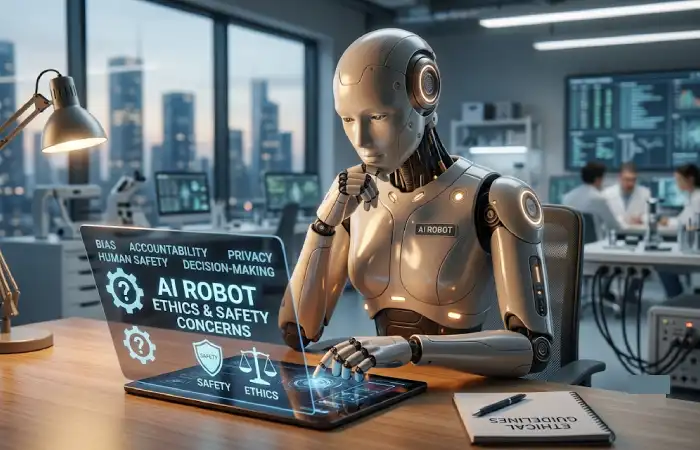
As intelligent machines become more autonomous, understanding AI robot ethics is essential for addressing privacy, bias, accountability, and responsible AI development.
Future of AI Robots
Several trends are shaping the future:
Physical AI
Robots will have a better understanding of and will be able to manipulate the real world.
Humanoid Robots
Humanoid robots are being used in the areas of logistics, customer service and industrial.
Vision-Language-Action Models
Future robots will combine:
- Vision
- Language understanding
- Physical actions
into a unified intelligence system.
AI + IoT + Robotics
The connected robotic ecosystems will be an inherent part of factories and applications in the future.
Self-Learning Robots
Alongside the development of AI intelligent agents, more complex learning techniques that involve the systems teaching themselves are emerging.
FAQs
What is an AI robot?
Definition: The term refers to, “a robot combined with artificial intelligence, which is capable of independently performing a task and acquiring new skills from previous experience.
Are AI robots replacing humans?
AI robots are primarily used to perform repetitive tasks while also opens up new opportunities within robotics, AI, maintenance and control.
What industries are using AI robots?
Industrial sectors: manufacturing, healthcare, logistics, retail, agriculture, hospitality, defense and education.
What is the distinction between AI and robotics?
Robotics is about machines, while AI is about minds. Robots integrated with AI combine the two:
Today are there any humaniform robots?
Yes. Several companies have introduced employment of humanoid robots not only in warehouses and logistics but also in service industries.
What are the greatest difficulties of AI robots?
Cost, cybersecurity, integration difficulties, quality of data, user safety, and adjustments to the workforce.
Where‘s the Future for AI Robotics?
Future trends are Physical AI, Auto learning, Humanoids, AI-IoT combination, Advanced collaborative robotics.
Conclusion
AI robots are changing the manner businesses and other industries operate by uniting the physical functionality of a robot with the intelligence of an AI system. While the robot aspects of a traditional robot are static and programmed, AI robots can utilize data, adapt to changing circumstances, decide, and improve. This combination allows business processes to be made much more efficient, accurate, productive, and innovative.
Kashifa Jafar is a technology writer and contributor at FutureTechExpert with 4+ years of experience in technology writing and content creation.
Read Full Bio of Author →Sameena reviews selected health, wellness, technology, and digital content for clarity, factual presentation, and reader usefulness.
Read Full Bio of Reviewer →