
 Kashifa Jafar
Technology Writer & Contributor
Kashifa Jafar is a technology writer and contributor at FutureTechExpert with 4+ years of experience in technology writing and content creation.
Read Full Bio of Author →
Kashifa Jafar
Technology Writer & Contributor
Kashifa Jafar is a technology writer and contributor at FutureTechExpert with 4+ years of experience in technology writing and content creation.
Read Full Bio of Author →
 Sameena Begum
Health, Technology & Digital Content Reviewer
Sameena reviews selected health, wellness, technology, and digital content for clarity, factual presentation, and reader usefulness.
Read Full Bio of Reviewer →
Sameena Begum
Health, Technology & Digital Content Reviewer
Sameena reviews selected health, wellness, technology, and digital content for clarity, factual presentation, and reader usefulness.
Read Full Bio of Reviewer →
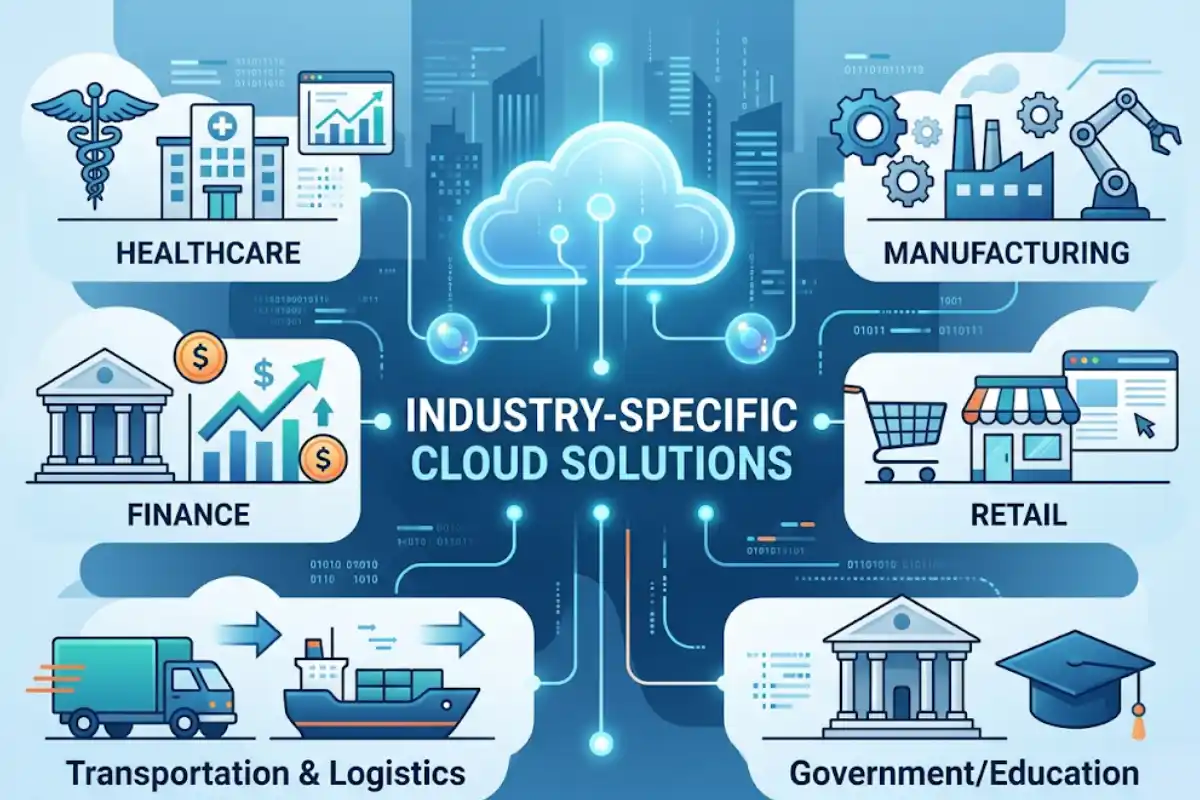
Cloud computing has moved beyond general storage and hosting services. Today, Industry-Specific Cloud Solutions cater to the specific needs, standards, processes and security of different industries.
Industry-specific cloud platforms from hospitals running patient records to manufacturers running smart factories are guiding companies toward greater efficiency, lower costs, and faster pace of digital transformation.
In this book, you will discover how cloud computing is revolutionising healthcare, education, banking, retail, manufacturing and more along with up-to-date 2026 trends, advantages and when to use.
Organizations exploring sector-specific applications often begin with the broader benefits of cloud computing to understand how cloud technology drives business growth.
 This article is part of
Benefits of Cloud Computing
Table of Contents
What Are Industry-Specific Cloud Solutions?
Industry-tailored clouds also refer to industry-specific cloud solutions, which are dedicated cloud systems providing the operational, regulatory and security needs of a specific business sector.
Unlike generic cloud services, these solutions often include:
- Industry-ready applications
- Compliance frameworks
- Specialized data models
- Security controls
- AI and analytics tools
- Industry-specific integrations
Decision-makers frequently consult cloud comparisons and tutorials when evaluating industry-specific cloud services.
Industry Cloud vs Traditional Cloud
| Feature | Traditional Cloud | Industry Cloud |
| General Infrastructure | Yes | Yes |
| Industry Compliance | Limited | Built-in |
| Specialized Workflows | No | Yes |
| Industry Data Models | No | Yes |
| Faster Deployment | Moderate | High |
| Industry Analytics | Limited | Advanced |
A strong understanding of cloud computing basics helps businesses implement industry-focused solutions more effectively.
Cloud Computing in Healthcare
Healthcare organizations are managing enormous amount of sensitive patient data in accordance to stringent policy requirements.
Cloud platforms now support:
- Electronic Health Records (EHR)
- Telemedicine
- Medical imaging storage
- AI-assisted diagnostics
- Remote patient monitoring
Benefits for Healthcare Providers
| Benefit | Impact |
| Faster Data Access | Improved patient care |
| Secure Data Storage | Better compliance |
| Telehealth Support | Expanded patient reach |
| AI Diagnostics | Faster disease detection |
| Disaster Recovery | Reduced downtime |
2026 Healthcare Cloud Trends
- AI-powered medical imaging analysis
- Predictive healthcare analytics
- Remote patient monitoring platforms
- Multi-cloud healthcare architectures
- GenAI medical documentation assistants
Many organizations achieve measurable results by leveraging the business benefits of cloud computing across different sectors.
Cloud Solutions for Education

There is an increasing utilization of cloud technologies in the education sector to enable online learning, sharing and digital learning.
Modern cloud-based education platforms enable:
- Virtual learning environments
- Student information systems
- Online assessments
- AI tutoring systems
- Collaborative classrooms
Industry-specific deployments often require robust cloud security and data protection strategies to ensure compliance and reliability.
Cloud Adoption in Education
| Educational Need | Cloud Solution |
| Online Classes | Learning Management Systems |
| Student Records | Cloud Databases |
| Collaboration | Shared Workspaces |
| Assessments | Online Testing Platforms |
| Research Computing | Cloud Infrastructure |
Key Benefits
- Reduced IT costs
- Greater accessibility
- Enhanced collaboration
- Improved scalability
- Better disaster recovery
Benefits of Cloud Computing in Banking
Cloud Computing has rapidly gained prominence in the world of banking. More efficient, faster and more secure services have led to a higher demand, with depositors and customers expecting even more personalised, 24/7 services. Many banks are turning towards a cloud-based infrastructure to service this, as the costs and risks are much lower than developing on-premise infrastructure.
Conventional banking applications usually utilize costly and rigid on-premises infrastructure that is hard to manage and scale. Cloud computing solves all these issues by enabling businesses to use dynamic, secure and affordable resources. Cloud platforms help banks:
- Detect fraud faster
- Process transactions efficiently
- Improve digital banking experiences
- Strengthen cybersecurity
- Meet regulatory requirements
Successful implementations frequently depend on selecting the right cloud computing platforms for organizational needs.
Banking Cloud Benefits
| Area | Cloud Impact |
| Fraud Detection | AI-driven monitoring |
| Customer Experience | Faster digital services |
| Security | Advanced threat protection |
| Compliance | Automated reporting |
| Analytics | Real-time insights |
Banking Regulations Driving Cloud Adoption
- PCI DSS
- GDPR
- Open Banking Standards
- Financial Risk Management Frameworks
- Data Sovereignty Requirements
Benefits of Cloud Computing in Banking at a Glance
| Benefit | Business Impact |
| Advanced Security | Enhanced security for cyber and fraud. |
| Improved Customer Experience | More evolved, designed for digital banking. |
| Scalability | Cost of infrastructure and maintenance is higher. |
| Cost Savings | Rapid expansion of digital product innovation |
| Faster Innovation | More adherence to financial rules and regulations |
| Regulatory Compliance | Improved Business Continuity and Uptime |
| Disaster Recovery | Better decision-making and customer intelligence. |
| Real-Time Analytics | Enhanced security for cyber and fraud. |
With digital transformation increasingly impacting financial institutions, cloud computing is evolving into the backbone of today‘s banking every day. Yet there are greater advantages that financial institutions who use these industry-specific cloud services will be able to take further.
They will be able to cement their security capabilities, realize efficiencies and ultimately provide a superior service to their customers in front of their competition.
Professionals specializing in cloud solutions can build rewarding careers through cloud computing career opportunities in growing industries.
Retail Businesses Using Cloud Technology
Cloud computing benefits those in the retail sector in planning the logistics network and making purchasing decisions.
Retail Cloud Applications
- Inventory management
- Customer analytics
- Omnichannel commerce
- Demand forecasting
- Smart pricing systems
Retail Cloud ROI Comparison
| Retail Function | Business Benefit |
| Inventory Tracking | Reduced stock shortages |
| Customer Analytics | Better personalization |
| E-commerce Platforms | Improved scalability |
| Supply Chain Visibility | Faster deliveries |
| AI Forecasting | Better demand planning |
Emerging Retail Trends in 2026
- AI-driven shopping assistants
- Real-time personalization
- Predictive inventory management
- Computer vision retail analytics
- Unified commerce platforms
Advanced applications increasingly combine cloud infrastructure with artificial intelligence in cloud computing to improve efficiency and automation.
Cloud Computing in Manufacturing
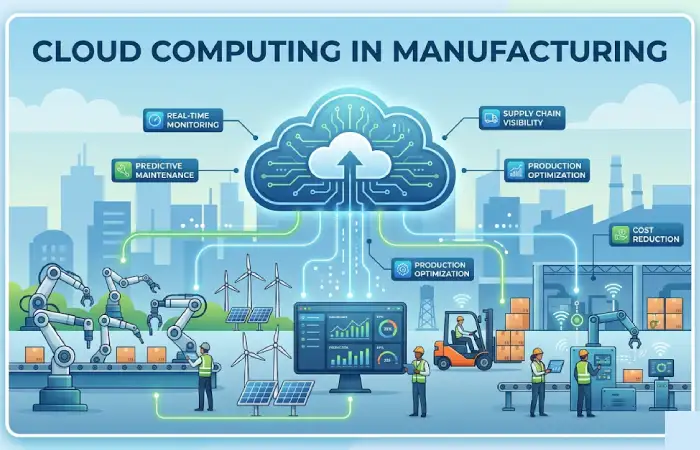
Manufacturers are adopting cloud-based Industry 4.0 technologies.
Cloud-enabled manufacturing supports:
- Smart factories
- Industrial IoT
- Predictive maintenance
- Digital twins
- Supply chain optimization
Organizations that monitor future cloud computing trends are often better prepared for technological change.
Manufacturing Cloud Advantages
| Capability | Business Outcome |
| Predictive Maintenance | Reduced downtime |
| IoT Monitoring | Real-time visibility |
| Digital Twins | Better planning |
| Supply Chain Analytics | Increased efficiency |
| Automation | Higher productivity |
2026 Smart Manufacturing Statistics
| Metric | Industry Impact |
| Predictive Maintenance | Up to 30% reduction in downtime |
| IoT Monitoring | Real-time machine insights |
| Digital Twins | Faster product development |
| Cloud Analytics | Improved decision-making |
Top Cloud Platforms for Industry-Specific Solutions (2026)
| Cloud Platform | Best For | Key Strength | Official Resource |
| Amazon Web Services (AWS) | Multi-industry deployments | Largest cloud ecosystem & industry-specific solutions | AWS Industry Solutions |
| Microsoft Azure | Healthcare, Banking, & Government | Enterprise compliance, AI, & hybrid cloud | Microsoft Industry Cloud Solutions |
| Google Cloud | AI, Analytics, & Retail | Advanced AI, machine learning, & data platforms | Google Cloud Industry Solutions |
| Oracle Cloud Infrastructure (OCI) | Financial Services, & Manufacturing | Enterprise databases & industry applications | Oracle Solutions Hub |
| IBM Cloud | Regulated Industries, Banking, & Healthcare | Security, compliance, & hybrid cloud environments | IBM Industry Solutions |
Many industry deployments rely on scalable cloud storage solutions for secure data management and accessibility.
FAQ
What are industry-specific cloud solutions?
Industry cloud solutions are cloud platforms that have been designed for the operation, security and regulatory requirements of a specific industry like health care, banking, retail, education or manufacturing.
Why are industry clouds growing in 2026?
An industry demands the emergence of particular cloud services that encompass industry regulations, AI incorporation, and industry related workflow.
Which industry benefits most from cloud computing?
The benefits to other sectors also are great in areas such as healthcare, banking, retail, manufacturing and education but the maximum ROI is ascertained by the particular organisations while targeting to various sectors.
Is industry cloud more secure than traditional cloud?
Most industry cloud platforms also include in-built compliance controls, sector-specific security schemes and protections.
What is the future of industry-specific cloud solutions?
In the future we will see, AI-enabled automation, digital twins, industry-specific generative AI models, more compliance automation and multi-cloud deployments.
Conclusion
Industry clouds remain a key enabler for digital transformation in 2016. From healthcare increasing patient outcomes, to financial institutions advancing their fraud profiling, to retailers offering personalised experiences for their customers, educational establishments extending digital learning, and manufacturers executing Industry 4.0, leading organisations leverage the cloud technology specifically built for their industry‘s needs.
Those choosing the ideal Industry cloud strategy will prove to have better security, compliance, scale and a huge advantage over their competitors in the relentless digital economy.
Kashifa Jafar is a technology writer and contributor at FutureTechExpert with 4+ years of experience in technology writing and content creation.
Read Full Bio of Author →Sameena reviews selected health, wellness, technology, and digital content for clarity, factual presentation, and reader usefulness.
Read Full Bio of Reviewer →