
 Kashifa Jafar
Technology Writer & Contributor
Kashifa Jafar is a technology writer and contributor at FutureTechExpert with 4+ years of experience in technology writing and content creation.
Read Full Bio of Author →
Kashifa Jafar
Technology Writer & Contributor
Kashifa Jafar is a technology writer and contributor at FutureTechExpert with 4+ years of experience in technology writing and content creation.
Read Full Bio of Author →
 Sameena Begum
Health, Technology & Digital Content Reviewer
Sameena reviews selected health, wellness, technology, and digital content for clarity, factual presentation, and reader usefulness.
Read Full Bio of Reviewer →
Sameena Begum
Health, Technology & Digital Content Reviewer
Sameena reviews selected health, wellness, technology, and digital content for clarity, factual presentation, and reader usefulness.
Read Full Bio of Reviewer →
The Future Trends in Cloud Computing are changing corporate data storage, application deployment, and digital transformation for 2026. It was initially an affordable solution to traditional on-site infrastructure. Today, it is the selling point behind some of the most popular technologies: Artificial Intelligence, Machine Learning, Edge Computing, IOT, and Secure Data Centres.
Throughout organisations’ digital transformation journey, cloud is becoming smarter, scalable and sustainable. Companies are trying to find better ways to leverage multi-cloud or hybrid cloud solutions to prevent vendor lock-in, improve agility and strengthen resilience. Meanwhile, breakthroughs in serverless, edge-cloud, and green-cloud will allow organisations to utilize data and cloud infrastructure more efficiently while decrease green-house gases and the cost of operating.
Understanding the long-term benefits of cloud computing helps organizations prepare for upcoming technological advancements.
 This article is part of
Benefits of Cloud Computing
Table of Contents
Future Trends in Cloud Computing
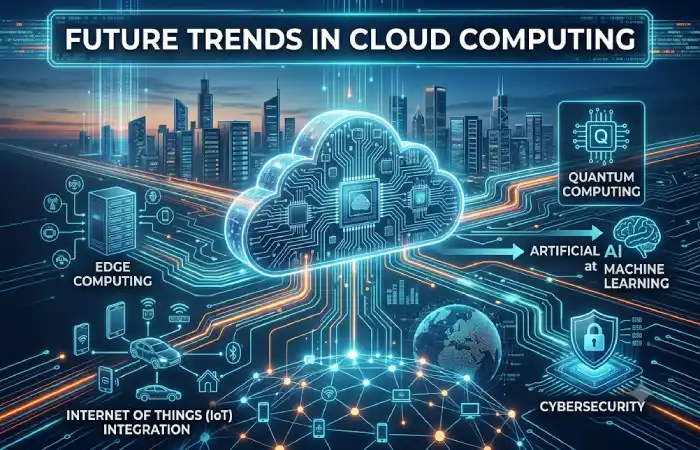
Future Trends in Cloud Computing are defining how corporates build, deploy and scale applications in 2026. Cloud computing is evolving from a mere off-site storage service, to the backbone of AI, edge computing, automation, security and green programs across the globe.
According to three of the 2026 industry reports, fastly expanding cloud technologies are AI-native, multi-cloud, serverless, and edge-clouds. Customer priority includes Environment, Flexibility, Cost-Efficiency, and Resiliency.
A solid foundation in cloud computing basics makes it easier to understand future innovations and industry developments.
Cloud Computing Trends Comparison (2026)
| Trend | Business Impact | Adoption Level |
| AI-Powered Cloud | Faster automation | Very High |
| Multi-Cloud | Vendor flexibility | Very High |
| Hybrid Cloud | Better compliance | High |
| Edge Computing | Lower latency | High |
| Serverless Computing | Reduced infrastructure management | High |
| Green Cloud Computing | Sustainability goals | Growing |
| FinOps | Cost optimization | Growing |
Multi-Cloud vs Hybrid Cloud
With digital transformation as just one of many factors, selecting a cloud approach has become one of the biggest business decisions you can make. Multi-Cloud and Hybrid Cloud are two of the most prevalent strategies around, and although similar in nature, they are markedly different.
Gaining a clear grasp of the Multi-Cloud versus Hybrid Cloud distinctions can enable businesses to select the right deployment types to maximise efficiency, tighten security, cut down costs and eliminate vendor lock-in.
Emerging technologies are expected to enhance the business benefits of cloud computing through greater efficiency and scalability.
What Is Multi-Cloud?
Multiple cloud strategy is applying services from two or more public clouds concurrently. For Instance, a company may use Amazon web services (AWS) for storage, Microsoft Azure for analytics, and Google Cloud for machine learning.
The purpose of multi-cloud is to take advantage of the benefits offered by various providers and avoid reliance on an individual one.
Example of Multi-Cloud
- AWS for application hosting
- Azure for identity management
- Google Cloud for AI services
- Cloudflare for content delivery
It enables a company to select the best services for each workload.
Future cloud environments will place even greater emphasis on cloud security and data protection strategies to address evolving threats.
What Is Hybrid Cloud?
A hybrid cloud is a combination of private cloud infrastructure (or on-premises data centre) and public cloud services. Business workloads are dynamically moved between private and public clouds.
Often, a hybrid cloud is used by organisations that need to gain the benefit of scale offered by public cloud while maintaining tight control over the most sensitive information.
Example of Hybrid Cloud
- Customer databases stored in a private cloud
- Web applications hosted on a public cloud
- Backup and disaster recovery in cloud storage
This is close to optimal in separating security from other ‘high risk’ capabilities.
Innovation among leading cloud computing platforms will continue shaping the direction of the industry.
Multi-Cloud vs Hybrid Cloud Comparison
| Feature | Multi-Cloud | Hybrid Cloud |
| Uses Multiple Public Clouds | Yes | Optional |
| Includes Private Cloud | Not Required | Required |
| Vendor Lock-In Reduction | Excellent | Moderate |
| Compliance Management | Good | Excellent |
| Security Control | Shared Across Providers | Greater Control |
| Deployment Complexity | High | Moderate |
| Scalability | Very High | High |
| Cost Optimization | High | High |
| Data Sovereignty Support | Moderate | Excellent |
| Best For | Flexibility and resilience | Compliance and control |
Multi-Cloud Advantages
- Avoids dependence on a single provider
- Improves redundancy
- Enables best-of-breed services
- Optimizes cloud spending
Market surveys state that due to high requirements on resilience and flexibility, most enterprises (more than 85%) have today adopted a multi-cloud approach.
Growing demand for cloud expertise is expected to create additional cloud computing career opportunities in the coming years.
Hybrid Cloud Advantages
- Better control over sensitive data
- Easier regulatory compliance
- Suitable for healthcare, banking, and government sectors
Which Is Better?
For most enterprises in 2026:
- Multi-cloud is ideal for scalability and flexibility.
- Hybrid cloud is ideal for compliance-sensitive workloads.
Many institutions are favoring a combination of these between “hybrid multi-cloud”
Green Cloud Computing Explained
Green Cloud Computing is dedicated to minimizing the ecological impact of the cloud infrastructure.
With AI workloads growing heavier, the energy demands of data centers are becoming a concern. The cloud providers are heavily investing into greener energy sources, cooling systems, and carbon-neutral data center operation.
Advancements in artificial intelligence in cloud computing are likely to transform automation, analytics, and decision-making.
Benefits of Green Cloud Computing
Lower Carbon Emissions
The modern cloud providers use more efficient facilities, who have the ability to use less energy than on-premise data centers.
Reduced Operating Costs
Utilizing resources efficiently also helps in reducing the cost of infrastructure.
Regulatory Compliance
Several countries are implementing sustainability reporting standards and regulations that clearly support a greener use of IT.
Better Brand Reputation
Consumers are more and more interested in supporting “eco-responsible” companies.
Green Cloud Technologies
| Technology | Purpose |
| Renewable Energy Data Centers | Reduce carbon footprint |
| AI Energy Optimization | Improve efficiency |
| Liquid Cooling Systems | Lower power consumption |
| Workload Optimization | Reduce waste |
| Carbon-Aware Scheduling | Minimize environmental impact |
Serverless Computing Benefits
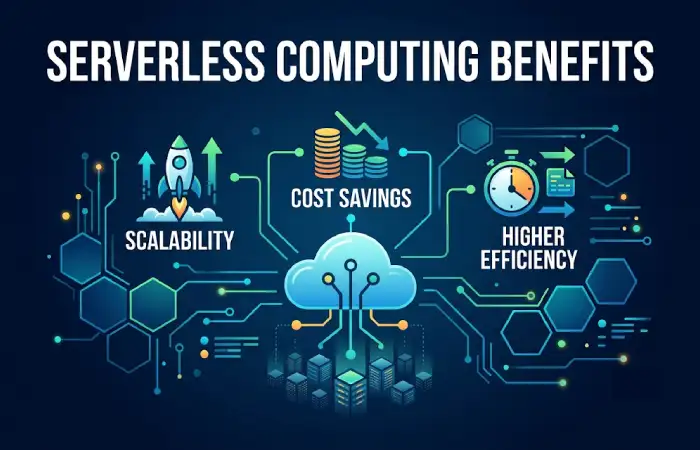
The popularity of using serverless computing is rising as it allows developers to focus solely on the development of the application without having to think about, or manage servers.
Some well-known serverless platforms are AWS Lambda, Azure Functions and Google Cloud Functions. (AWS Cloud Computing Trends)
Key Benefits
Faster Development
Less time required to manage the infrastructure by developers.
Automatic Scaling
Applications automatically scale during traffic peaks.
Cost Efficiency
Businesses avoid keeping inactive servers as they are charged solely for the actual use.
Improved Agility
Introducing new features is quicker.
Reduced Maintenance
Cloud Providers will be responsible for all the patching/security updates/availability.
According to industry experts, serverless will become the dominant deployment model for many of AI accelerated applications in the next few years.
Organizations across multiple sectors will continue adopting specialized cloud industry solutions tailored to their operational needs.
Traditional Cloud vs Serverless
Cloud services and serverless computing it‘s your call. With the traditional cloud we provide more control over the environment; with serverless, you‘re not concerned with the servers, you just write your application. The decision lies with whether your application needs control or not.
Traditional Cloud vs Serverless Comparison
| Feature | Traditional Cloud | Serverless Computing |
| Infrastructure Management | Managed by IT teams | Managed by cloud provider |
| Server Provisioning | Required | Not Required |
| Scaling | Manual or Auto-Scaling | Fully Automatic |
| Cost Model | Pay for allocated resources | Pay only for execution time |
| Maintenance | High | Minimal |
| Deployment Speed | Moderate | Fast |
| Resource Utilization | May have idle resources | Efficient resource usage |
| Operational Complexity | Higher | Lower |
| Customization | Extensive | Limited |
| Best For | Large, long-running applications | Event-driven applications |
The evolution of cloud storage solutions will play a critical role in supporting larger datasets and faster access requirements.
Future of Edge & Cloud Technology
Edge computing and cloud computing are seen as competitors, in fact to some extent they are increasingly working together.
Rather than transmitting the entire dataset to central cloud servers, edge computing handles data nearer the source.
This is especially important for:
- Autonomous vehicles
- Smart cities
- Industrial IoT
- Healthcare devices
- Real-time analytics
Why Edge Computing Matters
Lower Latency
Critical applications, responses come back in a matter of milliseconds.
Reduced Bandwidth Costs
Only required data is being transferred.
Better Reliability
Operational systems even in the face of connectivity outages.
Enhanced Security
Sensitive information can stay local.
Edge-cloud integration is considered one of most influenced technology drivers affecting cloud architecture through 2030.
2026 Cloud Adoption Forecast
| Technology | 2026 Growth Outlook |
| AI Cloud Services | Very High |
| Multi-Cloud | Very High |
| Edge Computing | High |
| Serverless | High |
| Green Cloud | High |
| Quantum Cloud Services | Emerging |
| Cloud Security Automation | Very High |
A recent survey of industry indicated that AI workloads were the strongest justification for cloud investment, as providers continue pumping infrastructure to meet the demand.
Professionals can better understand new developments through detailed cloud comparisons and tutorials that evaluate emerging technologies.
Frequently Asked Questions
What is the future of cloud computing in 2026?
AI-native infrastructure. Multi-cloud deployment. Serverless computing. Edge-cloud integration. Solutions building on sustainability.
Is multi-cloud better than hybrid cloud?
For these reasons, neither is outright better. Multi-cloud strategy helps with vendor lock-in and is flexible; however hybrid cloud gives more control.
Why is serverless computing growing?
Going native eliminates operating system management and volume management overhead in addition to making your application more efficient and cheaper to run because you only pay for the resources you use.
What is Green Cloud Computing?
Green Cloud Computing – Address the environmentally friendly operation of the cloud through its support of energy efficient infrastructures and renewable energy.
How does edge computing work with cloud computing?
User devices handle the processing, the cloud handle the storage, analysis, and management.
Conclusion
The Future Trends in Cloud Computing will be found in intelligence, agility, sustainability and speed. Organizations with multi-cloud frameworks, serverless application development, Green Cloud, and edge-cloud ecosystems will be at the front edge of digital transformation in 2026.
Today, the cloud is more than just an infrastructure platform. It is the platform of innovation for AI, real-time computing and the enterprise of the future. Those organizations that develop a “cloud-smart” strategy today will be the winners of the tomorrow.
Kashifa Jafar is a technology writer and contributor at FutureTechExpert with 4+ years of experience in technology writing and content creation.
Read Full Bio of Author →Sameena reviews selected health, wellness, technology, and digital content for clarity, factual presentation, and reader usefulness.
Read Full Bio of Reviewer →